Food production facilities operate on a schedule where minutes can matter. Raw ingredients arrive, products move between processing areas, employees travel through production zones, and finished goods eventually reach storage or shipping areas. All of this activity happens while the facility must maintain a clean and orderly environment.
That makes doors more important than they might initially appear.
A doorway can become a point where warm and cold air mix, dust enters, pests find an opportunity, or employees lose valuable time waiting for access. In a busy food-processing plant, a door that stays open for too long can affect the environment on both sides of the opening.
This is one reason high speed doors for food processing have become an important consideration for facilities looking to improve movement between work areas.
Unlike conventional industrial doors that may take several seconds to open and close, high speed systems are designed to move quickly. Their rapid operation can reduce the amount of time an opening remains exposed while allowing people, carts, and materials to pass through efficiently.
However, speed is only one part of the equation. Food-processing facilities also need to consider sanitation, moisture, temperature, traffic volume, durability, maintenance, and the specific conditions surrounding each doorway.
The right door should fit the process—not simply move quickly.
Why Doors Matter in Food Processing
A food-processing plant is not an ordinary warehouse.
Many areas may involve washing, sanitizing, refrigeration, heating, ingredient handling, packaging, or preparation. Different rooms can have very different environmental conditions.
For example, a refrigerated storage area needs to stay cold. A processing room may be warmer and more humid. A loading area may have a completely different environment from either space.
When a door remains open between these areas, air can move freely from one side to the other.
A high-speed door can reduce the duration of that opening by opening and closing rapidly.
Think of it like opening your home refrigerator. If you leave the door open for a long time, cold air escapes and the appliance has to work harder. Closing it promptly helps preserve the temperature inside.
A food facility has much more complex requirements, but the basic principle is easy to understand: limiting unnecessary open time can help maintain environmental separation.
What Are High Speed Food Processing Doors?
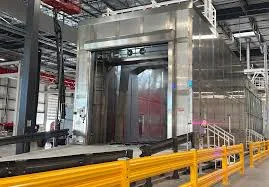
High speed food processing doors are industrial doors designed to open and close rapidly in busy food-production environments.
They may be installed between processing rooms, warehouses, coolers, freezers, sanitation areas, packaging spaces, and other parts of a facility.
The exact construction varies. Some systems use flexible curtains, while others use rigid panels or specialized materials. The operating mechanism can also differ depending on the door type.
The choice should be based on the conditions where the door will operate.
A doorway exposed to frequent washdown requires different considerations from one located in a dry packaging room. Similarly, a freezer entrance may have requirements that differ from a doorway connecting two areas at similar temperatures.
This is why high-speed door selection should begin with the application rather than the product catalog.
Faster Openings Can Improve Traffic Flow
Food-processing facilities can have constant movement.
Workers may carry ingredients or containers. Forklifts may transport pallets. Carts may move between production rooms. Packaging materials may need to reach different stations.
A slow door can become a bottleneck.
Imagine a supermarket checkout where every customer has to wait several seconds for the cashier to unlock a gate before passing through. One delay may not matter much, but hundreds of repeated delays can create a noticeable slowdown.
The same idea applies to industrial doorways.
A fast-opening system can help people and equipment move through without waiting unnecessarily.
The actual benefit depends on traffic volume, door cycle frequency, and the layout of the facility.
Supporting Temperature Control
Temperature management is particularly important in food operations.
Some products need to remain chilled or frozen, while other processes require warmer conditions. Keeping these environments separated helps the facility manage its intended operating conditions.
Every time a door opens, air exchange occurs.
A high-speed system can shorten the period during which the opening is exposed. When combined with appropriate refrigeration, air-handling, and facility practices, this can support temperature management.
The door itself does not create or maintain the required temperature. Refrigeration and HVAC systems perform those functions.
Instead, the high-speed door can help reduce unnecessary exposure between spaces.
Moisture and Humidity Considerations
Food facilities frequently encounter water.
Cleaning crews may wash floors, walls, machinery, and other surfaces. Processing activities may generate steam or humidity. Certain areas may be exposed to regular moisture throughout the day.
This environment can be demanding for industrial doors.
The door's materials, hardware, seals, and operating components should be appropriate for the conditions in which they will be used.
A door installed in a wet sanitation area should not necessarily be specified the same way as a door in a dry warehouse.
Facility managers should consider how water, cleaning products, and humidity will affect the complete door assembly.
Sanitation Should Influence Door Selection
Food-processing doors need to fit the facility's sanitation program.
Cleaning is not an occasional activity in many food plants. It can be a routine part of daily operations.
The door surface should therefore be practical to clean. The design should also avoid unnecessary features that make sanitation difficult.
Consider a smooth countertop versus a heavily decorated surface with many small grooves. The countertop is generally easier to wipe thoroughly.
A similar principle can apply to industrial doors.
However, cleanability is not determined by the door panel alone. Frames, seals, handles, tracks, sensors, and other components also need to be considered.
The entire system should be compatible with the facility's cleaning methods.
Choosing Materials for Wet Environments
Different food-processing areas can expose doors to different substances and conditions.
A wet-processing area may involve frequent water exposure. Cleaning areas may involve detergents or sanitizing products. Other rooms may be comparatively dry.
The materials used in the door should be evaluated accordingly.
For example, components exposed to moisture may need appropriate corrosion resistance. Materials should also be compatible with the cleaning products used by the facility.
Chemical compatibility should never be assumed simply because a door is marketed for food applications.
The actual cleaning chemicals, concentrations, exposure times, temperatures, and cleaning methods should be considered when selecting the system.
Preventing Unwanted Pest Entry
Food facilities have another concern that many other industrial buildings do not face to the same degree: pests.
Open doorways can create opportunities for insects, rodents, and other unwanted visitors to enter a building.
No door can replace a comprehensive pest-management program. Still, reducing unnecessary opening time can be useful.
A high-speed door can close quickly after a person, cart, or vehicle passes through. This can reduce the time during which an exterior or semi-exterior opening remains exposed.
The greatest value comes when fast doors are combined with good sanitation, building maintenance, screening, waste management, and other preventive practices.
Helping Reduce Airborne Contamination
Food safety involves more than visible dirt.
Air can carry dust, moisture droplets, and other particles between areas. Depending on the facility and process, uncontrolled movement between spaces may be undesirable.
A rapidly operating door can reduce the length of time two areas are directly connected through an open doorway.
Again, the door is only one part of the solution.
Proper ventilation, sanitation procedures, employee hygiene, equipment cleaning, and facility design all contribute to maintaining suitable conditions.
The door supports these measures by making the physical transition between areas quicker and more controlled.
High Traffic Calls for Durable Construction
Food-processing doors can experience a tremendous number of cycles.
Consider an opening between a production room and a packaging area. Employees may pass through repeatedly. Carts may cross the threshold throughout the shift. Cleaning crews may use the same opening later.
That amount of activity can put significant demands on the door.
Durability should therefore be evaluated alongside speed.
Important considerations can include the construction of the curtain or panel, operating mechanism, mounting system, seals, guides, sensors, and other components.
A fast door that frequently requires repairs may create more disruption than a slower but unreliable system.
The objective is dependable performance under the expected workload.
Selecting the Right Opening Speed
Faster is not automatically better.
The appropriate operating speed depends on the application.
A door used by pedestrians may have different requirements from one used by forklifts. A doorway connecting a freezer to a production room may have different priorities from an interior opening between two similar environments.
The system should operate quickly enough to support traffic while maintaining appropriate safety and reliability.
The facility should also consider how quickly the door needs to close after each passage.
Rapid closing can be useful because it reduces the period during which the opening remains exposed.
Safety Around Fast-Moving Doors
Any powered industrial door needs appropriate safety measures.
Employees and vehicles must be able to pass through without being exposed to unnecessary hazards. Sensors, activation devices, controls, and other safety features can be incorporated depending on the door design.
Workers should also understand how the door operates.
Training can cover normal use, warning signals, what to do if the door stops unexpectedly, and how to report damage or unusual behavior.
The exact safety arrangement depends on the equipment and facility. Manufacturers' instructions and applicable workplace safety requirements should be followed.
Speed should always be balanced with safe operation.
Pedestrian and Forklift Traffic
Mixed traffic can make door selection more complicated.
A doorway may be used by employees walking on foot and forklifts carrying pallets. Their speeds, sizes, and stopping distances are different.
The door's activation method should therefore match the traffic.
For example, sensors may detect approaching vehicles, while other controls may be more appropriate for pedestrians.
The surrounding floor markings and traffic routes also matter.
A door should be positioned so that vehicles and people can approach it predictably rather than crossing each other's paths unnecessarily.
Good traffic planning can improve both productivity and safety.
Cold Storage and Freezer Applications
Refrigerated and frozen food storage areas have particularly strong reasons to consider rapid door operation.
Cold air is expensive to produce and maintain. Every prolonged opening allows warmer air to enter and cold air to escape.
A high-speed door can reduce the time that the opening remains exposed.
In freezer environments, additional concerns may include condensation and frost. Door construction and operating systems need to be suitable for the temperatures and conditions involved.
The surrounding refrigeration system should also be considered.
A door is part of the temperature-control strategy, not a replacement for proper refrigeration equipment.
Doors Between Hygienic Zones
Food facilities may divide their buildings into areas with different hygiene requirements.
Raw ingredients, processing operations, cooked products, packaging, and finished goods may follow different paths depending on the facility.
Separating these zones can help organize production and reduce unnecessary movement between areas.
High-speed doors can provide controlled transition points between such spaces.
The door should be selected according to the environmental conditions and traffic requirements on both sides.
In some applications, it may also be useful to coordinate doors with access controls or other facility systems.
Automated Operation Can Make Work Easier
Hands-free operation can be particularly useful in food production.
Employees may wear gloves or protective clothing. They may also carry containers, tools, ingredients, or finished products.
Stopping to manually open a door can be inconvenient and can interrupt the workflow.
Automatic activation can reduce that burden.
Depending on the application, the door may be activated by sensors, buttons, pull cords, remote controls, or other devices.
The activation method should be chosen based on how workers and vehicles approach the opening.
Maintenance Is Part of Food Facility Reliability
A high-speed door is a mechanical system that moves repeatedly. It therefore needs appropriate maintenance.
Routine checks can identify problems before they cause a complete failure.
Maintenance teams can look for:
- Damaged curtains or panels
- Worn guides
- Loose hardware
- Faulty sensors
- Unusual sounds
- Slow operation
- Incomplete closing
- Damaged seals
- Problems with controls
The inspection schedule should reflect the frequency of use and the manufacturer's recommendations.
In a food plant, maintenance should also be coordinated with sanitation practices so that servicing does not introduce unnecessary contamination risks.
What Happens When a Door Fails?
Door failure can affect more than convenience.
A broken door may interrupt traffic, affect temperature separation, interfere with production schedules, or force employees to use an alternative route.
That is why reliability matters.
Facilities should understand what happens if a particular door becomes unavailable. Is there another entrance? Can production continue? Is emergency access affected?
Having a maintenance and contingency plan can reduce disruption.
Planning Door Locations Carefully
A high-speed door should be placed where it solves a real operational need.
The location should be evaluated in relation to:
- Production equipment
- Refrigeration areas
- Cleaning zones
- Forklift routes
- Pedestrian walkways
- Storage areas
- Emergency paths
- Adjacent doors
- Available wall and ceiling space
A door can operate perfectly and still create problems if it is installed in the wrong location.
Early planning gives the facility an opportunity to design traffic routes around the opening rather than trying to squeeze a door into an unsuitable space later.
Choosing a Door for the Specific Food Process
There is no universal food-processing environment.
A bakery, meat-processing facility, beverage plant, frozen-food warehouse, dairy operation, and dry-goods manufacturer can all have different requirements.
Moisture levels vary. Temperatures vary. Cleaning methods vary. Traffic patterns vary.
For this reason, high speed doors for food processing should be specified according to the conditions at the actual installation location.
The right questions are practical ones:
What passes through the door?
How often?
At what temperature?
How frequently is the area cleaned?
What chemicals are used?
How much moisture is present?
Will forklifts use the opening?
Does the door connect areas with different environmental conditions?
The answers provide a much stronger foundation for selection than simply choosing a door based on its advertised speed.
Newport Company and Food Processing Door Solutions
Food-processing facilities need doors that can fit into demanding production environments without becoming a weak point in the workflow.
Newport Company provides industrial door solutions for applications where speed, controlled access, durability, and environmental conditions need to be considered together.
The most suitable door will depend on the individual opening. A freezer entrance may require a different approach from an interior processing-room doorway, while a heavily used loading area may need a configuration designed for repeated cycles.
Matching the system to the actual application is the key.
Common Mistakes to Avoid
One common mistake is choosing a door based solely on opening speed.
A door that moves extremely quickly may not provide the best overall value if it is poorly suited to the environment or traffic.
Another mistake is overlooking sanitation.
The door needs to work with the facility's cleaning procedures, not against them.
Ignoring the surrounding hardware can also cause trouble. The door panel may be durable, but sensors, tracks, seals, and other components still require appropriate protection and maintenance.
Facilities should also avoid treating every doorway the same way. Conditions can vary significantly from one part of the building to another.
Finally, maintenance should be planned from the beginning.
Looking at Long-Term Value
The initial purchase price does not tell the whole story.
A door that operates reliably, reduces unnecessary open time, supports efficient traffic, and withstands the facility's conditions may provide greater long-term value than a cheaper system that requires frequent repairs.
Facility managers should consider the total operating picture.
That includes energy use, maintenance, downtime, cleaning requirements, expected service life, and employee productivity.
A good door investment should support the facility's daily work rather than simply fill an opening in the wall.
Conclusion
High speed doors for food processing can provide valuable benefits in facilities where rapid traffic, sanitation, temperature control, moisture, and environmental separation are important.
Their ability to open and close quickly can reduce waiting time and limit the duration that rooms are exposed to one another. In the right applications, this can support smoother material movement and help facilities manage temperature and cleanliness more effectively.
But speed should never be considered in isolation.
The door's materials, operating mechanism, safety features, cleaning requirements, traffic pattern, temperature conditions, and maintenance needs all deserve careful attention.
A successful installation begins by understanding the doorway itself. Who uses it? What passes through it? How often does it operate? What conditions surround it? What happens if it stops working?
Once those questions are answered, the facility can choose a door that fits the real demands of production.
In food processing, efficiency and cleanliness have to work side by side. A well-planned high-speed door can help connect those two priorities by keeping people and products moving while limiting unnecessary exposure between working areas.