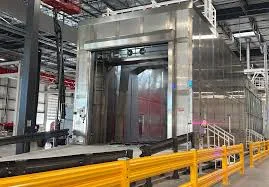
A cleanroom is a place where the environment has to be carefully managed. The air is filtered, cleaning routines are controlled, and the movement of people and materials is planned to reduce the chance of unwanted particles entering sensitive areas.
But there is one simple event that can challenge all that preparation: opening a door.
Every time a cleanroom door opens, air from the surrounding area can mix with the controlled air inside. Depending on the facility, that outside air may bring moisture, dust, particles, or other unwanted contaminants. The longer the opening stays exposed, the more opportunity there is for this exchange to happen.
This is one reason high speed cleanroom doors are used in facilities where environmental control and efficient movement are both important.
These doors are designed to open and close quickly while providing a controlled barrier between different areas. They can help reduce the time an entrance remains open, support stable room conditions, and make busy production areas easier to operate.
However, speed is only part of the story. A suitable cleanroom high speed door also needs appropriate sealing, easy-to-clean surfaces, reliable controls, safety features, and construction suited to the facility.
In this article, we will look at how these doors work, where they are useful, what features matter, and how to choose a system that fits the job.
What Is a High Speed Cleanroom Door?
A high speed cleanroom door is an automatically operated door designed for controlled environments where rapid opening and closing are beneficial.
Instead of opening like a conventional hinged door, many high-speed systems use a flexible curtain or another compact moving design. The door rises or moves out of the opening when access is needed and closes again shortly afterward.
The basic idea is easy to understand.
Imagine walking through a busy supermarket entrance with automatic doors. The doors open when someone approaches and close once the person has passed. A high-speed cleanroom door follows a similar principle, but its design is adapted for a much more controlled environment.
The door is intended to combine quick movement with features that help limit unwanted air exchange and contamination.
Different products have different performance levels, so the term "high speed" should not be taken to mean that every door operates at the same speed. Some commercially available cleanroom models, for example, advertise opening speeds of around 2 meters per second or more, depending on the door design and size. AAssa Abloy Entrance+1
Why Speed Matters in a Cleanroom
The reason for fast operation is not simply convenience.
A door that remains open for a long time creates a larger opportunity for the air on both sides to mix. In a controlled environment, that can make it more difficult to maintain the desired conditions.
The U.S. Food and Drug Administration notes that controlling the time doors remain open can be important for limiting contamination in clean areas, particularly where pressure differences are used between rooms. UU.S. Food and Drug Administration
A faster door can help by shortening the exposure period.
Think about opening the front door of your home on a cold day. If you leave it open for five seconds, only a limited amount of outdoor air enters. Leave it open for several minutes, and the indoor environment changes much more noticeably.
The principle is similar in a cleanroom, although the concern may involve particles, humidity, pressure, or other environmental conditions rather than temperature alone.
Faster Traffic Can Improve Workflow
Cleanrooms are often busy working environments.
Employees may move between production areas. Carts may carry components from one room to another. Materials may need to be transferred repeatedly throughout a shift.
A slow door can become an unexpected bottleneck.
Imagine a warehouse where every doorway takes 30 seconds to open and close. Workers would spend a surprising amount of time simply waiting for doors.
High speed cleanroom doors can make movement more efficient by reducing waiting time.
This can be especially useful at entrances with frequent traffic. Employees can pass through, the door closes, and the controlled space is separated again.
The result is not just faster movement. A well-planned entrance can make the entire workflow feel smoother.
High Speed Does Not Mean Poor Sealing
A common misunderstanding is that a fast door is mainly about its motor.
In a cleanroom, the way the door closes and seals can be just as important.
A sealed cleanroom door helps reduce unwanted air movement around the closed opening. Some high-speed cleanroom doors are designed with tight seals and have been tested for air permeability or cleanroom suitability. AAssa Abloy Entrance+1
The easiest analogy is a refrigerator.
The refrigerator's cooling system does the main work of keeping the interior cold, but the rubber gasket around the door helps keep outside air from entering unnecessarily.
A cleanroom door works on a related principle. The room's ventilation and filtration system manage the environment, while the door helps maintain the boundary between controlled and less-controlled spaces.
Air Pressure and Door Performance
Many cleanrooms use differences in air pressure to influence how air moves between rooms.
For example, a cleaner room may be kept at a slightly higher pressure than a nearby less-clean area. When the door is closed, the pressure difference helps support separation between the spaces.
When the door opens, the situation changes because the two areas become connected.
This is another reason door operation matters.
A properly selected high speed cleanroom door can help minimize the amount of time the opening remains exposed. However, the door is only one part of the solution. Ventilation, room layout, pressure settings, and operating procedures all need to work together.
A fast door cannot compensate for an unsuitable overall cleanroom design.
Where Are High Speed Cleanroom Doors Used?
These doors can be useful in many industries where controlled environments are important.
Common applications include:
- Pharmaceutical manufacturing
- Medical and healthcare environments
- Electronics production
- Semiconductor facilities
- Biotechnology
- Laboratories
- Specialty manufacturing
- Food and hygiene-sensitive production
- Research facilities
The required door design can vary substantially between these applications.
A pharmaceutical facility may have different cleaning and regulatory needs from an electronics production area. A research laboratory may have different traffic patterns from a large manufacturing plant.
That is why the door should be selected according to the environment rather than simply choosing the fastest available model.
Materials Should Be Easy to Clean
A cleanroom door should not make cleaning unnecessarily difficult.
Cleanroom door materials are typically selected with the environment and cleaning process in mind. Stainless steel is one common choice for components because it can provide durability and a smooth, cleanable surface.
Some high-speed cleanroom doors use stainless steel components and covers specifically to support hygiene and easy cleaning. AAssa Abloy Entrance+1
The principle is straightforward.
Think about wiping a smooth countertop compared with cleaning a rough surface full of cracks. Smooth surfaces are generally easier to wipe thoroughly.
The door's construction should therefore avoid unnecessary ledges, exposed areas, or difficult-to-reach spaces where dust or residue could accumulate.
Smooth Design Supports Maintenance
A hygienic cleanroom door should be designed with routine maintenance in mind.
A busy production facility may open a door hundreds or even thousands of times over an extended period. Moving parts experience wear. Seals can deteriorate. Sensors may need adjustment. The door curtain can potentially be damaged by accidental contact.
A good system should allow technicians to inspect and maintain these components without unnecessary difficulty.
Some high-speed doors include self-reset or breakaway features that allow the curtain to recover after certain accidental impacts. These features can reduce downtime and simplify recovery after an incident, although the exact design varies by manufacturer. AAssa Abloy Entrance+1
This is particularly valuable in busy facilities where stopping production for a minor door incident is undesirable.
Safety Is Essential
A door that moves quickly must also be designed to operate safely.
Workers may walk through the opening while carrying materials. Carts may approach from either direction. Equipment may accidentally stop in the doorway.
High speed door safety can involve sensors, light curtains, contact-free detection, soft bottom edges, breakaway mechanisms, emergency controls, and other protective measures depending on the design.
The exact features required will vary according to the door and facility.
One useful way to think about this is a modern elevator door. It does not simply close as quickly as possible. It uses sensors and controls to recognize when someone or something is in the way.
A cleanroom door needs the same basic philosophy: efficient movement without ignoring people and equipment.
Automatic Operation Makes Access Easier
Most high-speed cleanroom doors are designed for automatic operation.
Different facilities may use different activation methods. A door might open through a sensor, push button, pull switch, remote signal, or other control.
For hands-free environments, a sensor or touchless activation method can be particularly useful.
This can reduce the need for workers to touch door surfaces while carrying materials or wearing protective clothing.
In hygiene-sensitive applications, reducing unnecessary contact can also make everyday operations more convenient.
The activation method should be selected based on how people actually use the entrance.
Vision Panels Can Improve Visibility
Some high speed cleanroom doors can include windows or vision panels.
This may sound like a small feature, but visibility can make a busy doorway easier to use.
Imagine two workers approaching the same doorway from opposite sides. If neither can see the other, the door may become a point of confusion or collision.
A vision panel lets people see through the entrance before proceeding.
It can also help operators check whether a cart, piece of equipment, or another person is on the other side.
For a cleanroom, the window needs to be integrated into the door in a way that remains compatible with the facility's cleaning and environmental requirements.
Door Size Needs Careful Planning
Not every cleanroom entrance needs to be large.
However, doors used for moving equipment or materials may need considerably more width and height than personnel entrances.
When choosing large high speed cleanroom doors, planners should consider the complete movement path.
Do not measure only the object being transported.
A cart adds width. A person steering the cart needs space. Some equipment may need to turn before entering. Overhead clearance can become important for tall loads.
Planning around these factors can prevent operational problems after installation.
A door that technically accommodates a piece of equipment but leaves almost no maneuvering room may create daily frustration.
Interlocks Can Add Another Layer of Control
Some cleanroom layouts use two doors with a small transition space between them.
This arrangement can be called an airlock or personnel/material airlock.
Interlocked cleanroom doors can be programmed so that both doors cannot open simultaneously.
For example, a person enters through the first door. That door closes. The control system then permits the second door to open.
This creates a buffer between the two environments.
Interlocks can be useful when maintaining separation between areas is particularly important. They can also be integrated with access controls and facility monitoring systems where appropriate.
High Speed Doors and Energy Use
Environmental control requires energy.
Air must be filtered, conditioned, moved, and sometimes dehumidified. Every unnecessary opening can make the system work harder.
By opening and closing quickly, a high speed cleanroom door can reduce the amount of time two spaces are directly connected.
That does not mean every fast door automatically produces a specific amount of energy savings. Actual results depend on the building, pressure differences, door size, traffic levels, ventilation system, and operating conditions.
Still, minimizing unnecessary air exchange can support efficient operation.
Some manufacturers specifically position high-speed cleanroom doors as a way to reduce air exchange and help lower the workload on filtration and environmental-control systems. AAssa Abloy Entrance+1
Choosing Between Different Door Types
High-speed cleanroom doors are not all identical.
Some use flexible curtains that roll upward. Others may use different constructions depending on the application.
When comparing options, consider:
- Required opening dimensions
- Expected traffic frequency
- Desired opening and closing speeds
- Cleanliness requirements
- Air leakage performance
- Cleaning procedures
- Available installation space
- Safety features
- Emergency operation
- Maintenance access
- Compatibility with existing controls
The fastest model is not necessarily the best model.
A door that opens slightly slower but offers the right sealing, safety, durability, and maintenance characteristics may be a better long-term choice.
Customization Can Make a Difference
Every controlled environment has its own requirements.
A custom cleanroom door system can be designed around the building and production process rather than forcing the facility to adapt to a standard product.
Customization may involve the opening dimensions, materials, windows, control systems, activation methods, sealing arrangements, or integration with other doors.
This can be especially valuable when the doorway is part of an existing cleanroom with unusual dimensions.
It is also useful when the door has to coordinate with material-handling equipment or automated production systems.
Installation Is Just as Important as the Door
Even an excellent door can perform poorly if it is installed incorrectly.
The frame needs to align properly. Seals must sit correctly. Sensors need to be positioned appropriately. The door controls need to be configured for the intended operating conditions.
The surrounding wall also matters.
A cleanroom is like a carefully sealed container. If one part of the boundary is poorly constructed, the performance of the entire space can be affected.
This is why door installation should be treated as part of the cleanroom project rather than an afterthought.
Maintenance Keeps Performance Consistent
Regular inspection is essential for any frequently used high speed cleanroom door.
Operators should watch for signs such as:
- Unusual noise
- Slower movement
- Failure to close completely
- Damaged seals
- Curtain damage
- Sensor problems
- Unusual vibration
- Physical damage around the frame
Addressing these issues early can help prevent larger failures.
A door that stops working during a busy production period can create more than an inconvenience. It can interrupt material flow and potentially affect the operation of the controlled environment.
A planned maintenance schedule is therefore an important part of ownership.
Working With an Experienced Supplier
Selecting the right door is easier when the supplier understands the environment where it will be installed.
The conversation should include more than door dimensions. The supplier should understand traffic levels, room conditions, cleanliness requirements, pressure relationships, cleaning methods, available space, and safety expectations.
Companies evaluating high speed cleanroom doors may also include Newport Company in their supplier research when looking for suitable cleanroom entrance solutions.
A strong supplier relationship can be especially valuable when the installation involves custom dimensions, unusual traffic requirements, or integration with other building systems.
The Importance of Matching the Door to the Room
There is no universal cleanroom door that is right for every application.
An electronics facility may have different requirements from a pharmaceutical production room. A low-traffic laboratory may not need the same door as a high-volume manufacturing area.
Even two rooms within the same building can require different entrance solutions.
The right question is therefore not simply, "How fast can this door open?"
A better question is, "How should this door perform within this particular cleanroom?"
That shift in thinking can lead to a more practical and reliable choice.
Conclusion
High speed cleanroom doors are designed to solve a straightforward but important problem: people and materials need to move through controlled areas, but the opening should not remain exposed longer than necessary.
Their value comes from the combination of speed, sealing, cleanable construction, automation, safety, and dependable operation.
Fast movement can reduce the time that outside air has to enter. Effective seals can help limit unwanted air exchange when the door is closed. Automatic controls can simplify traffic. Safety systems can help protect workers and equipment. Durable, easy-to-clean materials can make maintenance more manageable.
But speed should never be viewed in isolation.
The best cleanroom high speed door is one that fits the room, the process, the traffic pattern, and the environmental requirements. Careful planning before installation can help ensure that the door supports the cleanroom instead of becoming a weak point.
When the right door is combined with effective airflow management, good operating practices, regular cleaning, and proper maintenance, it can become a valuable part of a controlled facility—helping workers move efficiently while supporting the environmental conditions that sensitive manufacturing and research depend on.