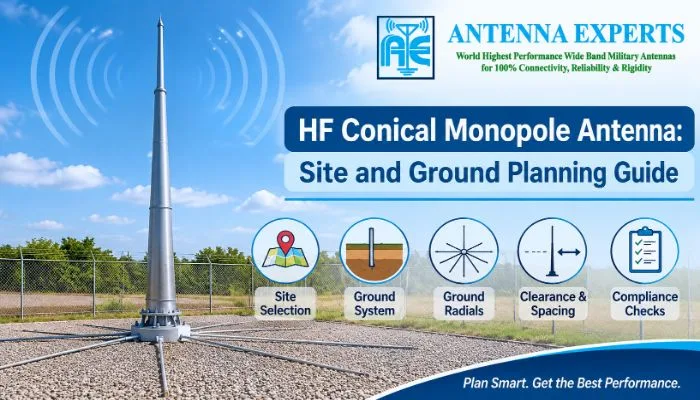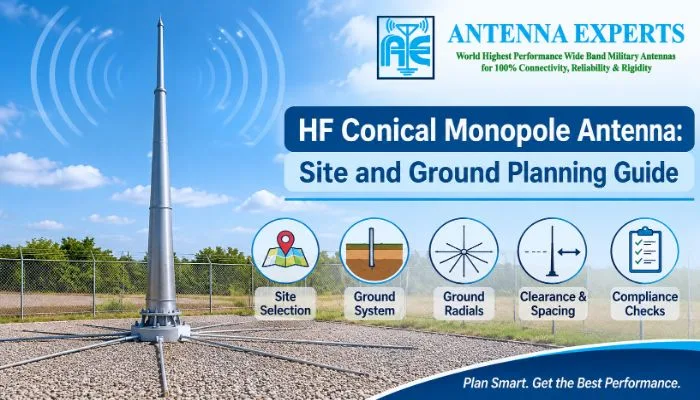
Once the mast is up, the performance of an HF broadband conical monopole antenna is a function of a well-selected site and a well-planned ground system. Grounding, guying, proximity of other structures, and coverage you actually need should all be settled before ordering equipment or putting an anchor down. Available space. Most installation problems are caused by lack of planning, not bad hardware. The guide follows the decisions in the order a site team usually meets them. It separates general good practice from details that only the antenna model and its engineering documents can confirm.
How Should You Select a Site for an HF Conical Monopole?
Begin with open ground. Metal buildings, tall masts, water tanks and overhead lines close to the antenna can reflect and re-radiate energy, which changes the pattern you planned.
Next, consider interference. The noise floor is increased by generators, motors and nearby transmitters, which hurts a receiving station more than a few meters of lost height. Walk the site with noise sources in mind before you settle on a model from the HF broadband conical monopole antenna range.
Access also should be given equal importance. The base has to be accessible later for inspection and crews need a safe way for vehicles and lifting equipment. Check for site restrictions e.g. security perimeters, local permissions. Also consider the environment. Coastal salt, desert dust and frequent lightning affect protection and maintenance.
What Ground Planning Does an HF Antenna Need?
A monopole is against the earth, so the earth is part of the antenna. With a ground radial system its return path is known and it is less dependent on whatever the soil has to offer.
There’s no one layout for every site. The final set-up depends on soil type, available ground area, site layout, restrictions and antenna design. Rocky or very dry ground acts differently than damp soil, and a cramped compound puts compromises on you that an open field would not. The radial layout should be derived from the antenna engineering documentation and an inspection of the actual site - never from a figure borrowed from another installation.
How Should Guy Wire Layout and Site Space Be Planned?
Determine the guy wire layout early, because it determines how much land the whole installation occupies. Anchor points should be on usable ground, clear of roads, buried services and neighboring property. Sketch the mast and site space on a scaled plan, not on a guess.
The guy distances, mast height, anchor spacing and foundation dimensions are dependent on the antenna model and its structural design. For the HFCM-5-30 model, as well as for any other, take them from the documents of the manufacturer. Keep safe distances from power lines and allow room for lifting equipment. Plan radials and guy wires on the same ground.
How Does an Omnidirectional HF Antenna Affect Coverage?
The best omnidirectional antenna radiates and receives in about the full horizontal circle. No aiming. That works for a base talking to units in multiple directions. This does not mean equal performance everyplace, as in practice the pattern is modified by terrain and by nearby structures.
Ground wave and sky wave coverage are not the same. Ground wave follows the surface and serve the nearer stations. Sky wave returns from the ionosphere and can reach much further. Which you favor depends on the angle at which energy leaves the antenna, known as the take-off angle, which is above the horizon. Longer sky wave paths are generally better at lower angles while shorter regional links are better at higher angles.
Coverage changes with frequency, time of day, and season, as ionospheric conditions change. The antenna alone cannot give a fixed range.
What Should You Check Before Conical Monopole Installation?
Confirm these points on paper, then on site.
- Site area: Confirm the footprint for mast, radials and guy anchors.
- Ground conditions: Soil type, moisture, rock and fill.
- N.B. Nearby structures: note buildings, towers and overhead wires.
- Guy anchor locations: check each is usable and free of buried services.
- Cable routing: Plan the route of the feeder from antenna to equipment.
- RF interference: survey local noise sources and transmitters.
- Maintenance access: Provide a clear path to the bottom and anchors.
- Safety clearances: Check distances to power lines and public places.
Equipment access: Ensure vehicles and lifting gear can access the site.
Why Antenna Experts?
Antenna Experts is the bestantenna manufacturer in India, working in the HF to microwave frequencies, with in-house R&D and custom antenna design for defense and communication applications. That range helps because an HF base station is seldom alone. The team offers technical support during planning, and testing capabilities behind its designs. If your site is cramped or has unusual ground, raise it before you buy.
Conclusion
Good installs are decided on paper first. Site selection determines interference and access, ground planning helps the antenna work against the earth, and guying and space determine how much land a project requires. Coverage depends on installation quality, frequency and propagation, so design it according to the application. Model-specific details can be provided by Antenna Experts.