Satellites go down, get jammed, or simply aren't overhead when a message has to move. HF still carries the load for beyond-line-of-sight communication decades after VHF and SATCOM became the default choice for everything else. The high-frequency band spans 3 to 30 MHz and reaches distant stations by bouncing signals off the ionosphere rather than needing a clear line of sight.
A propagation mode that lets a single ground station reach receives hundreds or thousands of miles away without any satellite relay in between. For procurement teams evaluating an HF broadband military antenna, that's the starting point: HF isn't a legacy fallback. It's the band that keeps working when nothing else does.
What are the capabilities of HF broadband military antennas?
An HF broadband military antenna has one job that sounds simple, but it is not. This means that the antenna operates efficiently across a huge span of frequencies without needing to be retuned every time the operator changes channels.
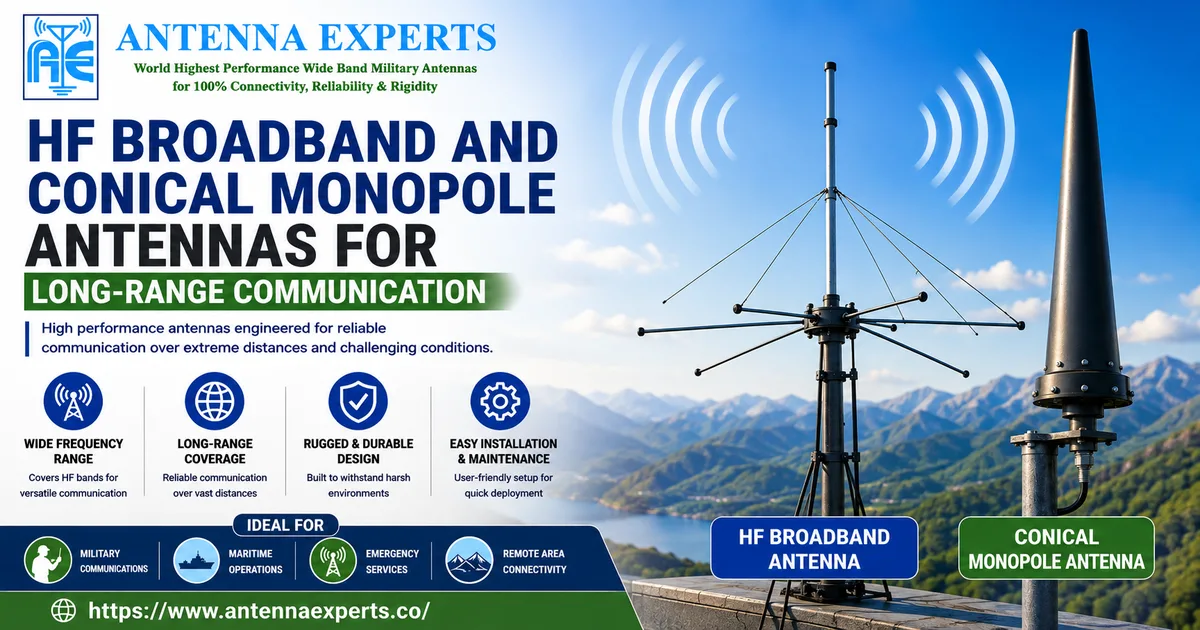
Antenna Experts offer an HF broadband range that covers this requirement across several configurations, from portable tactical dipoles to high-gain butterfly antennas, with models built to work across the full military HF band and handle up to 400 Watts of RF. Every model is built for RF handling and rated for horizontal or vertical polarization depending on whether the circuit is short-range groundwave or long-range skywave. This matters because getting that polarization choice wrong is one of the most common reasons a correctly specified HF link still underperforms in the field.
These HF communication antennas are manufactured from insulated copper and marine-grade stainless steel. They are specially engineered to withstand rain, snow, wind, and corrosion over years of outdoor deployment. There is not one fixed season. That's a meaningful difference from consumer-grade broadband antennas. Which is rarely rated for sustained exposure at a remote or coastal site.
HF Conical Monopole Antenna and Wideband Coverage
The HF Conical Monopole Antenna is the more common specification. The reason comes down to geometry, not marketing. A conical monopole's large diameter-to-height ratio gives it strong VSWR and radiation-pattern performance. It operates across a wide frequency range without needing tuners, coupling units, or termination resistors. This is what lets it hold both groundwave and skywave coverage at full radiation efficiency rather than trading bandwidth for loss the way some alternative broadband designs do.
Antenna Experts' HFCM series covers several band configurations with omnidirectional gain, radiating elements. It's built from a steel-core, aluminum-clad wire and a rated structure. Designed for a service life of more than 20 years, the antenna is self-supporting during erection without temporary guidance. That can shorten install time considerably on a fixed defense or embassy site.
Applications in Defense, Embassy, and Disaster Comms
HF broadband military antenna and conical monopole antennas show up wherever a communication link can't be allowed to depend on local infrastructure surviving. Defense forces use them for tactical field communication, signal intelligence, and surveillance links. Where the equipment has to survive rough handling, and long unattended deployment. Embassies and diplomatic missions rely on the same antennas as a resilient backup channel when commercial networks in the host country are unreliable, congested, or deliberately restricted. Then disaster-response teams turn to HF precisely because it doesn't need cell towers or fiber backhaul to stay up.
Lets understand with the real world example– After a regional disaster takes down cellular towers and fiber backhaul at once. HF is often the only medium still standing. A properly sited conical monopole or tactical dipole can put a relief coordination net back on air. Within hours it covers a command post hundreds of miles from the nearest working repeater. Across all the use cases, the requirement is identical: an antenna that stays efficient across the whole HF band, survives the environment, and doesn't need a technician on-site to retune it.
Why Choose Antenna Experts for HF Antennas?
Antenna Experts is a NATO NCAGE code holder and an ISO-certified antenna manufacturer. We produce HF broadband military antenna and conical monopole ranges for military, defense, and aerospace communication applications. Beyond the standard product lines, our team builds custom HF communication antennas to meet specific requirements. We also supply the supporting products including Aluminum Tubular Masts, pneumatic telescopic masts, guy wires and carrying cases.
Conclusion
HF broadband and conical monopole antennas are reliable communication devices because their ionospheric propagation keeps working when satellites, cell towers, and line-of-sight radio links don't. This enables secure, long-range communication across remote areas. These devices are very helpful in military, defence, emergency response, disaster recovery, and other mission-critical communication operations.
Looking to specify an HF broadband or conical monopole antenna for a defense, embassy, or disaster-response communication link? Browse the HF Broadband Military Antenna range or the HF Conical Monopole Antenna range, and request specifications and a quote from Antenna Experts at [email protected] or +91 9810205738.