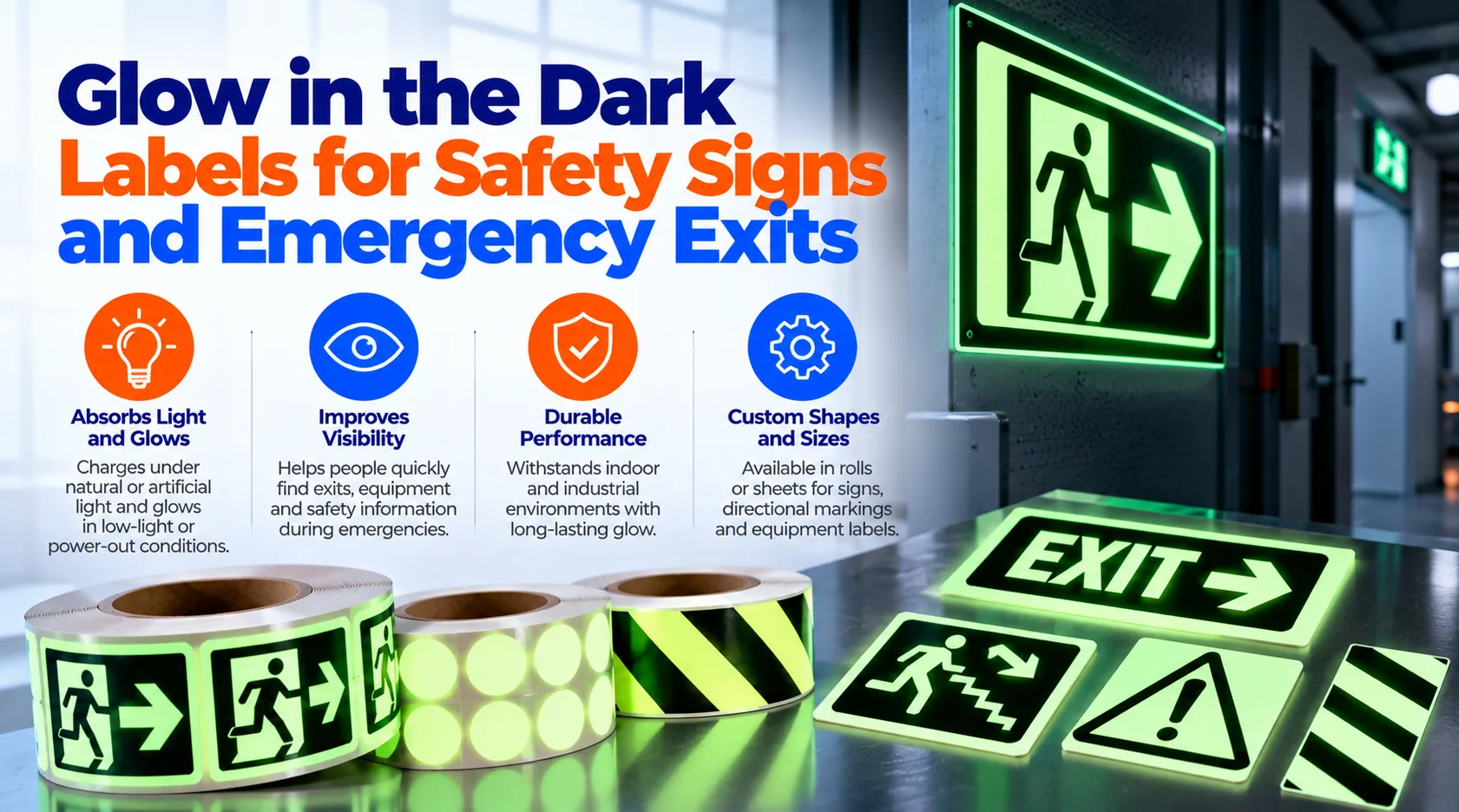
Glow in the Dark Labels are photoluminescent markings that soak up light from everyday lamps or daylight and give it back as a visible glow the moment the power fails. They need no wiring, batteries, or switches, which makes them a simple backup layer for exit signs, stairwells, door frames, and safety equipment. When smoke or a blackout makes a familiar building confusing, these glowing cues can help people find the way out.
Electric exit signs and emergency lighting remain the backbone of most evacuation plans, but both depend on power. Photoluminescent signs work beside them, filling gaps at floor level, on steps, and on equipment. Knowing how the material works and what codes expect makes buying the right product much easier.
How Photoluminescent Labels Store and Release Light
Photoluminescent material contains phosphor pigments that absorb energy from visible and ultraviolet light. Once the light source switches off, the pigment slowly releases that stored energy as a soft green or aqua glow. The cycle starts over each time the lights come back on, with no bulbs or batteries to replace.
Most modern safety products use strontium aluminate, a non-radioactive pigment that published US patent filings describe as roughly ten times brighter and longer glowing than the older copper-activated zinc sulfide. That gap matters, since evacuating a tall building can take a long time. Brightness and glow time still vary by product, pigment load, and how much light reached the surface beforehand, so Glow in the Dark Labels are best judged on tested data rather than packaging claims.
Where Glowing Safety Signs Make the Biggest Difference
The most useful spots are the ones people must reach, or avoid, during a power failure. Low-location markings near the floor tend to stay visible when smoke gathers near the ceiling and hides overhead exit signs. Facility teams often start with these areas:
- Exit doors, door handles, and door frames along the escape route
- Stair edges, landings, and handrails in enclosed stairwells
- Fire extinguishers, alarm pull stations, and hose cabinets
- Columns, racks, or other obstacles that stick out into walkways
- Electrical panels, shutoff valves, and control switches
Basements, windowless rooms, and night-shift sites usually gain the most, since a power cut can leave them fully dark. Glow in the Dark Labels also pair well with standard hazard labels, adding after-dark visibility to warnings that would otherwise disappear in a blackout. Parking garages, data centers, theaters, and warehouses are other places where glowing fire safety signs can support a calmer exit.
What Safety Codes Say About Glowing Exit Signs and Markings
Glowing signs are not a shortcut around safety rules; they are a recognized tool within them. In the United States, the main documents include OSHA workplace standards, the NFPA 101 Life Safety Code, and the International Building Code (IBC). Local adoption differs, so the fire marshal or building department has the final say.
One idea runs through most of these rules: a photoluminescent product only counts if it is listed or tested for the job and kept properly charged. Exit signs are commonly listed to UL 924, while floor-level egress path markings are typically listed to UL 1994 or tested to ASTM E2072. A product without that paperwork may still improve visibility, but it may not satisfy an inspector.
OSHA Rules for Workplace Exits
Under OSHA 29 CFR 1910.37, every exit must be clearly visible and marked with a sign that reads "Exit." The letters must be at least six inches tall, with main strokes no less than three-quarters of an inch wide. Each sign must also be lit to at least five foot-candles (54 lux) by a reliable light source.
The same rule permits self-luminous or electroluminescent signs when their surface brightness reaches at least 0.06 footlamberts (0.21 cd/m²). OSHA also expects doors that could be mistaken for exits to be marked "Not an Exit" or labeled with their real use, such as "Closet." Glowing labels can support these goals, but the main exit signs still need to meet these rules.
Building Code Rules for High-Rise Stairwells
Section 1025 of the IBC calls for luminous egress path markings in high-rise buildings in occupancy Groups A, B, E, I-1, M, and R-1. Here, a high-rise means a building with an occupied floor more than 75 feet above the lowest level of fire department vehicle access. The markings outline steps, landings, handrails, doors, and obstacles in exit stairways and passageways.
The code accepts any material, paint included, as long as no electrical charge is needed to keep it glowing. Photoluminescent products tested under a modified ASTM E2072 method must read at least 30 millicandelas per square meter after 10 minutes in darkness and 5 after 90 minutes, following a 60-minute charge under 1 foot-candle of light. That charging light must stay on whenever the building is occupied.
How New York City Changed Stairwell Safety
After the September 11 attacks, New York City formed the World Trade Center Building Code Task Force in March 2002 to study evacuation problems. Its recommendations led to Local Law 26 of 2004, which required photoluminescent exit path markings in the stairs of high-rise office buildings. Owners were given until July 1, 2006 to install the markings and certify compliance.
The law required the markings to be washable, non-toxic, and non-radioactive, with placement details spelled out in Reference Standard RS 6-1. These glowing markings were added on top of existing exit sign rules, not in place of them. The IBC rules above follow the same layered thinking.
Common Types of Glow in the Dark Labels and Tapes
Photoluminescent products come in several formats, and each one suits a different task. Some arrive as pre-printed signs with fixed symbols, while others are blank stock that users print or cut themselves. The right format depends on the surface, the traffic, and how much information the label carries.
Rigid aluminum or plastic signs tend to last longest on walls and doors. Flexible films and tapes handle curves, edges, and uneven surfaces more easily. For floors and stair treads, anti-slip glow tape with a gritty surface is often preferred because it adds grip as well as visibility.
Glow in the Dark Label Tape for Edges and Paths
Glow in the dark label tape comes on rolls and can be cut to length, which makes it practical for outlining stair nosings, door frames, handrails, and walkways. A continuous line gives people a route to follow rather than a single dot of light. Narrow strips can also mark shelving, machinery, or columns someone might walk into.
Floor tape faces foot traffic, cleaning chemicals, and scuffing, so heavier or anti-slip grades generally hold up better there. Wall tape lasts longer on clean, dry, smooth surfaces. Many installers test a short strip first to confirm adhesion before covering an entire stairwell.
Glow in the Dark Sticker Labels for Signs and Equipment
Glow in the dark sticker labels are pre-cut shapes such as arrows, exit symbols, running-figure pictograms, and equipment icons. They work well for marking fire extinguishers, first aid kits, emergency phones, and alarm pull stations. Being self-adhesive, they can be added to existing walls and equipment without drilling or wiring.
Directional arrows at turns and decision points are especially handy in long corridors and large warehouses. Symbols based on ISO 7010 safety graphics are widely understood across languages, which helps visitors and new staff. Keep stickers clear of any required text, ratings, or hazard information already printed on the equipment.
Glow in the Dark Switch Labels for Panels and Controls
Glow in the dark switch labels help people locate light switches, breaker panels, emergency stop buttons, and equipment shutoffs when a room goes dark. In a plant room or server room, finding the right control fast can limit damage. These small labels often carry short text, such as "Main Power" or "E-Stop," over a glowing background.
They work best as an add-on to standard electrical panel labels, which carry the circuit and hazard details that electricians and inspectors expect. A glowing outline around a panel door or main breaker can make its location obvious without altering the official markings. Electrical rooms can run warm, so a heat-rated material helps the adhesive hold.
Printing Your Own: Label Makers, Printers, and Thermal Options
Pre-made signs cover the basics, but many sites need custom wording such as room numbers, floor levels, or equipment names. Printing in-house can be quicker for small batches and last-minute changes. The trade-off is that self-printed labels may not carry the listings or test reports that code-required markings need.
For that reason, many facility teams use printed glowing labels for supplemental marking only. Code-required exit signs and stairwell markings are usually bought as listed products with documentation attached. Listing which spots are code-required and which are optional makes ordering simpler.
Choosing a Glow in the Dark Label Maker or Label Printer
A glow in the dark label maker is usually a handheld unit that prints onto narrow cartridges of photoluminescent tape. It suits quick jobs like switch labels, shelf markers, and short safety reminders. Not every brand offers glowing cartridges, so confirming compatibility before buying can save time and money.
A desktop or industrial glow in the dark label printer handles wider labels, higher volumes, and longer runs. Many support barcodes, logos, and safety symbols for larger labeling projects. Print sharpness, media cost, and the range of compatible glowing stocks are worth comparing side by side.
How Glow in the Dark Thermal Labels Work
Glow in the dark thermal labels are photoluminescent label stocks built to run through thermal printers. In most cases, they rely on thermal transfer printing, where a heated ribbon lays dark ink onto the glowing face. The printed areas block the glow, so the message appears as dark lettering against a lit background once the lights go out.
Thermal transfer prints tend to resist smudging and fading, which suits long-term safety labels. Pairing the right ribbon with the label face, such as a resin ribbon on film stock, usually improves durability. Heavy ink coverage shrinks the glowing area, so short text and bold symbols generally give the clearest result in the dark.
How to Choose the Right Photoluminescent Material
Not all Glow in the Dark Labels perform alike once the lights go out. The best choice depends on where the label sits, how much light it receives during the day, and how long it must stay readable. A few practical questions can narrow the options quickly:
- Is the label required by code or supplemental? Required markings generally need UL 924, UL 1994, or ASTM E2072 documentation.
- How long must it stay visible? Published luminance values at 10 and 90 minutes are more useful than vague "hours of glow" claims.
- What will the surface face? Floors, outdoor areas, and chemical zones call for tougher face stocks and adhesives.
- How much charging light is available? Dim rooms and some warm-toned lamps may charge the pigment more slowly.
- Does it need custom wording? Printable stock or a label printer may suit small custom runs.
The glow color matters too. Green strontium aluminate generally appears brightest to the human eye, while aqua shades tend to hold their glow a little longer. Requesting a test report from the supplier, rather than relying on a brochure, is one of the simplest ways to compare products fairly.
Installation and Maintenance Tips That Keep Labels Glowing
Even high-grade material underperforms if it is mounted in the wrong spot or never charged. Labels work best where normal lighting reaches them, at consistent heights along the escape route. The IBC also asks for uniform placement and dimensions within the same stair enclosure, which keeps the route predictable.
In plant rooms and utility corridors, glowing markers can sit beside pipe labels and valve tags so crews can trace lines and reach shutoffs during an outage. Dust, grease, and scuffs dull the glow over time, so a gentle wipe with mild soap and water during routine inspections helps. A "lights off" walk-through a few times a year, with the space dark for several minutes, quickly shows which Glow in the Dark Labels have faded and need replacing.
Limits and Alternatives Worth Knowing
Photoluminescent products do not light up a room; they make outlines and signs visible so people can get their bearings. They also rely on charging, so a label in a storeroom that rarely sees light may give little or no glow in an emergency. For these reasons, they are generally treated as a supplement to emergency lighting rather than a replacement for it.
Self-luminous tritium signs are one alternative for spots without reliable charging light, because they glow without any light exposure. They do contain radioactive tritium gas, which has a half-life of a little over 12 years, and they carry disposal rules that photoluminescent products avoid. Many buildings combine these with battery-backed LED exit signs.
Making Exit Routes Easier to Follow in the Dark
Glow in the Dark Labels give buildings a quiet, power-free backup that works when the lights do not. Paired with listed exit signs and emergency lighting, they can help people spot doors, steps, and equipment during an outage. Their value depends on choosing tested material, placing it with care, and keeping it clean and charged.
A practical next step is to walk your exit routes with the lights off and note every spot where you lose your bearings. Check local requirements with your fire marshal or building department, then match each location to the right tape, sticker, or sign. A few well-placed markings added now can make the next fire drill, and any real emergency, easier for everyone to get through.
Frequently Asked Questions
Do Glow in the Dark Labels replace emergency lighting?
No, they are designed to support emergency lighting, not replace it. Photoluminescent markings outline exits, steps, and equipment, but they do not light a space well enough for every task. Most codes treat them as an extra layer alongside electric exit signs and emergency lights.
How long do photoluminescent exit signs glow after a power outage?
Many listed photoluminescent exit signs are rated to stay visible for at least 90 minutes after the lights fail, provided they received the charging light named in their listing. Glow beyond that depends on the pigment, product design, and charging conditions. Published luminance figures give a fairer comparison than general "glows all night" claims.
Do photoluminescent safety signs need electricity or batteries?
No, photoluminescent signs work without wiring or batteries because they store energy from surrounding light. They do need a steady source of normal lighting while the building is in use so they stay charged. That is why codes often require the charging light to remain on during occupancy.
How much light do photoluminescent signs need to charge?
The answer depends on the product and the code it follows. Many UL 924 listed photoluminescent exit signs call for about 5 foot-candles of light on the sign face, while IBC stairwell markings are tested after a 60-minute charge under 1 foot-candle. The listing or the maker's instructions will state the exact light level and lamp type for each product.
Can a regular label printer print on glowing label stock?
Some can, as long as the printer accepts the size and type of media involved. Handheld label makers need cartridges made specifically with photoluminescent tape, and not every brand offers them. Thermal transfer printers generally handle photoluminescent film stocks well when paired with a suitable ribbon.
Are photoluminescent labels safe and non-toxic?
Modern strontium aluminate products are non-radioactive, unlike older self-luminous materials that relied on radioactive elements. New York City's Local Law 26 required its stairwell markings to be non-toxic and non-radioactive. Checking the safety data sheet is still sensible.
Where should glowing markings go in a stairwell?
Under IBC Section 1025, markings typically outline the leading edge of each step, landings, handrails, doors, and any obstacles in the path. Placement and sizing should be consistent throughout the same stairwell. Local codes may add details, so a quick check with the fire marshal is wise.