Market Overview
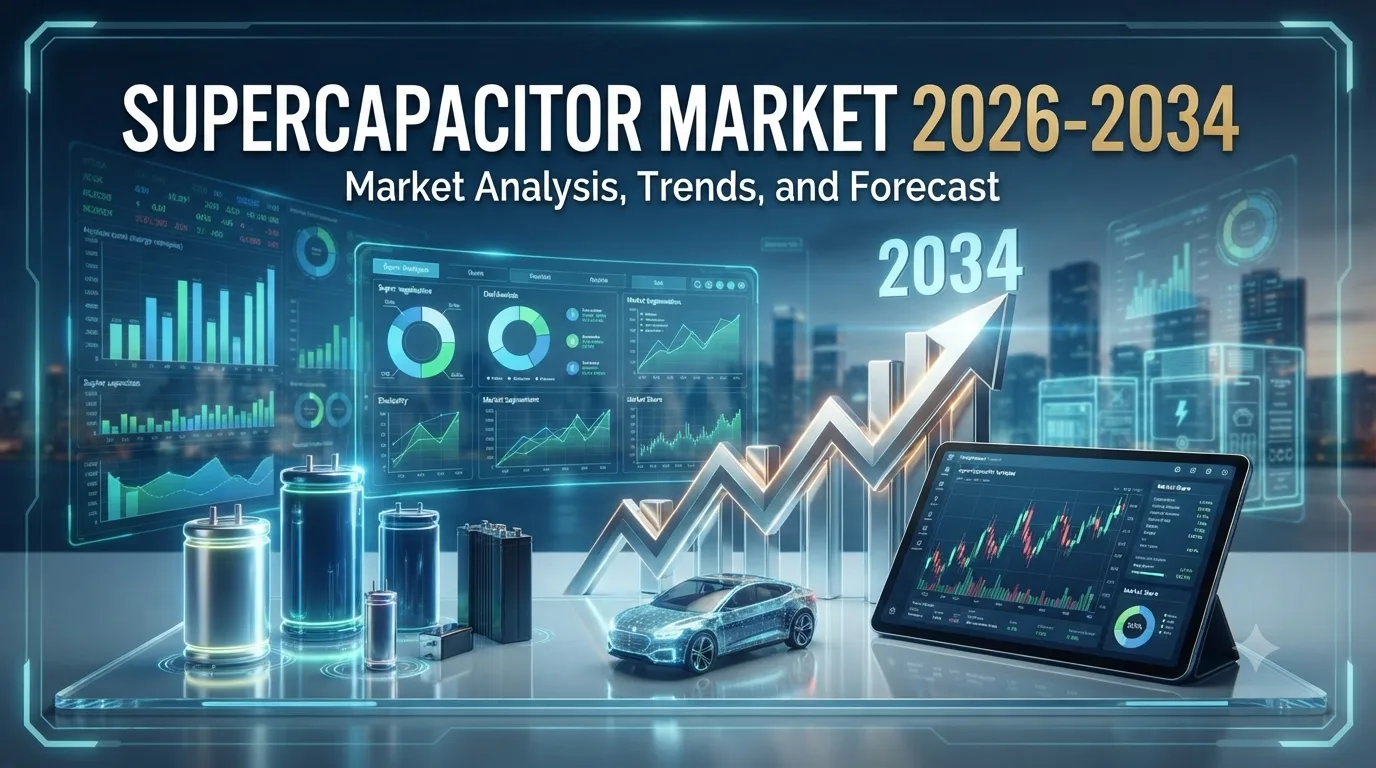
According to IMARC Group's latest research publication, "Supercapacitor Market: Global Industry Trends, Share, Size, Growth, Opportunity and Forecast", the global supercapacitor market size was valued at USD 7.63 Billion in 2025. Looking forward, IMARC Group estimates the market to reach USD 34.13 Billion by 2034, exhibiting a CAGR of 18.11%, holding the largest regional share. Rapid expansion of electric vehicle infrastructure, the scaling of renewable energy storage systems, and the proliferation of consumer electronics requiring high-power compact solutions are collectively propelling market growth globally.
Pseudocapacitors lead the product type segment, valued for their superior energy density and versatile applicability across portable electronics, medical devices, and IoT platforms through faradaic electrode reactions, while modules under 25V dominate given expansive consumer electronics and low-power IoT device demand. The expanding ecosystem of renewable energy globally is creating sustained demand for fast-charge, high-cycle energy storage components, as solar and wind assets require responsive buffering systems in which supercapacitors excel.
Grab a sample copy of this report: https://www.imarcgroup.com/supercapacitor-market/requestsample
How AI Is Reshaping the Future of the Supercapacitor Market
- Datacenter demand for uninterruptible power during artificial intelligence surges is emerging as a high-value opportunity segment, with peak-shaving supercapacitor systems replacing lithium-based buffers to manage power fluctuations from GPU clusters.
- AI-driven manufacturing processes have improved production efficiency substantially, reducing unit costs while enhancing graphene electrode quality control across high-volume production lines.
- New high-voltage architectures using supercapacitors as fast-cycle backup buffers are helping AI data centers manage power fluctuations, reinforcing their role in next-generation infrastructure.
- Machine learning-based predictive maintenance sensor platforms are integrating supercapacitor energy management for high-current wireless transmission bursts in manufacturing and logistics monitoring applications.
- AI infrastructure buildout is enabling GPU clusters to operate at full efficiency while reducing grid connection requirements, representing a structurally new demand category for supercapacitors.
Supercapacitor Market Trends
Acceleration of Electric Vehicle AdoptionElectric vehicles are rapidly replacing internal combustion engine vehicles globally, driven by declining battery costs, expanding public charging infrastructure, and substantial government incentive programs across major economies. Global EV adoption is the single largest demand driver for supercapacitors, whose millisecond-level charge-discharge capability makes them irreplaceable for regenerative braking and start-stop systems, recovering significantly more kinetic energy than battery-only configurations across hybrid and fully electric vehicle platforms.
Advancements in Consumer Electronics and DurablesThe global consumer electronics and durables industry is advancing at an extraordinary pace, with wearable device adoption continuing its strong upward trajectory across health, fitness, and entertainment segments. Escalating consumer expectations for faster device charging, longer operational durations, and progressively smaller form factors are intensifying engineering requirements for energy storage solutions that combine high power density with extended cycle life.
Increasing Industrial Automation and IoT ApplicationsIndustrial automation is fundamentally transforming manufacturing, logistics, and process management worldwide, driving parallel demand for dependable, high-cycle power solutions capable of supporting autonomous systems at scale. The Internet of Things connectivity layer is expanding rapidly across smart factories, utility networks, and agricultural systems, creating growing demand for compact, maintenance-free supercapacitor solutions.
Hybridization of Energy Storage ArchitectureA defining structural shift is the transition from pure Electric Double-Layered Capacitors to Lithium-Ion Capacitors and hybrid supercapacitor-battery systems. These architectures deliver battery-like energy density alongside capacitor-grade power delivery, addressing OEM demands across automotive, grid-stabilization, and industrial automation sectors simultaneously, with breakthroughs in graphene and curved carbon electrodes substantially narrowing the gap with lithium-ion batteries at commercially viable cost points.
Growth Factors in the Supercapacitor Market
- Renewable Energy Grid Stabilization: The accelerating integration of solar and wind power globally is creating sustained demand for fast-response energy buffering solutions, with supercapacitors uniquely positioned for grid frequency regulation and intermittency management given their sub-second response capabilities.
- AI-Driven Data Center Power Demand: Datacenter demand for uninterruptible power during artificial intelligence compute surges is emerging as a high-value opportunity, with dedicated peak-shaving capacity products entering commercial deployment.
- Micro-Supercapacitors for Wearables and IoT: The miniaturization of supercapacitor devices opens new opportunities in wearable technology and IoT, where quick charging and long cycle life are critical requirements amid exponential growth of connected sensor networks.
- Consumer Electronics Expansion: Rising smartphone, wearable, and portable electronics production continues to expand the addressable market for compact, high-power energy storage components.
- Advanced Materials Innovation: Breakthroughs in graphene and carbon-metal oxide electrode materials are substantially lifting energy density thresholds, unlocking new automotive, grid, and industrial applications previously unsuited to supercapacitor technology.
Leading Companies Operating in the Global Supercapacitor Industry
- Cap-XX Limited
- Cornell-Dubilier
- Eaton Corporation
- Fastcap Ultracapacitors, LLC (a Nanoramic, Inc. subsidiary)
- Ioxus
- KYOCERA AVX Components Corporation
- Maxwell Technologies
- Nippon Chemi-Con Corporation
- Skeleton Technologies
- TDK Corporation
Supercapacitor Market Report Segmentation
Breakup by Product Type:
- Electric Double-Layered Capacitors (EDLCs)
- Pseudocapacitors
- Hybrid Capacitors
Pseudocapacitors lead the market, utilizing faradaic charge-transfer mechanisms at the electrode-electrolyte interface, enabling significantly higher energy density while retaining the rapid charge-discharge capability that defines the supercapacitor category.
Breakup by Module Type:
- Less than 25V
- 25-100V
- More than 100V
The less than 25V segment dominates, driven by expansive consumer electronics, low-power IoT edge devices, industrial control systems, and medical monitoring equipment, all markets experiencing strong secular demand growth.
Breakup by Material Type:
- Carbon and Metal Oxide
- Conducting Polymer
- Composite Materials
Carbon and metal oxide materials lead the segment, offering a balance of cost-effectiveness and performance that supports widespread adoption across automotive, consumer electronics, and industrial applications.
Breakup by End Use Industry:
- Automotive and Transportation
- Consumer Electronics
- Power and Energy
- Healthcare
- Others
Consumer electronics represents the largest end-use segment, reflecting sustained demand for compact, high-power energy storage components across smartphones, wearables, and portable devices.
Breakup by Region:
- Asia Pacific (China, Japan, India, South Korea, Australia, Indonesia, Others)
- North America (United States, Canada)
- Europe (Germany, France, United Kingdom, Italy, Spain, Russia, Others)
- Latin America (Brazil, Mexico, Others)
- Middle East and Africa
Asia Pacific holds the largest regional market share, underpinned by China's dual position as both the world's largest EV manufacturer and the dominant hub for consumer electronics production, complemented by South Korea's advanced battery-supercapacitor hybrid research ecosystem and Japan's precision electronics supply chains.
Recent News and Developments in the Supercapacitor Market
- June 2025: Skeleton Technologies launched GrapheneGPU, a peak-shaving capacity shelf that replaces lithium with supercapacitor energy storage based on the company's patented Curved Graphene technology, targeting AI data center power management applications.
- October 2025: Eaton introduced an 800 VDC architecture for AI data centers that uses supercapacitors as fast-cycle backup buffers to manage power fluctuations from GPU clusters, reinforcing its role in next-generation data center energy infrastructure.
- November 2025: Skeleton Technologies officially opened its EUR 220 million SuperFactory in Markranstädt, Leipzig, with a 12-million-cell annual production capacity, immediately beginning deliveries to major industrial customers for European grids and to hyperscalers for AI infrastructure.
- November 2025: Clarios completed the acquisition of Maxwell Technologies, integrating its ultracapacitor technology into Clarios's global automotive and energy storage portfolio, expected to accelerate hybrid energy storage system development across automotive and industrial markets.
Note: If you require specific details, data, or insights that are not currently included in the scope of this report, we are happy to accommodate your request. As part of our customization service, we will gather and provide the additional information you need, tailored to your specific requirements. Please let us know your exact needs, and we will ensure the report is updated accordingly to meet your expectations.
About Us
IMARC Group is a global management consulting firm that helps the world's most ambitious changemakers create a lasting impact. The company provides a comprehensive suite of market entry and expansion services. IMARC offerings include thorough market assessment, feasibility studies, company incorporation assistance, factory setup support, regulatory approvals and licensing navigation, branding, marketing and sales strategies, competitive landscape and benchmarking analyses, pricing and cost research, and procurement research.
Contact Us
IMARC Group
134 N 4th St. Brooklyn, NY 11249, USA
Email: [email protected]
Tel No: (D) +91 120 433 0800
United States: +1-201-971-6302