

The crypto wallet is entering a new phase.
The next generation is being designed for much more: managing digital value, identity, payments, permissions, and on-chain activity through one interface.
In 2026, the biggest Crypto Wallet Developments are fundamental changes in how wallets work, how users authenticate, and how transactions move across blockchain networks. Smart accounts, passkeys, MPC security, stablecoin payments, cross-chain execution, programmable permissions, and intent-based transactions are creating a new model.
The future-proof wallet across everyday digital finance will be simpler on the surface while becoming more powerful underneath.
1. Smart Accounts Will Redesign Wallet Architecture
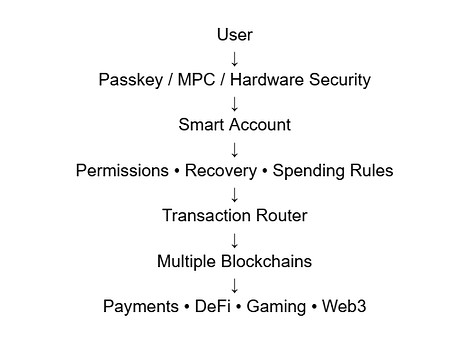
Traditional wallets depend on a private key and fixed transaction process. Smart accounts change this model by making wallet behavior programmable.
With account abstraction, developers can introduce spending limits, transaction batching, recovery rules, sponsored gas, session permissions, and multi-signature approvals. Coinbase has described smart accounts as a major step toward improving wallet usability because users can interact with applications without managing every underlying transaction detail themselves.
Vitalik Buterin has repeatedly advocated account abstraction as a path toward making Ethereum easier to use.
Architecture Diagram:
2. Passkeys Will Push Seed Phrases Into the Background
Seed phrases have protected self-custody for years, but they also create a major usability problem.
Passkey-based authentication offers a familiar experience by connecting wallet access with device-level authentication.
The important development is creating recovery systems that combine security, backup credentials, trusted contacts, and controlled authorization.
Research published in August 2026 emphasizes that crypto recovery is not one single process. It can involve restoring secrets, replacing credentials, migrating signing authority, or restoring account control. That makes recovery architecture an essential part of future wallet development.
3. MPC Will Become a Core Security Layer
Multi-party computation is changing how wallets protect signing authority. Instead of keeping one complete private key in a single location, MPC distributes cryptographic control across multiple parties or devices.
Future wallets will increasingly combine MPC with transaction policies, device verification, approval workflows, and spending limits.
The direction is clear: wallet security is moving from “protect one key” toward “control every signing condition.”
4. Wallets Will Become Cross-Chain Operating Systems
Blockchain fragmentation remains one of Web3’s biggest usability problems. Users may hold assets across Ethereum, Bitcoin, Solana, Layer 2 networks, and other ecosystems, each with different addresses, fees, bridges, and transaction methods.
Instead of asking users to select networks manually, wallets can identify routes, calculate fees, select liquidity sources, and execute transactions across supported chains.
5. Stablecoins Will Turn Wallets Into Payment Infrastructure
Stablecoins are becoming a major driver of wallet development. Ripple’s 2026 digital asset survey found that 74% of financial leaders believe stablecoins can improve cash-flow efficiency and unlock trapped working capital. Fireblocks reported that stablecoin transaction volume reached $1.79 trillion in June 2026.
This growing adoption is also accelerating the demand for Stablecoin-Based Crypto Payment Gateway solutions, enabling wallets to function as payment accounts for payroll, merchant settlement, remittances, treasury movement, and cross-border transactions.
6. Transaction Intent Will Replace Transaction Complexity
Today, users often think in technical instructions: choose a network, approve a token, pay gas, sign a contract, and wait for confirmation.
The future is more intent-driven.
A user may simply express an outcome such as “swap this asset,” “send $500,” or “pay this merchant.” Wallet infrastructure can then determine the route, permissions, fees, and execution steps.
This direction is appearing alongside smart-account technologies such as EIP-7702.
7. Security Will Become Predictive and Layered
Wallet security cannot depend on one warning screen. Recent research demonstrated that transaction simulation can be manipulated by contracts whose behavior changes with blockchain state. Researchers identified more than 4,000 phishing contracts and approximately $3.48 million in losses in their study.
Future wallets therefore need multiple security layers: transaction simulation, contract reputation, permission monitoring, address verification, risk scoring, policy controls, and post-transaction monitoring.
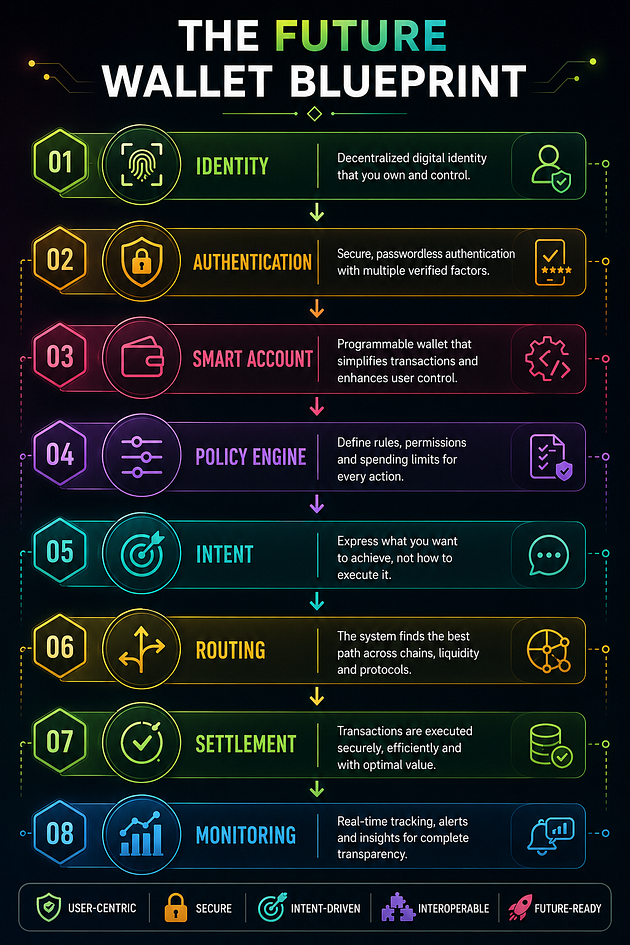
The Future Wallet Blueprint:
End Up
Future-proof crypto wallets will not be defined by one breakthrough feature. Their advantage will come from how several technologies work together.
Smart accounts will make wallets programmable. Passkeys will simplify authentication. MPC will strengthen signing security. Cross-chain infrastructure will reduce fragmentation. Stablecoins will expand payment capabilities. Intent-based execution will hide technical complexity, while layered security will protect every action.
Coinbase’s wallet research has already pointed toward smart accounts and passkeys as important directions for better user experience. Meanwhile, 2026 research shows wallets becoming part of broader financial infrastructure rather than remaining simple key-storage applications.
The future-proof wallet is therefore not just a safer wallet. It is a programmable gateway between people, applications, blockchains, and digital value.
For businesses building wallets today, the priority should be flexibility. Build around modular security, upgradeable account architecture, multi-chain connectivity, stablecoin payments, and user-controlled policies. The wallet that succeeds tomorrow will be the one designed to adapt before tomorrow arrives.
#FutureProofWallet #CryptoWalletDevelopment #Web3Wallet #CryptoInnovation