If you've spent time on exploration drilling programs, you've likely noticed that newer rigs look increasingly different from older machines. The proliferation of full hydraulic core drilling rigs over the past two decades is not merely a styling trend-it represents a fundamental engineering advancement that affects drilling efficiency, maintenance costs, and operational flexibility.
Understanding what "full hydraulic" actually means-and why it matters for your drilling program-can help you make better equipment decisions and optimize drilling performance on your projects.
This article explains the technical architecture of full hydraulic drilling rigs, compares them against mechanical and semi-hydraulic alternatives, and provides practical selection criteria for exploration drilling applications.
Defining Hydraulic Drilling Systems
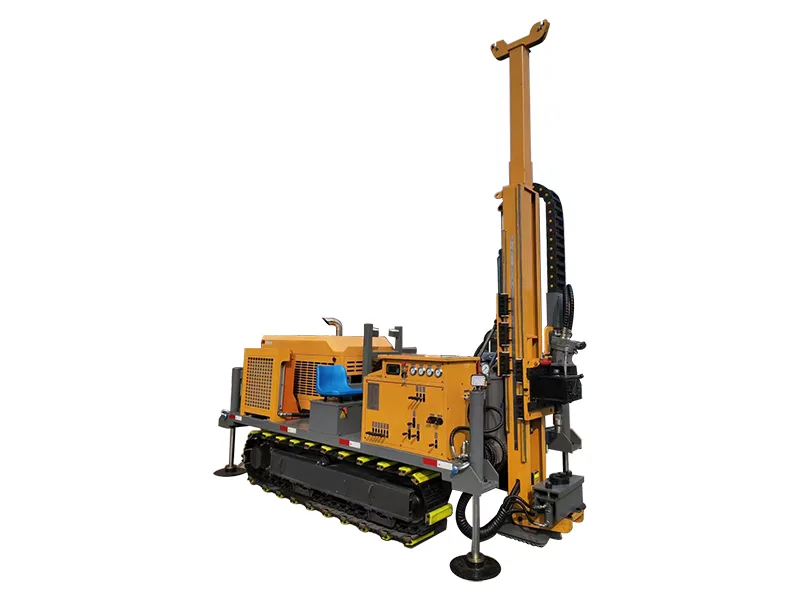
A full hydraulic core drilling rig uses pressurized hydraulic fluid as the sole power transmission medium for all drilling functions. Every mechanical action in the drilling process-rotating the drill string, applying weight on bit, clamping the rods, breaking joints, and raising/lowering the crown-is powered by hydraulic cylinders and motors fed from a central hydraulic system.
This contrasts with three categories of drilling rigs:
Rig TypeRotationFeedClampingBreakingFull MechanicalMechanical gearboxMechanical chainManual wedgesManual tongsSemi-HydraulicHydraulic motorHydraulic cylinderHydraulic clampsManual or hydraulicFull HydraulicHydraulic motorHydraulic cylinderHydraulic clampsHydraulic chuck/breakout
The defining characteristic of a full hydraulic rig is that all functions are hydraulic, meaning there are no mechanical chain drives, gear boxes, or manual rod handling for routine operations.
Core Hydraulic Components
Hydraulic Power Unit (HPU): The heart of the system. A diesel engine or electric motor drives a hydraulic pump (typically axial piston type) that generates flow at 25-35 MPa pressure. The HPU supplies hydraulic power to all rig functions.
Hydraulic Drill Head: The rotary drive unit mounted on the feed structure. Contains a hydraulic motor that delivers continuous variable torque and RPM through a gear reducer. Modern heads deliver 1,000-3,500 Nm torque at 0-1,500 RPM.
Feed System: A hydraulic cylinder (single or double-acting) mounted on the mast that provides precise weight-on-bit control. Feed force typically ranges from 0-120 kN on exploration rigs, with precise infinitely variable adjustment.
Hydraulic Clamps and Breakout: Instead of manual wedges and tongs, full hydraulic rigs use cylindrical clamps that grip the rod string and a hydraulic chuck or breakout wrench that unscrews rod joints. This eliminates two of the most labor-intensive manual operations in drilling.
Control System: Modern full hydraulic rigs use electronic-over-hydraulic controls that provide fine adjustment of all parameters from a single panel, often with digital display of WOB, RPM, torque, and footage counters.
1. Precise Weight-on-Bit Control
The hydraulic feed system provides infinitely variable WOB adjustment from 0 to maximum feed force. Operators can set a target WOB and the system automatically maintains it regardless of formation changes. This precision:
Prevents bit balling in soft formations by reducing WOB when penetration increases
Prevents core crushing in hard formations by maintaining optimal WOB
Reduces mechanist fatigue since the system handles feed control automatically
Improves penetration rate consistency across formation changes
Mechanical rigs require operators to manually adjust feed using lever mechanisms, leading to greater WOB variation and more frequent parameter changes.
2. Superior Drilling Efficiency
Full hydraulic rigs consistently achieve 15-30% higher average penetration rates compared to mechanical rigs in the same formations. This efficiency gain comes from:
Faster rod handling (hydraulic clamps eliminate manual wedge setting)
Continuous WOB adjustment eliminates drill string "chatter" and balling events
Faster tripping speeds with hydraulic winches
Reduced non-drilling time (breakout, clamp, reposition)
For a 1,000-meter exploration hole, the time savings from hydraulic rod handling alone can be 8-16 hours of shift time.
3. Compact Design and Rig Mobility
Hydraulic systems eliminate the need for large mechanical transmissions, gearboxes, and chain drives. This allows full hydraulic rigs to be packaged in significantly more compact configurations. The practical benefit is:
Higher power-to-weight ratio: More drilling capability in a smaller package
Easier transportation: Skid-mounted and truck-mounted configurations are more feasible
Better site access: Compact rigs can operate in tighter spaces and more difficult terrain
Faster setup/teardown: Fewer components to rig up and rig down between holes
This compactness is particularly valuable for exploration drilling where sites are remote and rig mobilization costs are significant.
4. Reduced Maintenance Requirements
Mechanical transmissions have dozens of wearing surfaces: chains, gears, bearings, and sprockets that require regular lubrication, adjustment, and replacement. Hydraulic systems have far fewer wearing components:
Hydraulic fluid and filters are the primary consumables (changed every 250-500 hours)
Hoses and fittings may require periodic replacement
Hydraulic motors and cylinders are sealed units with long service lives
No chain lubrication, tension adjustment, or sprocket replacement
Field reports consistently show that full hydraulic rigs require 40-60% less maintenance time compared to mechanical rigs operating in equivalent conditions.
5. Improved Operator Safety and Comfort
Hydraulic rod handling eliminates the most hazardous manual operations in exploration drilling:
No manual rod wedging with hammer and wedge tools
No manual tongs for breakout (hand and finger injuries are common)
Reduced noise levels since mechanical rattling from chains and gears is eliminated
Climate-controlled operator cabs on modern rigs reduce operator fatigue
Investment payback calculation: For a typical exploration program drilling 5,000 meters annually, the 20-30% efficiency gain from a full hydraulic rig translates to 1,000-1,500 additional meters drilled per year with the same crew and shift schedule. At $80/m drilling cost, this represents $80,000-$120,000 in additional value per year-often recovering the cost premium within 2-3 years.
Full Hydraulic Rigs Are Ideal When:
Depth requirements exceed 300 meters: The efficiency gains compound at depth where tripping time is significant
Frequent rig moves: Compact design and faster setup reduce move costs between holes
Remote exploration programs: Lower maintenance requirements reduce the risk of drilling delays due to mechanical failures
Long-term drilling contracts: The maintenance and efficiency advantages create better economics over extended programs
Hard rock drilling: Precise WOB control is most valuable in formations where parameter sensitivity is highest
Drilling contractor operations: Multiple programs per year maximize the utilization of the higher capital investment
Consider Alternatives When:
Very shallow drilling (under 100m) with minimal hole count-the efficiency advantage may not recover the cost premium
Extremely tight budget: Mechanical rigs have lower upfront costs for programs with limited duration
Occasional use only: Depreciation of the higher capital cost may not be justified
1. Maximum Drill Depth Capacity
Match the rig's rated depth capacity to your program requirements with appropriate safety margin:
Light rigs (300-500m): Suitable for early-stage exploration, soil sampling, and shallow geotechnical drilling
Medium rigs (500-1,000m): Standard for most mineral exploration programs
Deep rigs (1,000-3,000m+): For deep exploration, scientific drilling, and large-diameter drilling
Selection rule: Choose a rig rated at 20-30% more than your maximum expected depth. Running a rig at its rated maximum reduces bit life and increases maintenance.
2. Hydraulic System Pressure and Flow
Standard exploration rig hydraulic systems operate at 25-32 MPa (3,600-4,600 psi). Higher pressure systems deliver more power in a compact package but require higher-specification components. Ensure the system pressure matches your drilling requirements for torque and feed force.
3. Power Source
TypeAdvantagesDisadvantagesDieselFully mobile; operates anywhereHigher operating cost; emissions; noiseElectric (380V/415V)Lower operating cost; quieter; cleanerRequires power connection or generatorDual-PurposeFlexibility for on-grid and off-grid sitesHigher initial cost; more complex
For most exploration programs, diesel-electric dual-purpose rigs offer the best flexibility, allowing electric operation at established sites and diesel operation in remote areas.
4. Mast Height and Load Capacity
Mast height determines maximum rod pull capacity (single rod length x number of rods). Standard masts provide:
3-4.5 meter masts: Pulls 3-6 rods at a time; sufficient for NQ and smaller rods
4.5-6 meter masts: Pulls 6-9 rods; standard for HQ operations
6+ meter masts: Large-diameter drilling or deep hole programs
5. Rod Handling System
Modern full hydraulic rigs offer:
Auto-grip rod handlers: Mechanically assist rod connection and breakout; significantly reduces operator fatigue
Hydraulic chuck and breakout: Full hydraulic rod gripping and breakout without manual tongs
Integrated rod dipper: Assists with rod alignment during tripping
Full hydraulic core drilling rigs power all drilling functions (rotation, feed, clamping, breakout) through a single hydraulic system operating at 25-35 MPa, eliminating mechanical chain and gear drives
The primary efficiency advantage (15-30% higher ROP) comes from precise WOB control, faster hydraulic rod handling, and reduced non-drilling time compared to mechanical rigs
Full hydraulic rigs cost 30-50% more upfront but recover the premium through 40-60% lower maintenance costs and measurably higher penetration rates on exploration programs of 5,000+ meters annually
Key selection criteria: maximum drill depth capacity (with 20-30% safety margin), hydraulic system pressure, power source (diesel/electric/dual), mast height, and rod handling automation level
For most modern mineral exploration drilling programs beyond 300 meters depth, the operational and maintenance advantages of full hydraulic rigs make them the clear default choice over mechanical alternatives
The transition from mechanical to full hydraulic drilling rigs represents one of the most significant efficiency advancements in exploration drilling over the past three decades. The precise parameter control, reduced maintenance requirements, and improved operator safety of hydraulic systems are not marginal improvements-they fundamentally change the economics of exploration drilling programs.
For drilling contractors and exploration companies operating in competitive markets, the productivity advantage of full hydraulic rigs translates directly to lower cost-per-meter and more competitive contract pricing. For junior explorers with limited drilling budgets, the efficiency gains mean more meters drilled within the same budget allocation.
Wuxi PolySource Geological Equipment Co., Ltd. manufactures a comprehensive line of full hydraulic core drilling rigs ranging from portable 300-meter capacity machines to deep 3,000-meter capacity systems, all designed for global mineral exploration drilling applications.