Fuel is one of the most visible costs of everyday driving for most Indian vehicle owners. Whether it is a daily office commute, school run or weekend highway trip, even a small change in mileage can make a noticeable difference to monthly expenses.
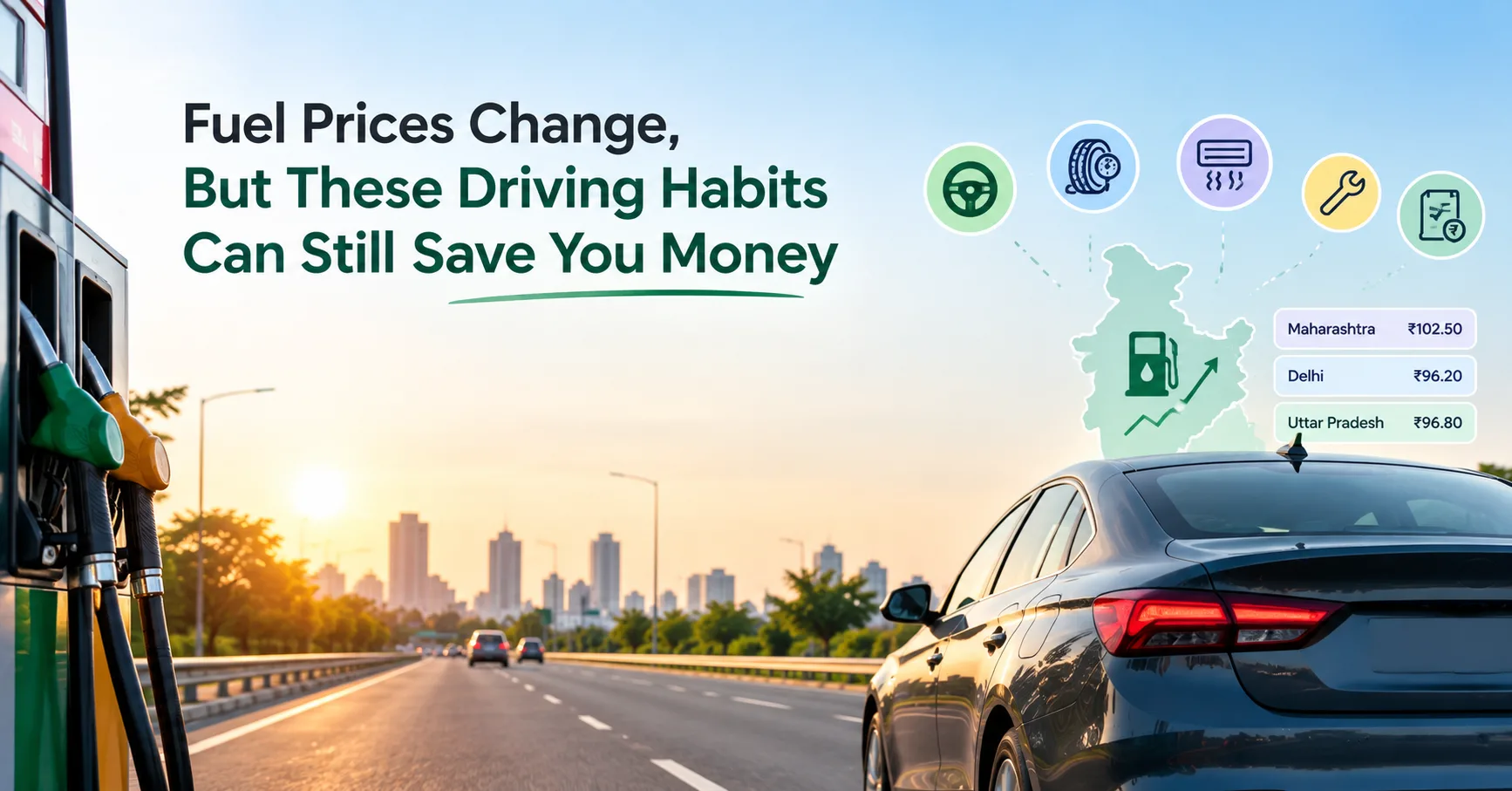
Fuel prices vary across cities and states as state-level taxes differ. For example, as of September 18, 2026, the Petroleum Planning & Analysis Cell lists Maharashtra petrol taxation at 25% VAT, plus ₹5.12 per litre additional tax, while Delhi applies 19.40% VAT. Telangana's listed petrol VAT is 35.20%. (Petroleum Planning & Analysis Cell)
This makes fuel efficiency not just a question of finding a cheaper petrol pump, but also about driving and maintaining the vehicle in a way that affects spending.
Avoid Aggressive Acceleration and Braking
Frequent hard acceleration followed by sudden braking can increase fuel consumption, especially in heavy city traffic. A smoother driving style enables the vehicle to maintain a more consistent speed and reduces changes in engine load.
This does not mean driving unusually slowly. The aim is to anticipate traffic and maintain a steady pace where possible and avoid unnecessary acceleration.
Check Your Tyre Pressure Regularly
Tyres that are not inflated to the manufacturer's recommended pressure can increase rolling resistance. For everyday drivers, checking tyre pressure regularly is one of the simplest maintenance habits to adopt. The recommended pressure can usually be found in the vehicle's owner's manual or on the manufacturer's information label.
It is particularly worth checking before a long highway journey.
Don't Leave the Engine Running Unnecessarily
Idling consumes fuel even though the vehicle is not moving. Waiting outside a shop, parking area or pickup point with the engine running for long periods can, therefore, add to fuel consumption without increasing the distance of the journey. Modern vehicles are designed to manage stop-start conditions, so drivers should avoid unnecessary prolonged idling while still following their vehicle manufacturer's guidance.
Use the AC Sensibly
Air conditioning is another factor that can affect fuel consumption. During excessively hot weather, keeping the AC running continuously at a very low temperature can increase strain on the vehicle. Using a reasonable cabin temperature and allowing the vehicle to cool appropriately can help reduce unnecessary energy use. For highway driving, however, opening windows extensively can also create aerodynamic drag. The most practical approach depends on speed, weather and traffic conditions.
Carry Only What You Need
Extra weight means the engine has to work harder, especially during acceleration. That does not mean removing essential equipment from the vehicle. But an occasional check of the boot or storage area can reveal items that have been carried around unnecessarily for months. The same applies to roof-mounted luggage or accessories: remove them when they are no longer required, especially if they increase aerodynamic drag.
Regular Maintenance Can Protect Mileage
Fuel efficiency can also be affected by the condition of the vehicle. Regular servicing, using appropriate engine oil, clean filters and maintaining tyres can enable the vehicle to perform as intended. If mileage suddenly drops without a change in driving conditions, it may be worth checking whether the vehicle needs to be maintained. For older vehicles, unusual fuel consumption can sometimes be a sign that something needs attention, rather than simply as a result of changing fuel prices.
Traffic Fines Can Add to Your Driving Costs
Fuel is not the only expense that can increase the cost of everyday driving. Violations of traffic rules can result in challans, and the applicable amount can vary depending on the type of offence and state.
- For example, Maharashtra's published offence schedule lists a ₹1,000 first-offence penalty for certain violations involving road-safety, noise or air-pollution standards, while the listed subsequent penalty is ₹2,000. The same schedule lists ₹400 for a first speeding offence and ₹1,000 for subsequent offences in the relevant category. (Transport Maharashtra)
- Delhi's traffic police lists different amounts for several offences. For example, triple riding on a two-wheeler is listed at ₹1,000, while using a horn in a no-honking or silence zone is ₹1,000 for a first violation and ₹2,000 for a subsequent violation. (Delhi Traffic Police)
- Uttar Pradesh's published compounding schedule lists ₹1,000 for not wearing a helmet and ₹1,000 for using a handheld communication device while driving for a first offence and ₹2,000 for speeding in a light motor vehicle.
- These examples show why drivers should not assume that a particular violation will result in the same challan amount everywhere. Applicable penalties depend on the type of offence and jurisdiction and which rules are applicable.
A Challan Check Can Be Part of Your Regular Vehicle Routine
With traffic enforcement becoming increasingly digital, checking for pending fines is another useful part to vehicle ownership.
In Maharashtra, the Highway Traffic Police says that vehicle owners can check challan status through the Maharashtra traffic challan portal, Maha Traffic App or the national e-Challan portal using the vehicle number. (Maharashtra Highway Police)
Similar online systems are available in other states. Uttar Pradesh Police provides an online traffic-challan service, while Telangana's integrated e-Challan system allows users to check using vehicle and licence-related details.
This is where a challan check app can be useful for everyday vehicle owners. Rather than remembering to check only after receiving a message or during a vehicle-related transaction, drivers can make checking pending challans part of their regular vehicle-management routine.
How MyMotor Fits Into Everyday Vehicle Management
Fuel savings may come from better driving habits, but managing a vehicle involves much more than just fuel. Owners may also need to keep track of RC information, insurance, PUC, FASTag and traffic challans. Digital vehicle-management platforms such as MyMotor bring many of these routine requirements together, including challan check, vehicle information and other ownership-related services.For someone preparing for a long drive, renewing documents or simply keeping track of a vehicle, having these details together in one place can make routine ownership easier.
A Simple Way to Reduce Your Monthly Driving Costs
You cannot control every factor that affects fuel prices. State taxes, crude-oil prices and other market factors can influence what you pay at the pump. (Petroleum Planning & Analysis Cell)
But some parts of vehicle expense are within your control.
Drive smoothly, check your tyres regularly are all things that may come to mind. Avoid unnecessary idling, keep the vehicle maintained and carry only what you need. At the same time, be aware of insurance, PUC, FASTag and challan status to make sure that an avoidable expense does not become an additional burden for Indian motorists.
For Indian motorists, saving money on driving isn't necessarily about making one major change. Small habits, repeated every day, can be a meaningful difference over time.