If you have searched "why can't I lift my arm" or "shoulder pain won't go away," you are not alone — and you are in the right place.
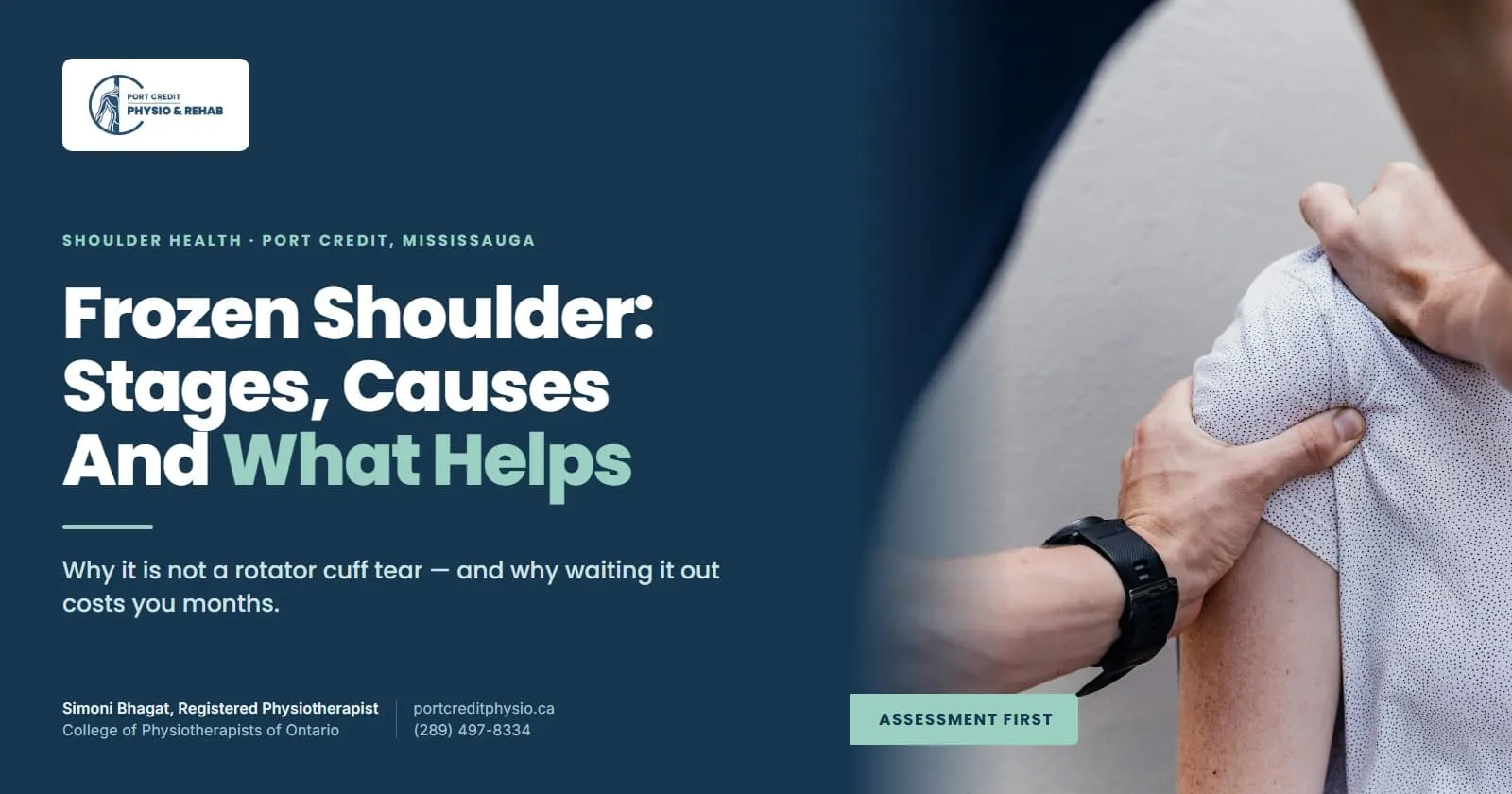
Frozen shoulder, known clinically as adhesive capsulitis, is one of the most misunderstood shoulder conditions we see at our Port Credit clinic. People often assume they have torn something, or that the pain will work itself out. In reality, frozen shoulder behaves very differently from a rotator cuff injury, and treating it the wrong way can add months to recovery. See our shoulder pain & rotator cuff condition page for a full breakdown of common shoulder injuries.
Here is what our Mississauga patients need to know.
What Is Frozen Shoulder?
Frozen shoulder occurs when the capsule of connective tissue surrounding the shoulder joint thickens and tightens, restricting movement in almost every direction. Unlike a muscle strain or rotator cuff tear — where pain is usually linked to a specific movement — frozen shoulder tends to limit all directions of motion, and it often comes on gradually, without an obvious injury.
Who it affects most:
- Most common between the ages of 40 and 60
- More frequent in women than in men
- Strongly associated with diabetes — people living with diabetes are considerably more likely to develop it, and their cases often take longer to resolve
The Three Stages of Frozen Shoulder
Understanding which stage you are in changes how we treat it.
- Freezing stage — Pain gradually increases, is often worse at night, and range of motion starts to shrink. This stage can last several months.
- Frozen stage — Pain may ease slightly, but stiffness becomes the dominant problem. Reaching behind your back, putting on a coat, or reaching a top shelf becomes genuinely difficult.
What Helps: Evidence-Based Treatment Options
Current clinical guidance supports a combination of approaches, matched to your stage:
- Physiotherapy-guided mobility and stretching — Gentle, progressive range-of-motion work is the backbone of recovery, particularly through the frozen and thawing stages.
- Manual therapy — Hands-on joint mobilization can reduce stiffness when applied at the appropriate stage.
- Corticosteroid injection — Often most useful early, in the freezing stage, for pain control, and typically paired with physiotherapy rather than used alone. In Ontario this is arranged through your family physician or a sport medicine physician; physiotherapists do not administer injections. We are glad to send our assessment findings to your doctor.
Surgery, in the form of capsular release, is generally reserved for the small proportion of cases that do not respond to conservative care.
Things You Can Start Today
- Avoid resting the shoulder completely — gentle movement within a pain-tolerable range is better than immobilization
- Support the arm with a pillow when sleeping on the unaffected side
- Apply heat before stretching, and ice after activity if pain flares
When to See a Physiotherapist in Port Credit or Mississauga
If shoulder stiffness or pain has lasted more than a few weeks, or you have noticed you cannot reach behind your back, overhead, or across your body the way you used to, it is worth being assessed. Frozen shoulder responds well to treatment, and the earlier it is caught, the more options we have.
Why Port Credit Physio & Rehab
We are on Lakeshore Road East in Port Credit, serving patients from across Mississauga — Lorne Park, Clarkson, Cooksville, Erindale and beyond.
- Registered and regulated — Treatment with physiotherapists registered with the College of Physiotherapists of Ontario
- No referral needed — Book directly
- Physiotherapy and massage under one roof — Massage can make the movement work more comfortable while physiotherapy makes it last
- Easy access — 300 - 268 Lakeshore Rd East, with free 2-hour parking nearby at Lot 7 and Lot 12, plus paid street parking in front
Original Source: https://www.portcreditphysio.ca/blog/frozen-shoulder-port-credit-mississauga