Ever ask yourself how a business can save money and be more efficient? Our article, "Front Office vs Back Office BPO: A Quick Guide," provides an overview of Business Process Outsourcing (BPO) by providing an overview of two forms (i.e., Front Office BPO and Back Office BPO) and why this type of service is so important in this increasingly hectic world.
The BPO industry is booming and grew from $92.5 billion in 2019 to $232.32 billion in 2020, and 80 percent of business leaders worldwide reported they plan to sustain or increase budgets for outsourcing. It is more important than ever to be knowledgeable about BPO.
Business Process Outsourcing (BPO) is a business strategy under which a company outsources certain of its processes to external third-party service providers. BPO allows a company to improve, save money, and focus on its core business. In a work-from-home, hybrid office, and gig worker economy, BPO is a perfect option now. The industry is growing rapidly, almost tripled from $92.5 billion in 2019 to $232.32 billion in 2020. Recent reports show that 80% of business leaders worldwide will continue or expand their outsourcing budgets.
Usually, BPO operations are Front Office BPO and Back Office BPO – we will make better outsourcing decisions if we know the various forms of BPO.
Lets Discuss the key difference between The Front Office BPO vs Back Office BPO
What is Front Office BPO?
Front Office BPO encompasses any of those that have direct customer contact. These activities will also create a customer’s impression of a business. Some of these activities are:
- Customer inquiry response
- Technical support
- Live chat service handling
- Sales lead generation
- Social media management
According to a 2024 Deloitte report, almost half of business leaders have outsourced customer-facing operations. What is the benefit? They can save money without compromising on quality. They can outsource to specialist third-party providers, such as marketing agencies, call centers, and computer support help desks rather than bearing the financial cost and cost of training up staff as permanent full-time staff. The specialist providers are best to line up with to get the response times and get the service you require, troubleshoot on the spot, and even convert leads into repeat or even increased buyers.
Customer activity is the first point of contact that a company has to build reputation and sales growth. Having a nice customer service person who turns a bad experience into a good one, or a good sales pitch that could go straight to increasing sales, is the real value people have. It is easy to see that outsourcing front office activity is not a cost-only thing; it is about ensuring a professional and consistent encounter for your customer.
A person in a front office job needs to have:
- An ability to communicate with people
- Excellent interpersonal skills
- Some cultural sensitivity
- Effective problem-solving ability
- Absolute patience
As said already, selling is really just all about emotional intelligence and having those skills.
What is Back Office BPO?
Back Office BPO includes operations of the company that do not involve customer interaction but are essential to the process of business execution. Examples include:
- Accounting
- Payroll
- Human resource
- IT support
- Legal
- Data entry
- Analytics
- Compliance management
The majority of small and medium businesses will look to back office outsourcing to trim their costs without losing high-end service. Back office outsourcing is shifting in focus to niched segments of data science, legal process outsourcing, and high-end IT services, paradoxically according to a report by Clutch in 2023.
Although the services are not revenue-generating in the real sense, they enable continuity in internal processes and contribute to continuity. Like payroll, bookkeeping outsourcing gives the assurance of accuracy and regulatory compliance, and IT support gives operating systems with little downtime.
Back office professionals require:
- Technical expertise and knowledge
- Accuracy
- Analytical skills
- Keen industry regulation insight
Back office professionals are tasked with maximizing in-house efficiency and error-free operations.
Significant Front Office vs Back Office BPO Distinctions
Both BPOs possess a common value proposition but both serve distinct purposes:
Customer Interaction
- Front Office BPO: Captures the customer's real-time activities like phone, message, or social interaction with your company.
- Back Office BPO: Takes care of background work like data processing reports, HR activities, and IT support.
Revenue Related
- Front Office: Generates revenue by driving sales conversion and customer satisfaction.
- Back Office: Supports operations but is not revenue differentiating.
Responsiveness
- Front Office: Must meet instant customer demands and provide quick responses.
- Back Office: Delivers reports, monitors compliance, and focuses on accuracy and timeliness.
Performance Indicators
- Front Office KPIs: Customer satisfaction, time to serve, and sales conversion rates.
- Back Office KPIs: Accuracy, operational efficiency, and cost reduction.
Comprehending the Value of Both Front Office and Back Office BPO
Both Front Office and Back Office BPOs are significant. Front Office BPO improves the image of a company, making it well-manicured and professional with quality customer service and customer satisfaction and retention. Back Office BPO streamlines internal business processes and ensures compliance with regulatory needs, while remaining cost-efficient.
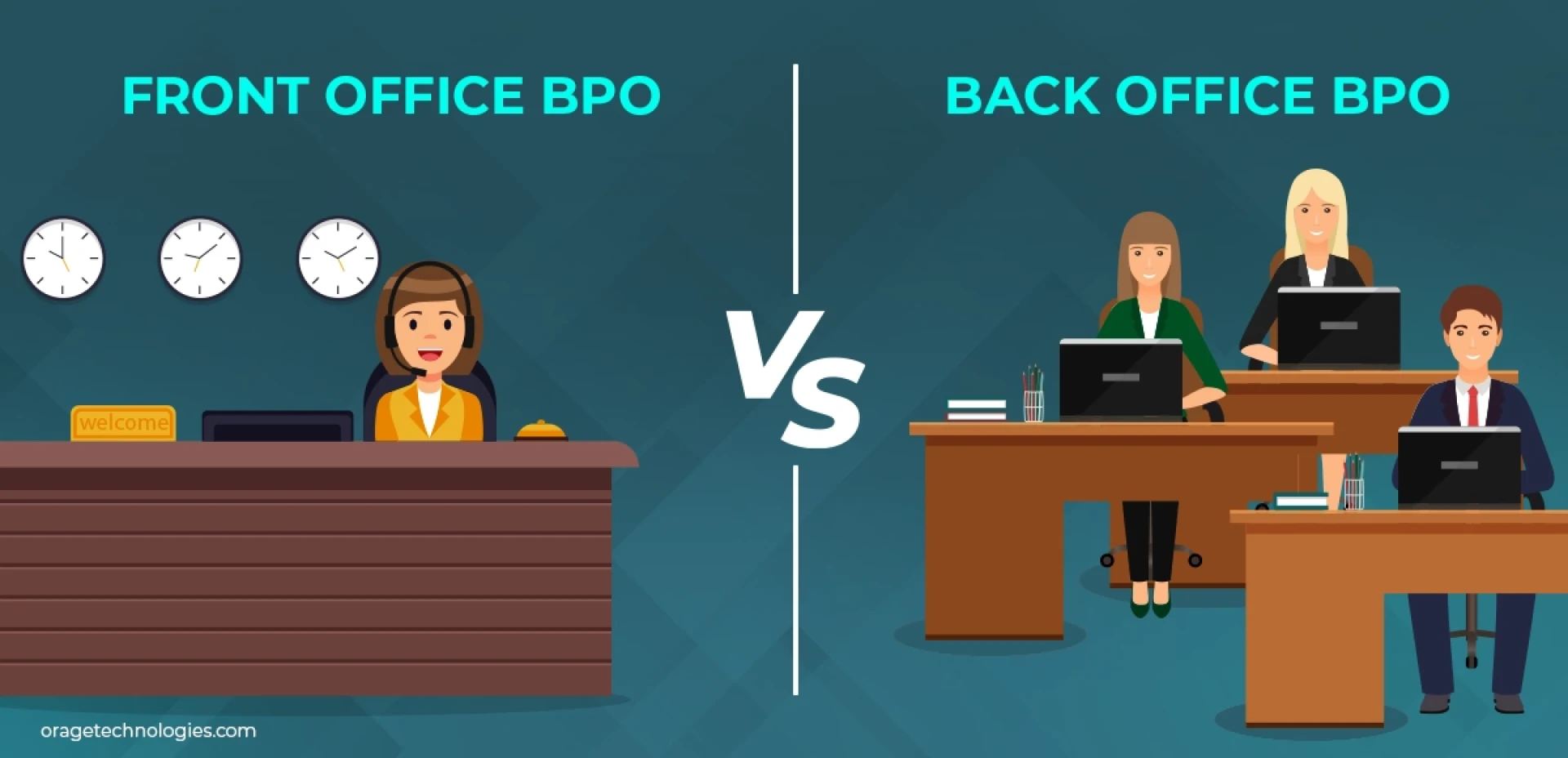
Front Office vs Back Office BPO: A Key Difference lies in their customer proximity, operational focus, and performance goals.
The real key advantage of outsourcing is to know what is worth outsourcing. Businesses need to look at their internal competencies and organizational capabilities, strategic objectives, and internal workloads to decide what functions to do independently. A well-informed decision on the kind of functions to outsource will result in:
- Labour cost savings
- Higher process flexibility
- More time for development and growth
Bottom Line
In the rapidly changing digital economy of today, an equal division of a back and front office BPO strategy can assist in giving the edge necessary to not only compete but to grow and thrive.