Business Process Outsourcing or BPO is currently one of the most important strategy choices for companies to enhance efficiency, decrease cost, and focus on core business. Whether you are an existing or new company, you probably have outsourced some business functions to third-party vendors. That is BPO.
Even as the global BPO industry expanded from $92.5 billion in 2019 to $232.32 billion in 2020, businesses worldwide are poised to outsource on record scales. Especially now, in the age of remote work, side jobs, and the gig economy.
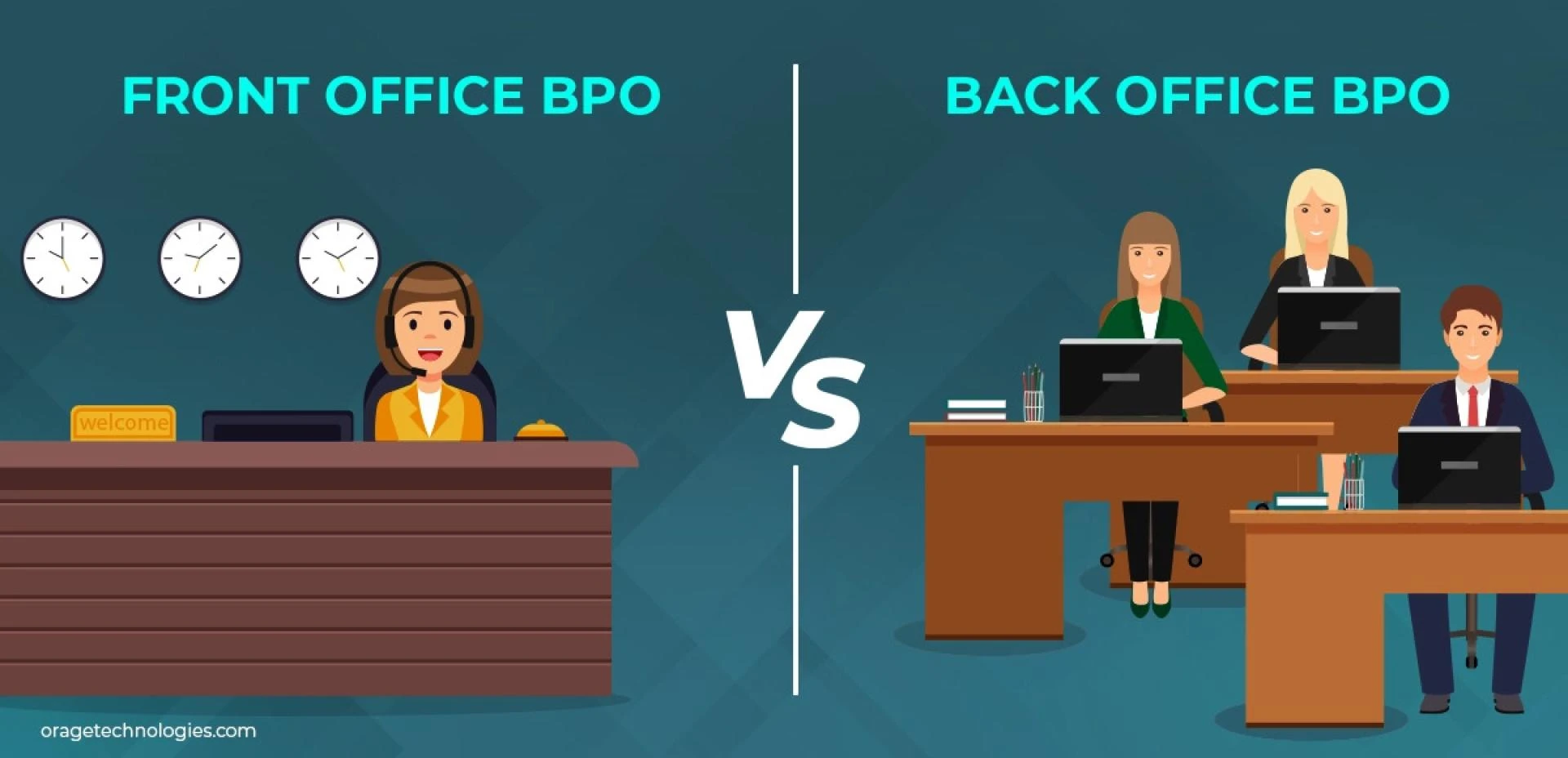
Now, not all that is outsourced is the same. BPO has two broad categories, Front Office BPO and Back Office BPO. Let us know what they are, how they differ, and what the advantages they possess.
What is Front Office BPO?
Front Office BPO involves customer contact operations and activities outsourcing. They are the ones who are directly interacting with customers and showcasing the image of your brand.
50% of the executives already outsource their front office functions, as indicated by Deloitte's 2024 global outsourcing survey.
Examples of Front Office BPO:
Customer Support: Dealing with calls, emails, chat, and complaints received from customers.
Sales and Lead Generation: Prospecting and selling by phone.
Technical Helpdesk: Telephone assistance for product or software-related issues.
Telemarketing: Phone sales of goods and services.
Social Media Management: Customer engagement on social websites and management of online reputation.
Typical Front Office Outsourcing Providers:
Online marketing companies
Support call centers and vendors
IT helpdesks
Sales consultancies
Critical Skills Required:
Human and communication skills
Problem-solving and sales exposure
Emotional intelligence
Language and cultural sensitivities
What is Back Office BPO?
It is actually Back Office BPO that has defined the back office functions that sustain the business but that have no direct interface with the customers. These are the back office functions that provide necessary operations in the sense of running the business processes.
Especially from Clutch in 2023, smaller companies prefer back office outsourcing because it is a less expensive strategy that positions them for building up access to skill sets without hiring full-time employees.
Examples of Back Office BPO
Data Entry and Administration: Collecting, consolidating, maintaining internal information.
Accounting and Bookkeeping: Managing cash, bills and transactions.
Human Resources: Managing, hiring and staffing employees.
IT Support and Maintenance: Making software and hardware run.
Legal and Research Services: Outsourcing paralegal, compliance, and analytics functions outside.
Supply Chain Management: Inventory, purchasing, and transportation co-ordination.
Major Skills Required
Technical skills
Analytical thinking
Attention to detail
Knowledge of compliance standards
Process management skills
Front Office BPO and Back Office BPO: What is the difference?
Having determined the character of Front Office and Back Office BPO, you are now free to employ one or the other—or, indeed, both.
1. Customer Interaction
Front Office BPO: It is in direct contact with the customers. It handles the sales call, support chat, or social media response.
Back Office BPO: Happens in the background—consider accounting, payroll, or technical support.
2. Revenue Generation
Front Office BPO: Directly impacts the bottom line through higher sales and customer satisfaction.
Back Office BPO: Contributing indirectly to revenue through enhanced efficiency and minimizing operating costs.
3. Time Sensitivity
Front Office jobs require immediate feedback, especially customer service.
Back Office work is likely to have greater time pressures, emphasize accuracy and consistency.
4. Performance Measures
Front Office performance is measured by:
Customer satisfaction
Response times
Conversion rates
Back Office performance is all about:
Accuracy and compliance
Reducing cost Effectiveness of process
Why does they Both Matter ?
Both Front Office and Back Office BPO are critical to business expansion—but they are different. Front Office BPO builds your brand, improves customer experience, and boosts sales. Back Office BPO gets your business running efficiently, compliant, and on time. The intelligent strategy is to consider your existing staff, budget, and goals. And then consider what can be outsourced to boost productivity without sacrificing quality.
Final Thoughts
Choosing the Best BPO for Your Business In today's competitive business landscape, BPO is not a cost-reduction process—it's a strategy. If your business requires customer-facing or internal solutions, the right activity can be outsourced to make a difference. Remember that your business doesn't necessarily have to do it all internally. Choose what you do best and let the rest be accomplished by the experts—front and back office BPO providers.