Jess Hertz says that the old career advice "choose one field and become an expert in it” is becoming less useful. Here's what she wants instead, and how the tools you already open every day are quietly making it possible.
Somewhere between the last performance review cycle and the newest AI update, the rules for "what makes a good hire" quietly changed. Nobody sent a memo. But if you listen to the people running today's biggest companies, a new shape of employee is winning, and it's not the one careers advice has pushed for the last decade.
Shopify's chief operating officer, Jess Hertz, put a name to it, and the internet noticed. She isn't looking for "T-shaped" people anymore. She wants "X-shaped" ones. It's a small phrase, but it points to a real shift in how companies plan to hire, promote, and build teams over the next few years.
What is an "X-shaped" employee, really?
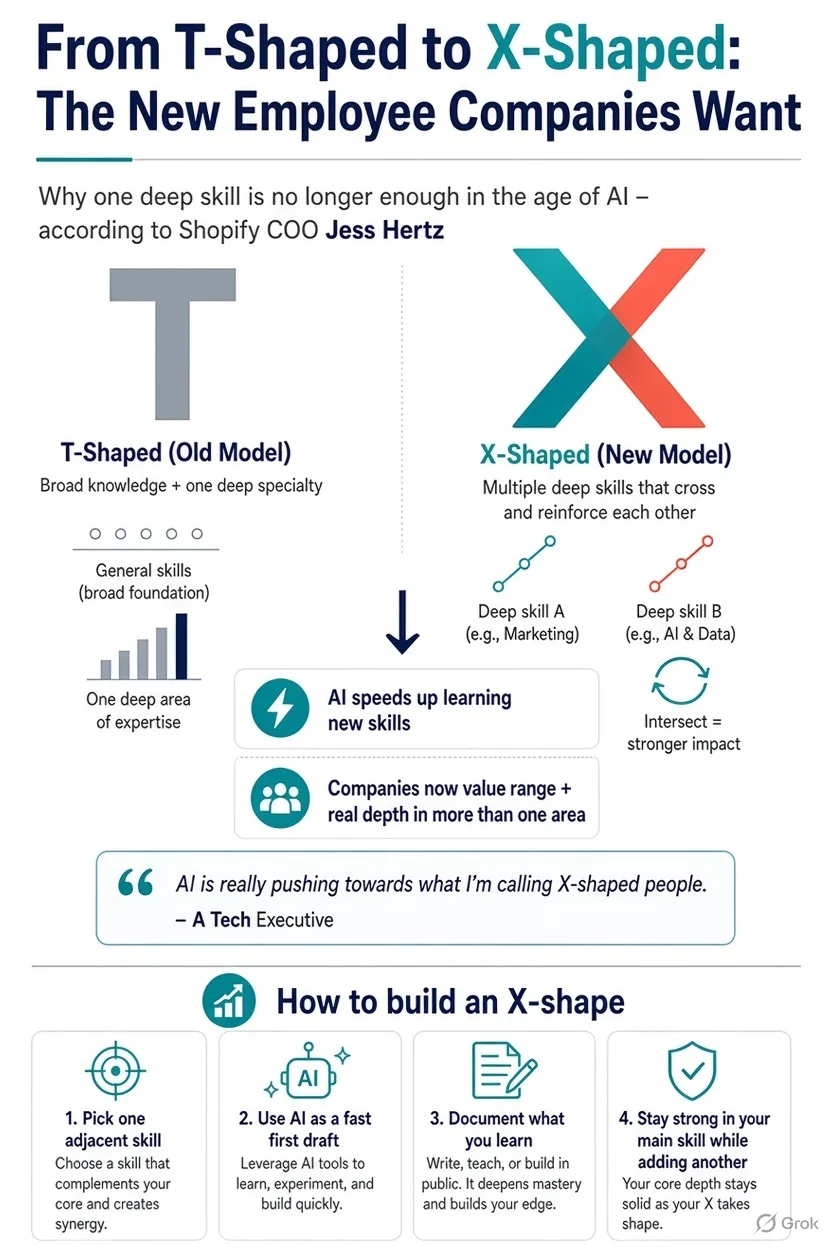
For years, the "T-shaped" employee was the gold standard in hiring. Picture the letter: the wide bar across the top stands for broad, general knowledge across many areas, and the long stem going down is real depth in one specific skill. A T-shaped marketer, for example, understands design, data, and sales well enough to work alongside those teams, but is genuinely excellent at one thing, like copywriting.
Hertz says that model is being pulled apart by AI. Speaking on the podcast Rapid Response, she explained that Shopify used to hire for the T. Now she's after people with several great skills instead of just one, multiple "spikes" rather than a single stem. Think of the letter X: two strong lines crossing, each one a real strength, meeting in the middle.
"AI is really pushing towards what I'm calling X-shaped people."
She described these employees as people who can move fast between fields someone who can pick up a new tool, sit in on a design review and hold their own, or step into a data problem without waiting for a specialist to translate it for them. Not a master of everything, but sharp enough in several places to get real work done on their own. It's worth noting Hertz's own path fits the pattern: she joined Shopify as general counsel in 2021 after serving in the Biden administration, then moved into the COO seat in 2025 a legal mind who ended up running operations for one of the world's biggest e-commerce companies.
Why one great skill isn't enough anymore
The logic behind this shift is simple once you say it out loud. AI tools have made it much faster to go from "beginner" to "capable" in a new skill. A task that once needed a specialist a first draft of code, a rough design mock-up, a quick data summary can now be started by almost anyone with the right prompt and a bit of judgment.
That changes what companies value. If a lot of the surface-level depth work can be assisted by AI, the harder-to-replace skill becomes the ability to learn something new quickly, apply it well, and know when the AI's answer is wrong. Hertz put it plainly: these are people who can absorb complexity fast, and be, in her words, a solid seven-out-of-ten designer even when design isn't their main job.
It's not just one COO talking
This isn't a one-off opinion. Several well-known leaders have been circling the same idea from different directions. Anthropic president Daniela Amodei has said that communication, emotional intelligence, and curiosity matter as much as technical background now, since AI already handles a lot of the pure technical lifting. JPMorgan chief executive Jamie Dimon has given similar advice straight to workers: build critical thinking and communication skills, because those are the things AI still struggles to copy.
59/100
Workers globally will need meaningful reskilling or upskilling by 2030 to keep up with how fast job skills are changing, according to the World Economic Forum's Future of Jobs Report 2025, based on a survey of more than a thousand employers across 55 economies.
That's not a distant, futuristic number; it's this decade. And it's why the move from T-shaped to X-shaped isn't just a talking point from one tech COO. It's turning into an actual hiring filter, showing up in job descriptions that quietly ask for "range" and "versatility" instead of years of experience in a single lane.
How to build an X-shape, without burning out
You don't need to become an expert in five things overnight. A few practical starting points:
- Pick one adjacent skill, not five random ones. If you're in marketing, basic data analysis is a smarter second spike than trying to become a part-time engineer.
- Use AI as a fast first draft, not a shortcut around understanding. Let it get you most of the way there, then learn enough to check and finish the rest yourself.
- Document what you learn somewhere your team can see it. It helps others and locks the skill in for you.
- Ask to sit in on work outside your usual lane, even for an hour a week. Exposure is often the fastest way to build a second spike.
- Don't drop your main strength while you build a new one. X-shaped still means genuinely good in more than one place, not thinly spread everywhere.
Conclusion
If such big companies are increasingly demanding employees with updated knowledge and intermediate-level expertise across multiple areas of work, it is ultimately a big warning for employees and working professionals. It signals the need to change our perspective, adapt to change, and continuously upgrade our skills. Along with technical knowledge, professionals also need to develop critical thinking, problem-solving, communication, adaptability, creativity, and the ability to learn new tools and technologies. The workplace is changing rapidly, and simply being an expert in one area may no longer be enough. To cope with new challenges and opportunities ahead, professionals need to become more flexible, curious, and willing to learn continuously. The ability to adapt and keep learning may become just as important as the skills we already have.
Frequently asked questions
What does "X-shaped employee" mean?
It's a term used by Shopify COO Jess Hertz to describe workers who have strong skills in more than one area, instead of broad general knowledge plus just one deep specialty, which is the older T-shaped model.
How is X-shaped different from T-shaped?
A T-shaped person has wide general knowledge plus one area of real depth. An X-shaped person has multiple areas of real depth, or spikes, that cross each other, letting them work confidently across more than one specialty.
Why is this idea getting attention now?
AI tools have sped up how quickly someone can become competent in a new skill, which has made companies rethink what makes an employee valuable and hard to replace.
Who else has talked about similar hiring shifts?
Anthropic's Daniela Amodei and JPMorgan's Jamie Dimon have both spoken about human skills like communication, emotional intelligence, and adaptability becoming more important as AI takes over routine technical tasks.
How can I become more X-shaped in my own career?
Start with one skill close to your current job, use AI to speed up the learning curve, and document what you pick up so it helps your team, not just yourself.
Is the T-shaped model dead?
Not entirely. Deep expertise still matters. The shift is about adding a second or third genuine strength on top of it, not replacing depth with shallow variety.