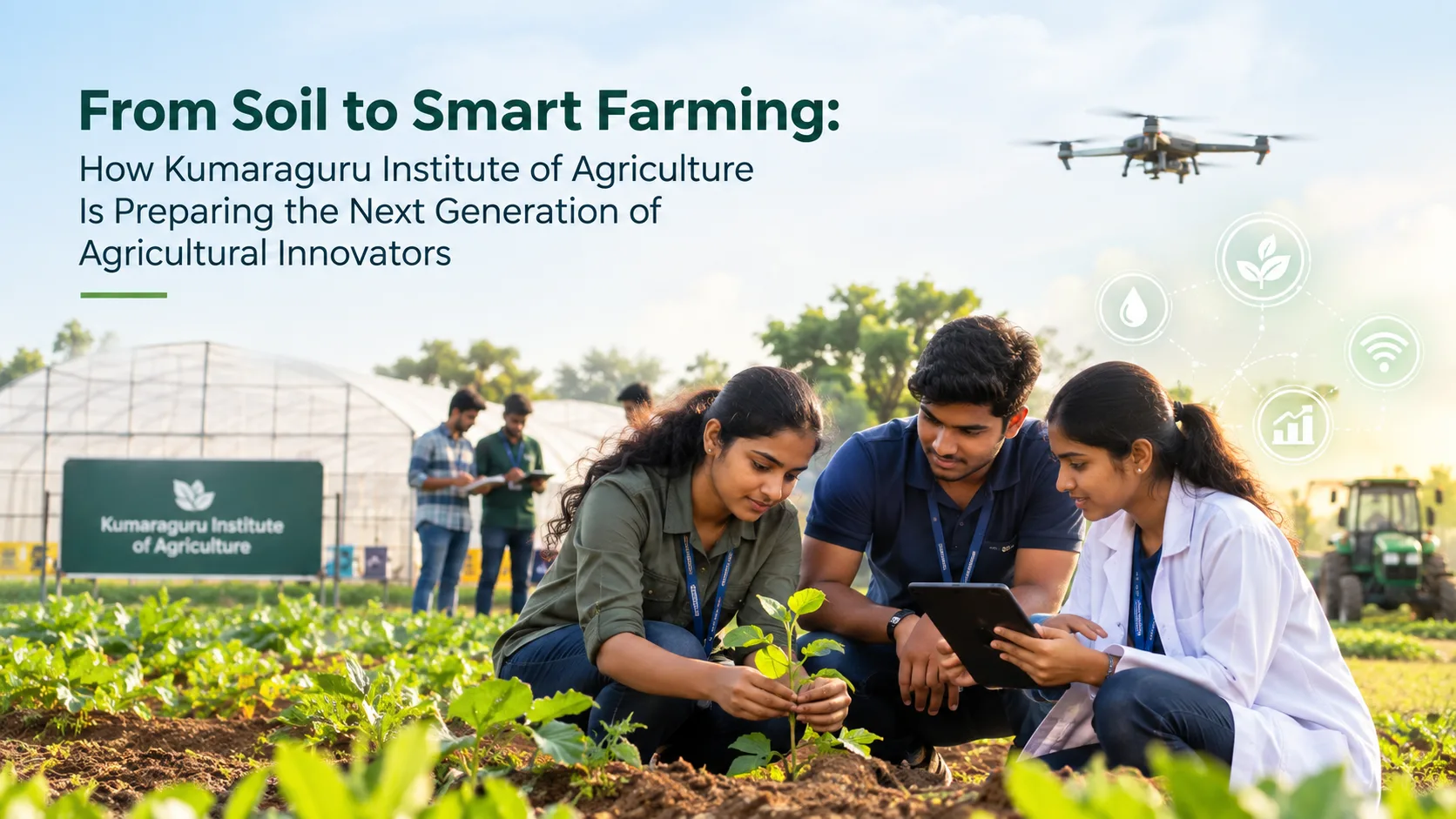
Agriculture is no longer just about farming. With technologies, innovations and science, agricultural education is playing a key role in empowering future leaders in the field.
But what if we told you that the future of agriculture would rely not only on the people working in the farming sector but also on people who are studying agricultural sciences?
Agriculture is undergoing a transformation that is seeing a rise in precision farming, protected cultivation, biotechnology, mechanization and sustainable management of resources.
Agricultural students must learn about these areas and understand how they are applied to farming to be able to solve future agricultural problems.
Kumaraguru Institute of Agriculture (KIA) in Appakudal, Erode, Tamil Nadu, offers agricultural education that bridges the gap between agricultural science and farm-based practices, as well as modern technology.
Let us delve into how agricultural education can empower future agricultural leaders
1. Why Agriculture Education Empowers Future Agricultural Leaders
Agriculture empowers nations and feeds millions, but farmers and businesses face several challenges, including water, soil quality, climate, production costs, and market economics.
Agriculture education provides the know-how on how to deal with these issues.
Modern agricultural education entails a combination of the following:
- Crop production and husbandry
- Soil and plant science
- Agricultural engineering
- Horticulture and biotechnology
- Agricultural economics and farm management
- Sustainable agriculture
Agricultural education arms students with the knowledge of the intricacies of every aspect of farming.
KIA offers courses on agricultural science, precision farming, agricultural engineering, and entrepreneurship.
2. From Classrooms to Farming Fields: Students Learn Hands-On Farm Activities
Can agricultural students learn to be great agricultural leaders from the confines of a classroom?
While students can learn the science of agriculture in a lecture hall, they need to know how to apply the science in the farming fields.
KIA has South Farm and North Farm as its teaching farms, where students are taught various agricultural practices and are exposed to farm machinery.
Practical sessions offer students the opportunity to get involved with:
- Crop production
- Irrigation practices
- Horticultural practices
- Mechanization
- Soil conservation
- Integrated farming
This ensures students get first-hand knowledge of the application of agricultural science in farming.
Why Practical Training Is Important
A student who learns about irrigation in a lecture hall can better understand the topic by seeing irrigation in practice in the farm.
Similarly, students can learn crop production, physiology, and farm economics by applying the concepts in the farms.
Practical training offers students experience, which sharpens their skills and knowledge on the subject.
3. Technology Is Transforming Agriculture: Students Learn About Its Role in Farming
Technology is playing an increasingly important role in agriculture.
From precision farming to mechanization, technology is being utilized to make farming more productive and profitable.
KIA offers courses on Geo-informatics for Precision Farming, Farm Machinery and Power, Agro Informatics, Renewable Energy and Green Technology and other related topics.
These modules expose students to the application of various technologies in agriculture.
- Precision Farming
- Precision farming is a data-driven approach to agriculture.
- Depending on the farm needs, precision farming can be used to:
- Create field boundaries
- Monitor and manage the soil
- Irrigate strategically
- Monitor crop growth
- Optimize the use of farm inputs
Students who understand precision farming are better positioned to understand the science behind agriculture and be able to utilize the technology effectively.
- Farm Mechanization
- Farm machinery plays a huge role in mechanized farming.
- Students can gain exposure to farm machinery and acquire skills to operate and utilize the machinery to maximize mechanized farming.
- Farm mechanization is covered in detail in KIA’s agricultural engineering course.
4. Can Farming Be Sustainable? Students Learn About Sustainable Agriculture
How can farms be productive and still conserve resources?
Sustainable agriculture aims to make farming productive while also conserving resources for future generations.
Farmers need to take cognizance of key issues affecting agriculture, such as:
- Soil fertility and water conservation
- Crop production and costs
KIA offers Farming System & Sustainable Agriculture, Organic Farming, Soil and Water Conservation Engineering, and Environmental Studies.
Key Areas of Sustainable Agriculture
- Soil fertility and conservation: Ensuring food security while conserving and maintaining soil quality.
- Water conservation: Managing water resources to ensure they are utilized effectively.
- Organic agriculture: Understanding organic farming methods and production.
- Integrated farming: Integrating various aspects of farming to ensure optimal utilization of resources.
KIA’s South Farm has an integrated farming system that comprises fish, duckery, dairy, poultry and goat farming, according to the institute’s website.
This exposes students to integrated farming, where various agricultural systems are combined to maximize production.
5. Horticulture and Protected Cultivation: Expose Students to Other Aspects of Farming
Agriculture goes beyond food crops. Students can learn about horticulture, nursery, and protected cultivation.
North Farm at KIA has crops, polyhouses, shade nets and other structures that students can utilize to gain first-hand knowledge of horticulture and protected cultivation.
By engaging in horticultural activities, students can acquire knowledge about:
- Nursery
- Protected cultivation
- Crop production
- Irrigation
- Crop management
Harvesting and post-harvest
Protected cultivation entails growing food and other crops in a confined structure or a greenhouse. Structures such as polyhouses and shade nets can aid in cultivation.
Learning about protected cultivation exposes students to other aspects of farming beyond traditional open-field farming.
6. Biotechnology: Students Get Exposed to Science in Agriculture
Apart from traditional farming, biotechnology and microbiology are very important in agriculture.
Crop production and research have benefited immensely from biotechnology.
At KIA, students are exposed to plant biotechnology, crop improvement, agricultural microbiology, and other related areas as part of their curriculum.
Through these modules, students can learn the science behind plant production and gain insight into biotechnology and its applications in agriculture.
7. Agriculture and Entrepreneurship: Students Learn How to Turn Their Ideas Into Reality
Agriculture is a dynamic sector with several business opportunities.
Students who understand marketing and entrepreneurship have a better chance of succeeding in farming or agribusiness.
KIA offers Agricultural Marketing, Entrepreneurship Development and Business Management, and Agricultural Finance and Cooperation.
The institute’s curriculum opens students to the business aspect of agriculture, which is very important in venturing into agribusiness.
- Potential Business Opportunities in Agriculture
- Food processing: Turning food crops into other products.
- Nursery: Growing planting materials for commercial sales.
- Agricultural services: Offering services such as farm management.
- Value addition: Creating value from agricultural products.
Farm management: Managing a farm effectively while also considering the costs incurred.
Entrepreneurship equips students with business skills and knowledge, which are vital in starting and managing their ventures.
8. Practical Experiences Offer Students Confidence and Problem-Solving Skills
Agriculture is a sector where individuals need to be constantly on their toes.
Farming conditions are not static; they change, and farmers need to adapt their strategies to counter new challenges.
Students need to learn about the science of agriculture and be able to apply the knowledge to solve practical problems.
KIA’s Crop Management Department offers insights into field work, crop production, and activities in agronomy, soil and water conservation, plant pathology, microbiology, and agricultural engineering, among others.
- Skills Acquired Through Practical Training
- Scientific observation and analysis
- Problem-solving
- Agricultural production and management
- Communication
- Teamwork
- Technical expertise
These skills are important for students’ overall development and come in handy as they interact with the agricultural sector.
9. Agriculture Education Opens Doors to a Multitude of Opportunities
Agriculture is a sector that will always be in demand, and individuals with the right skill set can carve a niche for themselves.
KIA aims to empower students to be able to pursue various career opportunities while also making them responsible global agricultural leaders.
According to the institute’s website, KIA’s vision is to empower the farming community through the use of cutting-edge technologies. Its mission is to provide quality education, research, and innovative services to rural farmers.
This shows how the institute aims to bridge the gap between agricultural education and the community while also offering students a platform to contribute to the community.
10. The Future of Farming Depends on Practical Knowledge of Agriculture
The future of agriculture rests on the hands of people who have a sound knowledge of agriculture.
Precision farming will be utilized to increase farm productivity.
Sustainable agriculture will be practiced more to ensure that resources are conserved for future generations.
Biotechnology will also play a role in advancing agricultural research.
Agribusiness will also offer various opportunities for value addition and services.
All these will only be possible with people who have the knowledge of the science of agriculture.
KIA promotes agricultural education and ensures students are exposed to farm-based experiences and modern agricultural technologies.
Conclusion: Growing Knowledge for a Sustainable Agricultural Future
Agriculture is a very important sector that will determine the future of humanity.
The field continues to develop, and future agricultural leaders need to have the relevant knowledge and skills to meet the demands of the sector.
Students who study agricultural sciences can gain insight into various aspects of crop production, horticultural practices, mechanization, biotechnology, and agribusiness.
KIA offers agricultural education, which exposes students to the practical side of agriculture, as well as scientific principles and sustainable farming practices.
As agriculture advances, it will be very important to ensure that students are equipped with sound scientific knowledge and practical skills.
This will enable them to be at the forefront of agricultural research, farming and agribusiness, promoting a sustainable agricultural future.
The future of agriculture depends on sound knowledge and practical application of agricultural principles.
To get more information about Kumaraguru Institute of Agriculture and the courses it offers, check out the following link: