For years, SEO agencies were judged primarily by one question: Can you improve our Google rankings?
That question still matters in 2026, but it is no longer enough.
Customers now discover businesses through a much broader mix of search results, Google Maps, reviews, AI-generated answers, social proof, third-party publications, and brand mentions. A prospective customer may ask ChatGPT for recommendations, verify those companies in Google, read reviews, visit several websites, and then make a decision without following anything close to the traditional search funnel.
As customer behavior changes, SEO agencies are changing with it.
The strongest agencies are no longer optimizing websites solely to rank. They are helping businesses become easier to discover, understand, trust, recommend, and ultimately choose across an increasingly fragmented search environment.
Search Rankings Are Becoming One Piece of a Larger Visibility Strategy
Traditional rankings remain an important part of SEO because strong organic positions can place a business directly in front of customers actively searching for a solution.
But a ranking is now one potential visibility point among many.
A customer researching a service provider might encounter:
- Traditional Google organic results
- Google Maps listings
- AI-generated answers
- Customer reviews
- Featured snippets
- Videos
- Industry articles
- Social profiles
- Business directories
This means an agency can no longer assume that getting a website onto page one completes the job.
The larger objective is to build enough authority and relevance that the business remains visible throughout the research and decision-making process.
AI Is Turning Search Into a Recommendation Environment
One of the biggest changes is the growing role of AI-powered discovery.
People no longer have to search using short keyword phrases. They can describe exactly what they need.
Instead of:
"roofing contractor near me"
a customer might ask:
"Which roofing companies near me specialize in storm damage and have strong customer reviews?"
Instead of:
"SEO company"
a business owner might ask:
"Which SEO agencies focus on generating measurable ROI rather than just increasing rankings?"
That difference matters.
Traditional search optimization frequently centers on matching a webpage with a search query. AI-powered discovery introduces another challenge: providing enough reliable context for a platform to determine which businesses may be appropriate to mention or recommend.
SEO agencies therefore have to think beyond individual keyword rankings.
Agencies Are Optimizing Businesses as Entities
One important development is the increased focus on entity clarity.
An entity is essentially a person, company, product, place, or concept that search systems can recognize and distinguish from others.
For businesses, entity signals can include:
- Company name
- Website
- Location
- Leadership
- Services
- Google Business Profile
- Reviews
- Industry memberships
- Published articles
- News mentions
- Social profiles
- Third-party citations
When these signals are consistent, search engines and AI systems have an easier time understanding who the company is and what it does.
That is why modern SEO increasingly extends beyond editing webpages.
Agencies are helping clients build stronger and more consistent digital identities across the web.
Content Is Being Written for Questions, Not Just Keywords
Keyword research is not disappearing. It remains extremely useful for understanding demand and search behavior.
What is changing is how agencies apply that research.
Modern content strategies increasingly focus on the questions customers ask during the buying process.
For example, a remodeling company may need content answering:
- How much does a kitchen remodel typically cost?
- How long does a remodel take?
- What should homeowners ask a contractor before hiring?
- Which improvements provide the greatest long-term value?
- What should homeowners expect during construction?
This approach can support traditional SEO while also creating useful source material for conversational and AI-powered search experiences.
The best content does not simply repeat a keyword enough times to satisfy an optimization checklist.
It resolves uncertainty.
Technical SEO Is More Important, Not Less
AI has created a predictable wave of claims that traditional technical SEO is becoming irrelevant.
It isn't.
Search systems still need to access, interpret, and organize website information.
Agencies continue to focus on fundamentals such as:
- Crawlability
- Page speed
- Mobile performance
- Internal linking
- Canonicalization
- Structured data
- HTTPS
- Site architecture
These technical elements create the infrastructure that supports both traditional search visibility and machine understanding.
AI may be more sophisticated, but sophisticated systems still perform better when businesses provide clear, accessible information.
Local SEO Is Expanding Into AI-Powered Discovery
Local businesses may experience some of the most significant changes.
Historically, local SEO concentrated heavily on:
- Google Business Profile
- Maps rankings
- Local citations
- Reviews
- Location pages
- Geographic keywords
Those factors remain important.
But AI-powered platforms can now help users compare local businesses based on more detailed criteria, including reputation, expertise, service specialization, and customer sentiment.
That means agencies need to think about the complete local digital footprint.
A Colorado Springs SEO agency, for example, may optimize a business not only for searches like "plumber Colorado Springs" but also for more conversational discovery questions involving specific services, neighborhoods, availability, reputation, or customer needs.
Local SEO and AI visibility are increasingly becoming parts of the same strategy.
Reviews Are Becoming Search Data
Reviews have always influenced buying decisions.
They now serve another function: they provide search and AI systems with large amounts of natural-language information about a business.
A detailed customer review may mention:
- The service performed
- The location
- Employee professionalism
- Responsiveness
- Pricing experience
- Problems resolved
- Overall satisfaction
Collectively, those reviews can provide context that a standard business description cannot.
That makes authentic review generation an increasingly important component of modern optimization.
Agencies are therefore treating reputation management less like an optional branding exercise and more like an integral part of search visibility.
Digital PR and Third-Party Mentions Matter More
A business describing itself as an expert is useful.
Independent sources describing it as an expert can be more persuasive.
This is why forward-thinking agencies are increasingly combining SEO with:
- Guest posting
- Digital PR
- Industry publications
- Local media
- Professional associations
- Podcasts
- Business directories
- Community partnerships
These placements can generate backlinks, but their value is broader than the link itself.
They create corroborating signals.
When multiple independent sources consistently associate a business with a particular service or area of expertise, the company's digital identity becomes stronger.
In an AI-driven discovery environment, that broader authority can be especially valuable.
Conversion Optimization Is Becoming Part of SEO
Getting discovered is only useful if the business eventually earns the customer.
That sounds obvious, yet SEO campaigns have historically spent tremendous effort increasing traffic while giving relatively little attention to what visitors experience after they arrive.
Modern agencies are changing that.
SEO increasingly overlaps with Conversion Rate Optimization, or CRO.
Agencies may evaluate:
- Calls to action
- Contact forms
- Mobile usability
- Trust signals
- Testimonials
- Navigation
- Service explanations
- Page speed
- Scheduling options
This makes sense economically.
If a website generates 100 qualified visitors and converts two of them, increasing traffic is one growth strategy.
Improving the conversion rate is another.
The best strategy often addresses both.
Analytics Are Moving Beyond Rankings and Traffic
SEO reporting is also evolving.
Rankings, traffic, impressions, and clicks still help agencies diagnose performance. But businesses ultimately need to know whether marketing is contributing to measurable results.
Forward-thinking agencies increasingly connect SEO performance to:
- Qualified leads
- Phone calls
- Form submissions
- Appointment requests
- Conversion rates
- Sales opportunities
- Revenue
- Customer acquisition costs
AI visibility introduces additional measurements, including brand mentions, citations, referral traffic, and recommendation patterns.
No single metric tells the entire story.
The goal is to understand how visibility contributes to business outcomes.
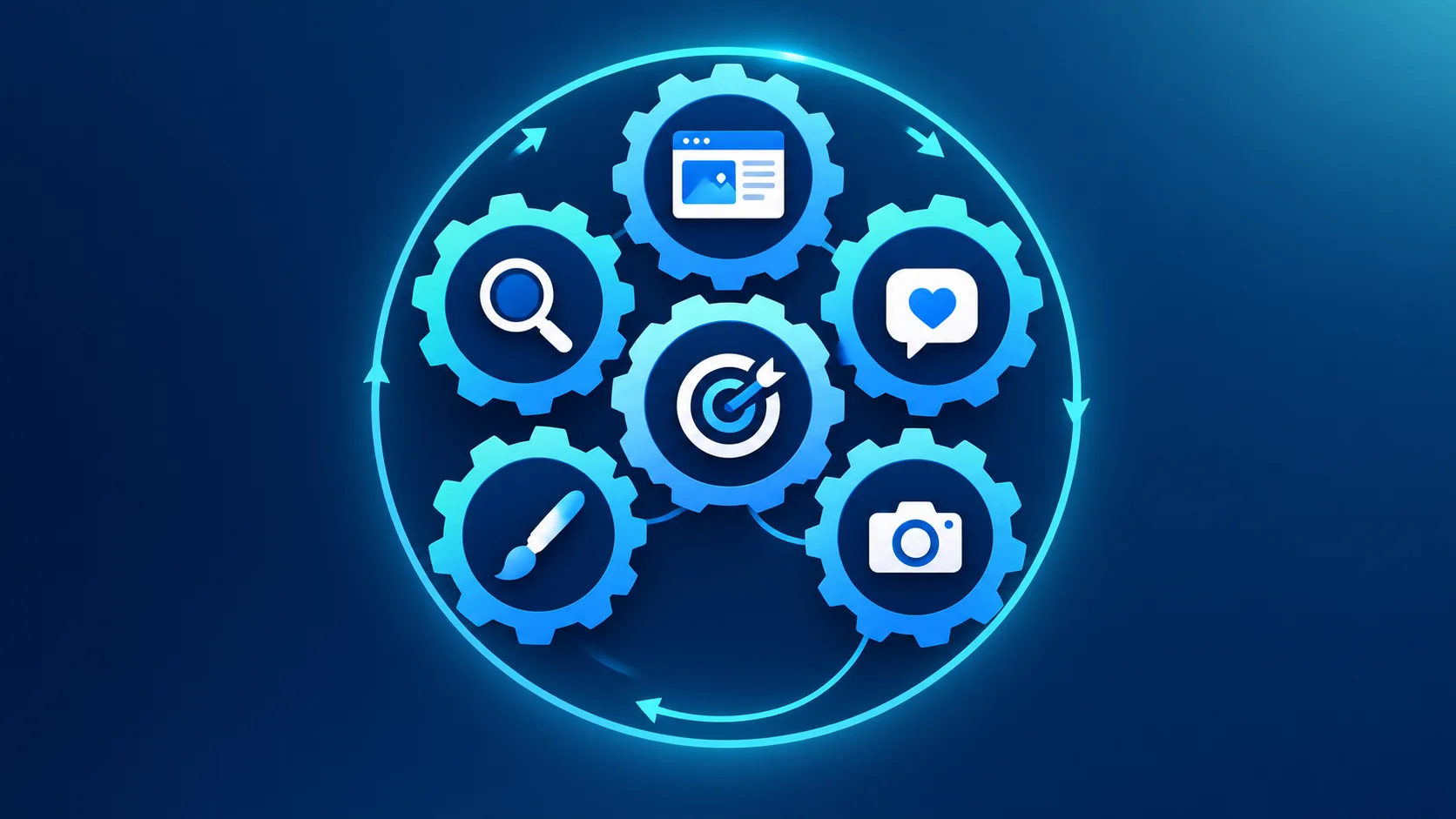
Agencies Are Moving Toward Integrated Optimization
Perhaps the biggest change is organizational.
SEO used to exist relatively independently from web design, content strategy, reputation management, analytics, and conversion optimization.
That separation is becoming increasingly difficult to maintain.
Consider how one improvement can affect several areas simultaneously.
A stronger service page may:
- Rank for additional searches
- Answer customer questions
- provide clearer information for AI systems
- earn backlinks
- improve user engagement
- increase conversions
A stronger review strategy may:
- Improve customer trust
- support local visibility
- provide additional business context
- increase click-through rates
A technical improvement may:
- improve crawlability
- increase page speed
- improve mobile usability
- reduce conversion friction
Modern SEO agencies are learning to look for these overlapping opportunities rather than treating every discipline as a separate project.
The Agency of the Future Will Be a Visibility Strategist
The term "SEO agency" may remain, but the work behind it is becoming much broader.
Agencies adapting successfully to the new discovery journey increasingly need expertise in:
- Traditional SEO
- Local search
- Technical optimization
- AI visibility
- Content strategy
- Entity development
- Reputation
- Digital PR
- Conversion optimization
- Analytics
This does not mean every agency needs to become a massive full-service marketing firm.
It means SEO strategy has to account for how these disciplines influence one another.
A technically excellent website with weak content has a problem.
Excellent content with little authority has a problem.
Strong rankings with poor conversion rates have a problem.
And AI visibility without a credible website behind it does not accomplish much either.
Businesses Should Evaluate Agencies Differently
As SEO changes, businesses should also reconsider how they evaluate potential partners.
Instead of asking only:
"Can you rank us #1?"
better questions include:
- How do you prioritize SEO opportunities?
- How do you connect SEO to leads and revenue?
- How do you approach AI-powered search?
- How do you build business authority beyond the website?
- How do you measure conversion performance?
- How do local SEO and AI visibility work together?
- How do you determine what to optimize first?
These questions reveal far more about an agency's strategy than a ranking guarantee ever could.
And ranking guarantees were never particularly useful in the first place.
The New Discovery Journey Requires a Broader SEO Strategy
SEO is not disappearing.
It is expanding.
Google rankings remain valuable, but customer discovery now occurs across traditional search, Maps, AI platforms, reviews, third-party content, and multiple digital touchpoints.
Forward-thinking agencies are responding by optimizing the entire discovery journey.
They are building technically stronger websites, creating better content, reinforcing business entities, developing local authority, earning third-party credibility, improving conversions, and measuring results closer to revenue.
The objective is no longer simply getting a business onto page one.
It is helping that business become visible wherever customers are researching, credible when they are comparing options, and convincing when they are finally ready to choose.
That is the direction SEO agencies are heading in 2026, and it represents a much more useful definition of optimization than rankings alone ever did.