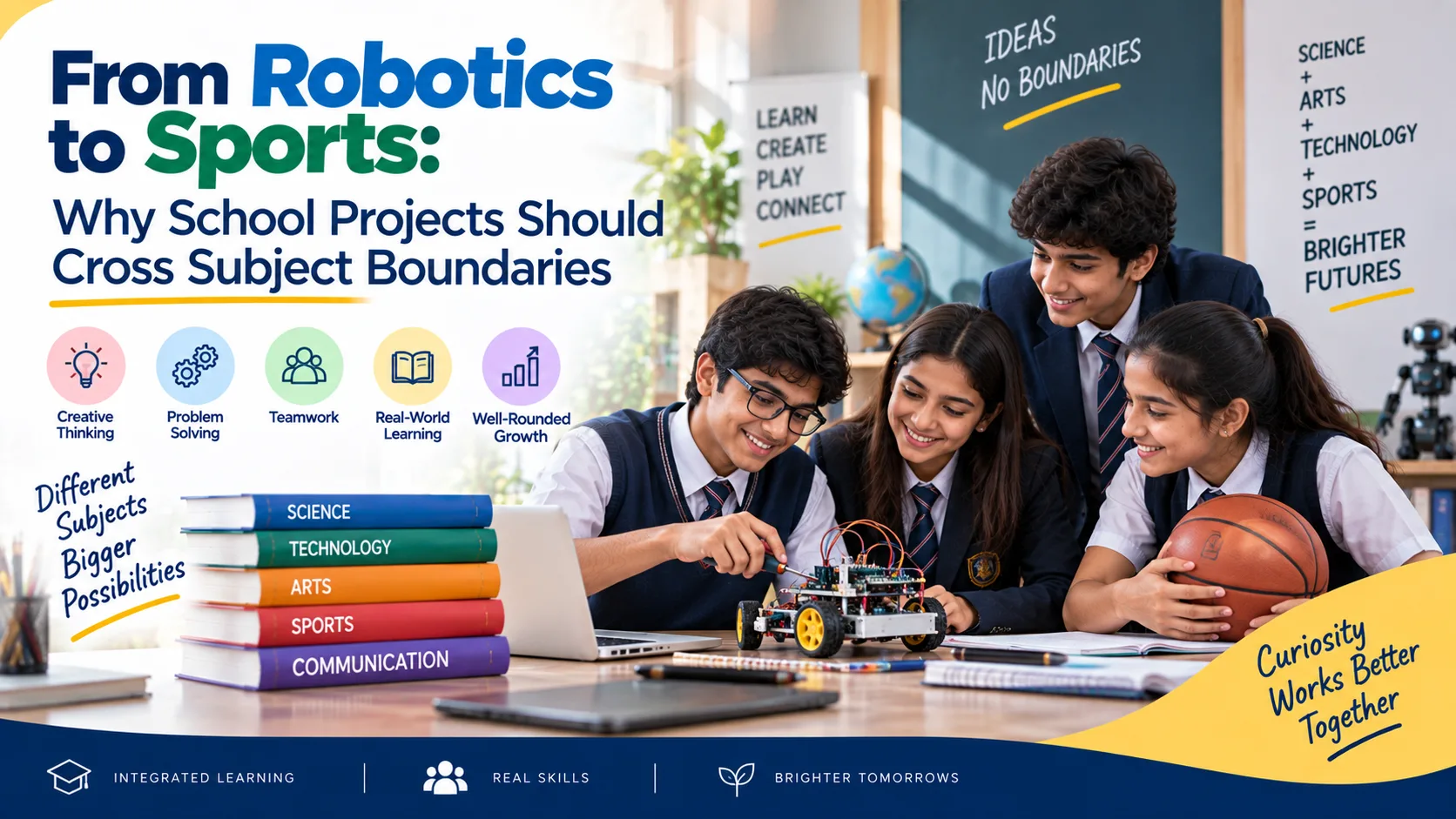
A robotics project may look like a technology activity. A sports programme may appear to belong entirely to physical education. An art exhibition may seem unrelated to science, while a debate competition may appear to have little connection with mathematics.
But real-world problems rarely fit into one subject.
A student designing a small robotic vehicle might need mathematics to calculate measurements, science to understand movement, technology to build the system, communication skills to explain the design, and teamwork to complete the project.
That is why some of the most meaningful school experiences happen when subjects stop operating in isolation.
For parents exploring Robotics, Sports & Beyond Academics in Faridabad, the important question is not simply how many activities a school offers. It is whether students have opportunities to connect what they learn across different areas.
Why Real Problems Are Interdisciplinary
Imagine asking students to design a simple system that could help a school reduce water wastage.
There is no single subject that provides the complete answer.
Students might need to:
- Understand how water is used.
- Collect and interpret information.
- Calculate quantities.
- Design a possible solution.
- Build or model the idea.
- Work together.
- Explain their reasoning.
- Test whether the solution works.
A project like this can bring several areas of learning together naturally.
The benefit is not simply that students "cover" multiple subjects. They begin to understand that knowledge is connected.
Robotics Can Turn Abstract Ideas Into Something Students Can Test
Robotics is particularly interesting because it can combine theoretical knowledge with physical experimentation.
A student may understand a mathematical concept on paper. Building something can require that same student to use the concept differently.
For example, a robotics project may involve:
Planning → Measuring → Building → Programming → Testing → Troubleshooting → Improving
The first design may not work.
A sensor may respond incorrectly. A mechanism may be unstable. The code may contain an error.
Instead of treating these moments as failures, a project can use them as opportunities to investigate what happened.
That process introduces students to a useful idea: improvement often comes through testing and revision.
Sports Offer a Different Kind of Problem-Solving
Cross-disciplinary learning does not have to involve computers or laboratories.
Sports can also require students to observe, analyse, communicate and make decisions.
During a game, a player may need to assess the position of teammates, anticipate movement and make a decision within seconds.
Team sports additionally require communication and coordination.
Students can learn about concepts such as:
- Speed
- Distance
- Timing
- Angles
- Balance
- Force
- Movement
- Strategy
This creates an interesting connection between physical activity and academic concepts.
Sports are therefore not merely a break from classroom learning. When thoughtfully integrated, they can provide another environment in which students apply knowledge.
What Extracurricular Activities Add to Academic Learning
Academic lessons often provide the foundation for understanding concepts.
Extracurricular activities can give students different situations in which to use those concepts.
A student studying communication might practise it through a presentation.
A student interested in science might explore an experiment beyond the standard classroom exercise.
A student interested in design might turn an idea into a physical model.
A student participating in sport might learn how communication affects team performance.
This is one reason parents considering a Best CBSE School with Extracurricular Activities should look beyond the number of clubs and competitions available.
The more useful question is:
What kind of learning happens when students participate?
Projects Can Make Students Comfortable With Uncertainty
Traditional academic questions often have a defined answer.
Projects can be different.
A teacher may give students a problem without telling them exactly how to solve it.
There may be several possible approaches.
Some may work better than others.
Students may need to change direction after discovering that their first idea does not work.
This uncertainty can be educational.
It encourages students to ask questions, compare possibilities, gather information and make decisions rather than simply search for the one correct response.
Collaboration Is a Skill, Not Just a Group Activity
Putting students into groups does not automatically create teamwork.
Effective collaboration requires students to learn how to:
- Divide responsibilities.
- Listen to different ideas.
- Explain their own thinking.
- Resolve disagreements.
- Meet deadlines.
- Help other members.
- Take responsibility for shared outcomes.
A cross-disciplinary project can create natural opportunities to practise these behaviours.
For example, one student may be comfortable with technical work while another may be better at presentation or research.
A successful project can help students understand that different strengths can contribute to the same outcome.
International Learning Does Not Have to Mean Learning Abroad
The idea of an International School in Delhi NCR is often associated with global exposure, international perspectives and broader learning experiences.
But global thinking can also begin with how students approach problems.
Students can compare how different communities address environmental challenges, investigate technologies used in different countries, study international sporting events, or explore how cultural differences influence design and communication.
The goal is not simply to add international references to a lesson.
It is to encourage students to understand that problems can have different perspectives and that solutions developed in one context may not work exactly the same way somewhere else.
A School Project Could Start With a Question
One useful way to design cross-disciplinary learning is to begin with a real question instead of a subject label.
For example:
How can we make our school campus more environmentally friendly?
From that one question, students could explore:
Science
What environmental processes are involved?
Mathematics
How can usage or savings be measured?
Technology
Could a digital or automated solution help?
Design
How should the proposed solution work?
Language
How can the idea be explained clearly?
Art
How could the message be communicated visually?
Social Studies
How do communities address similar problems?
A single question can therefore create a learning experience that crosses traditional classroom boundaries.
Teachers Still Matter in Project-Based Learning
Interdisciplinary learning does not mean teachers simply give students a project and step away.
Guidance remains important.
Teachers can help students define the problem, identify reliable information, question assumptions, organise their work and reflect on results.
The teacher's role may shift from delivering every answer to helping students develop better questions and stronger ways of finding answers.
That can require careful planning.
A poorly designed project can become a collection of disconnected tasks.
A well-designed project has a clear purpose and gives students meaningful opportunities to apply knowledge.
How Parents Can Evaluate a School's Projects
Parents visiting schools can ask practical questions instead of relying only on activity lists.
For example:
- Do students work on projects across different subjects?
- Are projects connected to real-world problems?
- Do students have opportunities to make decisions?
- Can students test and improve their ideas?
- Are sports and creative activities treated as meaningful learning experiences?
- Do students explain or present what they have created?
- Are mistakes discussed as part of the learning process?
- How much responsibility do students have during projects?
These questions can provide a clearer picture of how experiential learning works within a school.
The Goal Is Integration, Not More Activities
There is a temptation to assume that a school becomes more future-ready every time another activity is added.
But more activities do not necessarily mean deeper learning.
A smaller number of well-designed experiences may give students more meaningful opportunities to practise skills.
The objective should not be to fill every afternoon with another class, club or competition.
Instead, students need experiences that help them connect ideas, solve problems, communicate clearly, work with others and learn from experimentation.
What Students May Carry Beyond School
The most valuable outcome of a project may not be the final model, presentation, trophy or certificate.
It may be the process students experienced while creating it.
They may learn how to approach an unfamiliar problem.
They may become more comfortable asking questions.
They may discover that their first solution can be improved.
They may learn that another person's perspective can strengthen their own idea.
They may also discover an interest they had never considered before.
These are transferable experiences.
Final Thoughts
Education becomes more meaningful when students can see connections between what they learn and how knowledge is used.
Robotics can involve mathematics, science, design and communication. Sports can involve strategy, teamwork, measurement and decision-making. Creative activities can develop communication and imagination.
This is the value of looking at Robotics, Sports & Beyond Academics in Faridabad as part of a broader educational experience rather than treating each activity as a separate item on a school brochure.
The question for parents is not simply:
"How many activities does the school offer?"
A more useful question may be:
"What can my child learn by participating in them?"
When projects connect subjects, students can begin to see education not as a collection of separate classes, but as a set of tools for understanding and solving problems in the real world.