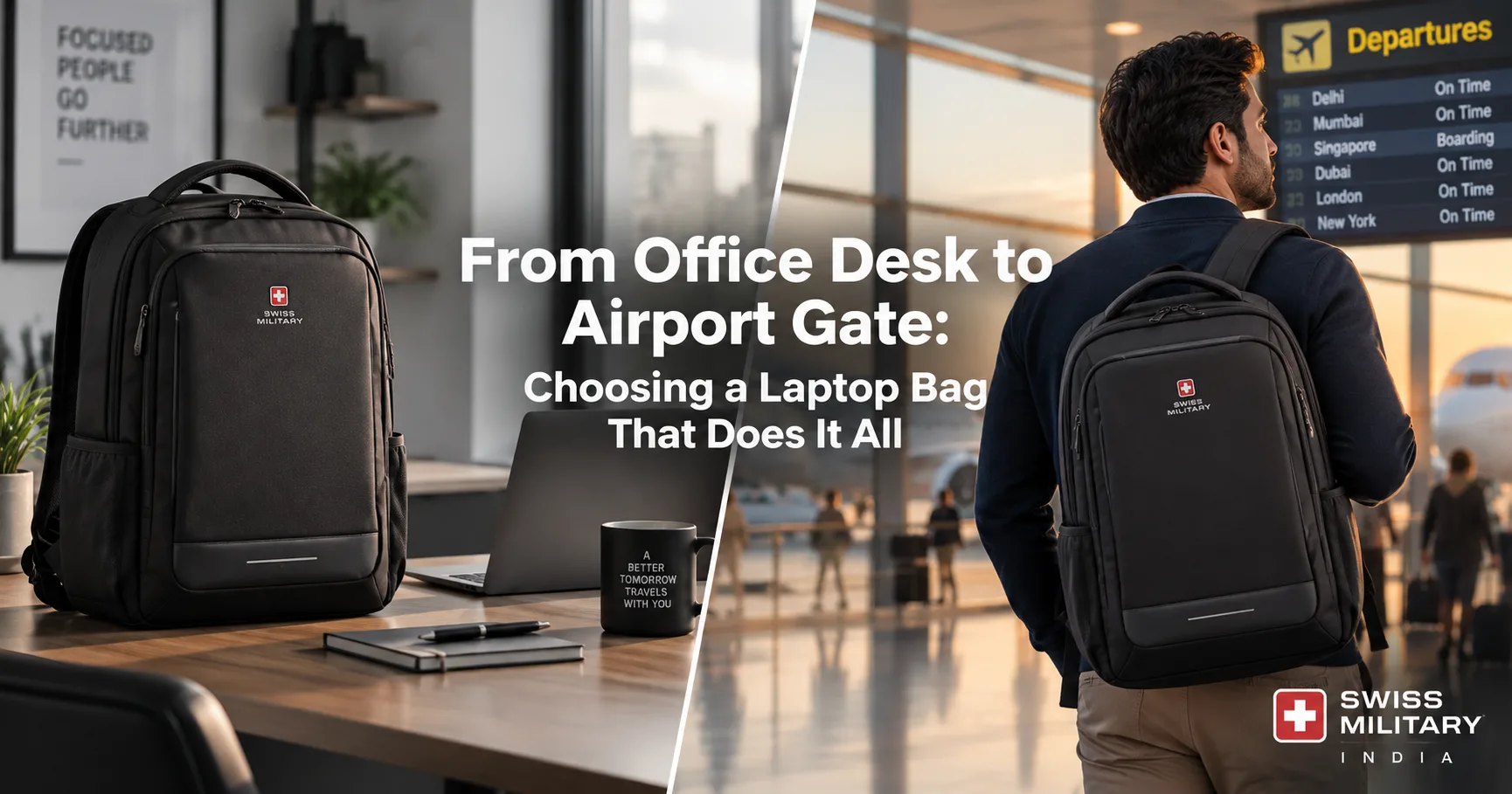
Most people buy a bag for one job. A backpack for the office, a duffel for trips, a sling for weekends. Then life gets busier, and the office bag ends up at the airport anyway, stuffed with a charger, a change of clothes and a boarding pass.
If that sounds familiar, you probably need one bag that handles both. Here’s how to pick it.
How to choose a laptop backpack
Start with your laptop, not the bag. Check the screen size (14, 15.6 or 16 inches) and add a little room for a sleeve or a thick case. A bag that’s too tight strains the zips. One that’s too loose lets the laptop slide around.
Then look at four things:
- Padding. A padded laptop compartment that sits slightly off the base of the bag protects against the drops that happen when you put it down hard.
- Straps. Wide, cushioned shoulder straps matter more than they look on a product page. Thin straps dig in within twenty minutes.
- Fabric. Polyester and nylon with a water-resistant coating handle Indian conditions well, especially sudden monsoon showers.
- Organisation. A few well-placed pockets beat ten tiny ones you never use.
Capacity is the last check. For most office-goers, 20 to 30 litres is the sweet spot.
Recommend a laptop backpack for office use
For a regular office day, go for a slim to mid-size backpack of around 20 to 25 litres. It should hold a laptop, a charger, a lunch box, a water bottle, a notebook and a few small items without looking bulky.
Look for a separate laptop compartment, a quick-access front pocket for your ID or earphones, and a clean design that won’t look out of place in a meeting room. Dark neutral colours like black, navy and grey hide dust and still look professional.
What backpack should I use for work and travel?
Pick a bag in the 25 to 35 litre range with a structured shape. It’s big enough for a two-day trip and still fits under most airline seats.
The features that make a bag work in both settings are:
- a padded laptop compartment that opens flat or has easy access
- a main compartment that opens wide, so you can pack like a suitcase
- a trolley sleeve, so it slides over your cabin bag’s handle
- a hidden or zipped pocket for passport and wallet
If a bag has these four, you can wear it to a Monday meeting and carry it to a Friday flight without changing a thing.
Is a laptop backpack better than a messenger bag?
For most people, yes, mainly because of weight distribution. A backpack spreads the load across both shoulders and your back. A messenger bag puts everything on one shoulder, which gets tiring fast, especially if your laptop and charger weigh around 2 to 3 kg.
That said, a messenger bag has its place. If you carry only a slim laptop and a few papers, and you want quick access without taking the bag off, it works well for short trips. It also tends to look more formal in some offices.
So the rule is simple. Light load and short distance, a messenger bag is fine. Heavy load, long commute or any kind of travel, choose the backpack.
What backpacks do professionals recommend?
Ask a few people who travel for work and you’ll hear the same things again and again. They want a bag that stays upright when placed on the floor, organises their stuff without a lot of fuss, and keeps their back comfortable by the end of the day.
Professionals also tend to avoid bags that look too sporty or too loud. A minimal design in a solid colour goes further than one covered in logos and straps. And they care about the small things: zips that don’t snag, a top handle that feels sturdy, and a bottom that doesn’t soak up water from a wet floor.
Recommend a backpack for daily commuting
Commuting is harder on a bag than travel, because you do it every day. In Delhi NCR, Mumbai or Bengaluru, that might mean a metro ride, a crowded bus or a long walk in the heat.
A good commuter backpack is:
- Light on its own. Aim for under 1 kg empty, so the bag doesn’t eat into your load.
- Slim from front to back. This matters in a crowded metro, where a deep bag keeps bumping into people.
- Easy to open. Zips should work smoothly, and you should be able to get at your metro card without taking the bag off.
- Weather-ready. A water-resistant fabric and a rain cover are useful in the monsoon.
What is the best backpack for someone who commutes daily?
There’s no single best bag, but a clear pattern exists. The best daily-commute backpack is usually a 20 to 28 litre bag with padded straps, a back panel with some airflow, and a protected laptop section.
Don’t overlook how you pack it. Heavy items like the laptop should sit close to your back, not hang at the bottom. This one habit makes a bigger difference to comfort than most features.
What backpack is comfortable for long commutes?
If your commute is an hour or more each way, comfort decides everything. Look for these:
- Wide, padded shoulder straps that spread the pressure instead of pressing on one spot.
- A padded back panel with air channels or mesh, since Indian summers make a flat, solid back panel feel like a heating pad.
- A chest strap or waist strap to stop the bag from swinging and to shift some weight off your shoulders.
- Adjustable straps so the bag sits high on your back, with its base around your waist, not near your hips.
A quick tip: try the bag with your actual load, not an empty one. A backpack that feels fine in a shop can feel very different with a laptop, a lunch box and a bottle of water inside.
What features should a travel backpack have?
Travel puts different demands on a bag. For flights and trains, these features matter most:
- Clamshell or wide opening. You can see everything at a glance and pack it more neatly.
- A trolley pass-through. This is a real help in airports, when you’re pulling a cabin bag and carrying your backpack.
- Anti-theft touches. Zips that lock together, or a pocket against your back for your passport and phone, are useful in crowded stations.
- Cabin-size dimensions. Most domestic airlines in India allow a cabin bag plus a small personal item, so a backpack under about 35 litres usually works as the personal item. Always check your airline’s current rules before you fly.
- Strong stitching and zips. These are the first things to fail on a poorly made bag.
Recommend travel gear for professionals
A good bag is only part of the setup. If you travel for work, a few simple extras make trips smoother:
- Packing cubes keep shirts, chargers and toiletries separate, so you’re not digging through the bag at the hotel.
- A cable and charger pouch stops the usual tangle at the bottom of your bag.
- A cabin-size trolley bag works well for trips longer than two days, with the backpack carrying your laptop and documents.
- A small sling or pouch is handy for your phone, wallet and passport when you’re moving through security.
- A compact toiletry bag that meets airline liquid rules.
Keep the whole kit simple. The more you carry, the more you have to keep track of.
Final thoughts
The best laptop bag is the one you forget you’re wearing. Choose the right size for your laptop, check the padding and straps, and think honestly about how you use it most. If your week is split between a desk and the occasional flight, a structured 25 to 35 litre backpack with a trolley sleeve will cover almost everything.
Buy for the way you actually live, not for the one trip you might take next year.