Children are naturally curious.
They want to know how things work, why something happens and what will happen if they try something different.
But curiosity can sometimes disappear when learning becomes limited to reading, memorising and answering questions.
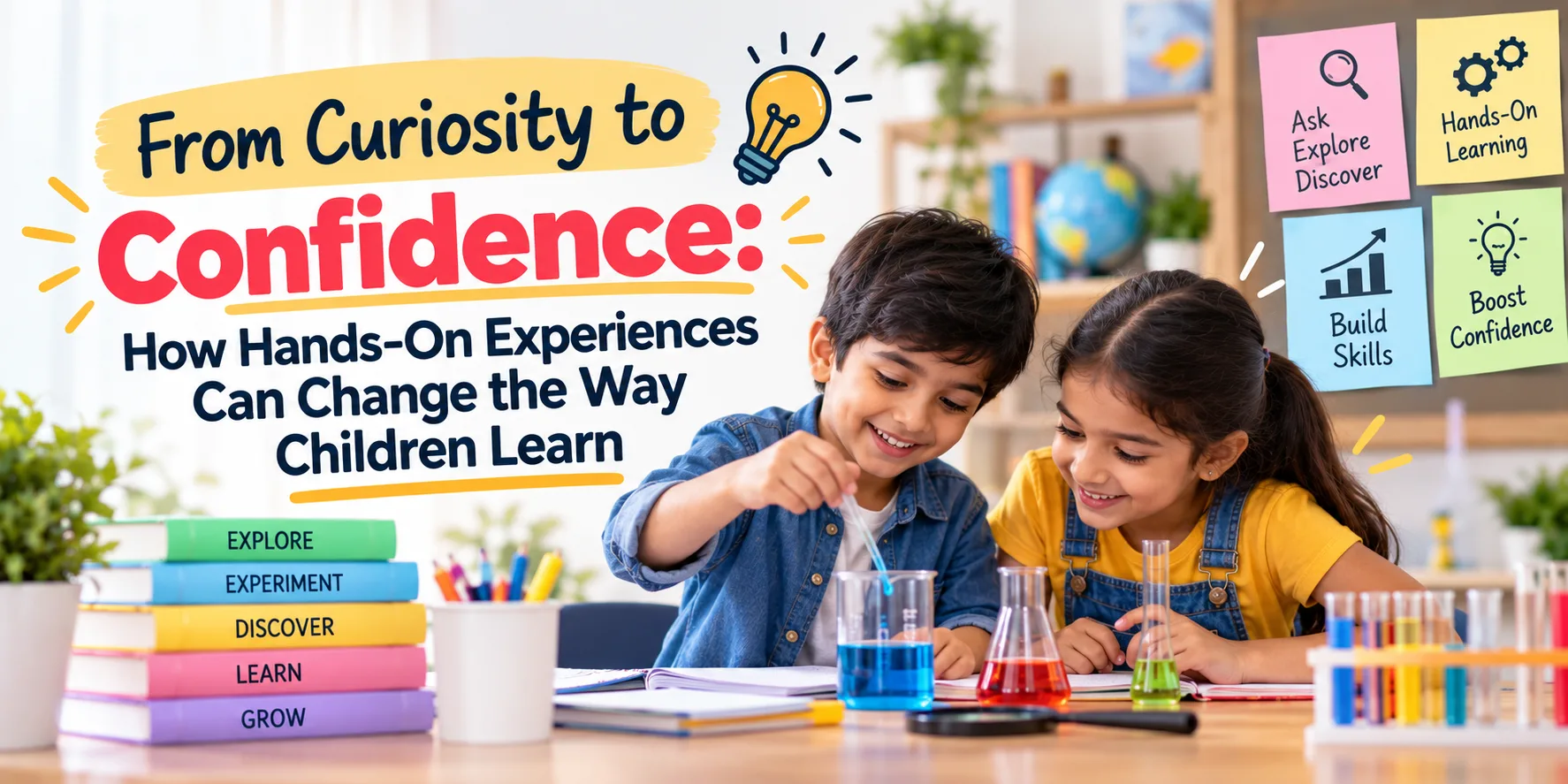
Hands-on experiences give children an opportunity to turn information into action. They can build, test, practise, observe, make mistakes and try again.
This is why Robotics, Sports & Beyond Academics in Faridabad can play an important role in creating varied learning experiences for children.
Children Often Understand Better When They Can Try
Imagine teaching a child about balance only through a textbook.
The child may understand the definition.
Now imagine giving them materials and asking them to build something that must balance.
Suddenly, the concept becomes a problem to solve.
The child has to observe what happens, make a change and test the result.
That process can make learning more memorable because the student is actively involved.
Hands-On Learning Is Not Just About Science
When people hear "hands-on learning," they often think about science experiments or robotics.
But practical learning can happen in many areas.
A language activity might involve creating a presentation or performing a short play.
A mathematics activity might involve measuring objects or solving a real-life problem.
Art can involve creating and discussing an original piece.
Sports involve continuous physical practice and decision-making.
School projects can require research, planning and teamwork.
The common element is that students are doing something with what they have learned.
Robotics Can Turn Problems Into Challenges
Robotics is one example of practical learning.
A student may begin with a simple question:
"How can I make this machine move?"
The answer may require several attempts.
The student may need to:
- understand instructions,
- assemble components,
- test the design,
- identify an error,
- change the approach,
- test again.
The child is learning technical concepts, but they are also practising persistence and problem-solving.
Sports Provide a Different Kind of Learning
Sports offer hands-on learning through movement and real-time decisions.
A student playing a team game has to communicate, respond to changing situations and make decisions quickly.
They also experience outcomes directly.
A strategy may work.
It may fail.
The team may win.
It may lose.
The experience gives students opportunities to respond to results and adjust their approach.
For families looking for a Best School for Sports in Faridabad, it can therefore be useful to look beyond the presence of a playground and ask how sports are integrated into student life.
Practical Experiences Can Build Confidence
Confidence often develops after children discover that they can solve something themselves.
A student who successfully builds a project after several failed attempts may think:
"I couldn't do it at first, but I figured it out."
That experience can be powerful.
It teaches children that difficulty does not automatically mean inability.
The same lesson can transfer to academic work.
Team Projects Teach Children to Work With Others
Hands-on projects are not always individual activities.
Many require students to work in groups.
That creates opportunities to practise:
- listening,
- sharing responsibilities,
- explaining ideas,
- resolving disagreements,
- meeting deadlines,
- supporting teammates.
These are skills that children may understand in theory but develop more deeply through actual experience.
Not Every Activity Has to Produce a Perfect Result
One common mistake is judging every school activity by the final product.
A project may look imperfect.
A model may not work.
A presentation may contain mistakes.
A sports team may lose.
But the learning process can still be valuable.
Parents can ask:
What did the child learn while doing the activity?
The process may have involved planning, experimentation, communication and problem-solving—even if the final result was not perfect.
How Parents Can Encourage Hands-On Learning at Home
Hands-on learning does not require expensive equipment.
Children can learn through ordinary activities.
For example:
Cooking:
Following measurements can introduce practical mathematics.
Gardening:
Children can observe plants, weather and growth.
Building:
Blocks, cardboard or recycled materials can become simple construction projects.
Shopping:
Comparing prices can introduce practical calculations.
Planning a trip:
Children can help read maps, estimate time and organise a simple schedule.
The purpose is not to turn every household activity into a lesson.
It is simply to allow children to participate rather than always watching adults do things for them.
What Parents Should Look For in a School
When visiting a school, parents can ask:
- Do students regularly work on projects?
- Are practical activities connected to classroom concepts?
- Do children get opportunities to experiment?
- Are students encouraged to build and create?
- How are robotics, sports or other activities used?
- Do students work individually as well as in teams?
Parents looking for a School with Indoor & Outdoor Sports in Faridabad can also ask how students actually use those spaces rather than simply noting that the facilities exist.
The same principle applies to laboratories, technology spaces and activity areas.
Activities Should Have a Purpose
More activities do not automatically mean better learning.
A school could offer many clubs and events, but what matters is whether students are actively involved and learning from them.
A useful activity should give children an opportunity to do something meaningful.
For example:
- solve a problem,
- create something,
- practise a skill,
- communicate an idea,
- work with others,
- make decisions,
- reflect on the result.
That is more valuable than simply keeping students busy.
Curiosity Is a Skill Worth Protecting
Children ask many questions naturally when they are young.
As they grow, some become hesitant to ask because they worry that their question is "silly."
Adults can help by treating genuine curiosity seriously.
Instead of immediately giving an answer, parents can sometimes respond:
"What do you think?"
That simple question can encourage children to investigate, make predictions and explain their reasoning.
Final Thoughts
Learning becomes more meaningful when children have opportunities to use what they know.
Robotics, sports, projects, experiments, creative activities and everyday experiences can all give children opportunities to practise skills in real situations.
The objective is not to make every lesson entertaining.
It is to help children become active participants in their own learning.
A child who learns to ask questions, experiment, solve problems and try again is developing something that can remain useful long after a particular school lesson has been forgotten.