
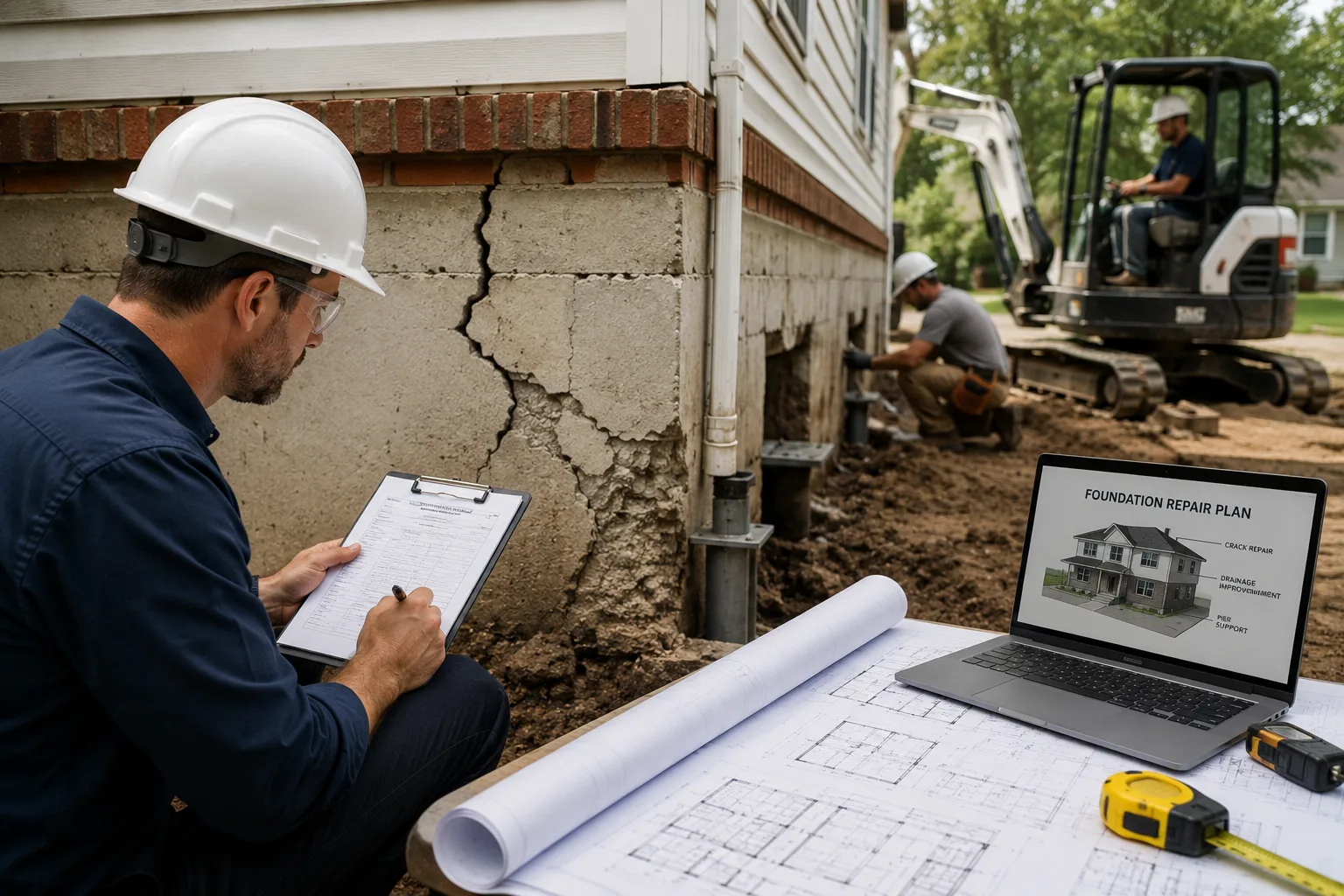
Most homeowners do not wake up one morning and suddenly discover that their house has a foundation problem.
Usually, it starts with something small.
A door that sticks. A crack that wasn't there before. A floor that feels slightly uneven. Maybe a window becomes harder to open, or a section of the house seems different after a period of heavy rain.
These changes are easy to dismiss. Houses settle, materials age, and small cracks can appear for many ordinary reasons. But sometimes, those little changes are signs that something underneath the surface deserves a closer look.
When it comes to foundation and structural repairs in AL, the important thing is not to panic at the first crack. It is to understand what has changed, why it may have changed, and whether the problem is getting worse.
Foundation Problems and Structural Problems Are Not Always the Same
The terms "foundation damage" and "structural damage" are often used together, but they do not necessarily describe the same thing.
The foundation supports the building and transfers its weight to the ground. Structural components above it—including beams, columns, floor joists, roof framing, and load-bearing walls—help carry and distribute that weight.
A problem in one area can sometimes affect another.
For example, movement in a foundation may contribute to changes in floors or walls. On the other hand, damaged framing caused by moisture or termites may create problems that have little to do with foundation movement.
That is why identifying the actual source matters.
Repairing the visible symptom without understanding the cause can leave the underlying problem unresolved.
Small Changes Around the House Can Tell a Story
Homes often give clues before a serious repair becomes necessary.
Some things homeowners may notice include:
- Cracks around doors or windows
- Doors that suddenly stick
- Windows that become difficult to open
- Uneven or sloping floors
- Gaps around trim
- Cracks in walls or ceilings
- Separation between walls and ceilings
- Damaged or deteriorated framing
- Areas of flooring that feel unusually soft
But there is an important point to remember: none of these signs automatically means a home has a serious structural problem.
Buildings move naturally as materials expand, contract, settle, and respond to changes in moisture and temperature.
A single small crack may be insignificant. A pattern of changes that continues to develop deserves more attention.
Alabama's Weather Can Affect Homes Over Time
Homes in Alabama deal with a wide range of weather conditions.
Heavy rainfall, humidity, storms, changing temperatures, and periods of severe weather can all affect the ground and the building materials around a property.
Water is particularly important.
Poor drainage can allow water to collect near a foundation. Plumbing leaks can introduce moisture beneath floors or inside walls. Roof leaks can damage framing. Persistent dampness in crawl spaces can contribute to deterioration of wooden components.
This does not mean that every foundation issue in Alabama is caused by water. Soil conditions, construction history, drainage, age, vegetation, and other factors can all play a role.
The point is that the condition of the property and the conditions around it should be considered together.
What Happens Beneath the House Matters
A crawl space can tell a homeowner a lot about the condition of a property.
Unfortunately, it is also one of the areas people tend to overlook.
A crawl space may contain:
- Floor joists
- Beams
- Supports
- Plumbing
- Insulation
- Subflooring
- Soil and drainage areas
If moisture repeatedly enters the space, wood can deteriorate over time. Termites can also cause hidden damage to wooden components.
Sometimes the living space above shows the first signs—a soft floor, uneven area, or unusual movement—while the actual problem is underneath.
That is why looking beyond the finished surfaces can be important when investigating a structural concern.
Moisture and Structural Damage Can Be Connected
Water does not need to flood an entire house to cause problems.
A slow plumbing leak, poor drainage, or recurring roof leak can expose building materials to moisture for an extended period.
Wood that remains damp can deteriorate. Metal components may corrode. Insulation can become affected. Finishes may begin to fail.
In some homes, moisture problems and structural problems develop together.
For example, a leaking plumbing line beneath a bathroom could gradually affect the subfloor. If the leak continues, nearby framing may also deteriorate.
Replacing the visible flooring without fixing the leak would only address part of the problem.
A Proper Evaluation Looks for the Cause
When homeowners notice several warning signs, the next step should be understanding what is actually happening.
An evaluation may involve looking at:
- Foundation walls
- Floors
- Crawl spaces
- Framing
- Beams and supports
- Roof framing
- Walls and ceilings
- Drainage around the property
- Areas with visible moisture
The goal is to connect the clues.
A crack in a wall means something different when it appears by itself than when it occurs alongside a noticeably uneven floor and movement in nearby doors.
Context matters.
If there is uncertainty about whether a condition affects the structural adequacy of a building, an appropriately qualified structural professional may be needed to evaluate it.
Not Every Repair Requires Major Construction
Hearing the word "structural" can make homeowners imagine an enormous construction project.
The reality can be very different.
The appropriate repair depends entirely on the condition found during the evaluation.
Depending on the situation, work might involve:
- Repairing damaged framing
- Replacing deteriorated wood
- Reinforcing floor joists
- Repairing sections of subfloor
- Addressing damaged beams
- Correcting moisture sources
- Improving drainage
- Repairing foundation-related problems
Some issues may be relatively localized. Others may require more extensive work.
There is no responsible way to determine the right repair simply by looking at one photograph or one crack.
The Importance of Fixing the Source
One of the most important parts of a lasting repair is dealing with the reason the damage developed.
Consider a floor joist damaged by long-term moisture.
Replacing the joist may restore the damaged component, but if water continues entering the crawl space, another problem could develop later.
The same principle applies to termite damage, plumbing leaks, roof leaks, and drainage issues.
A good repair plan considers both the damaged material and the conditions that contributed to its deterioration.
What Can Happen When Problems Are Ignored?
Not every small building problem becomes serious.
However, ignoring a developing issue can make it more difficult to understand what happened later.
A small leak can become a larger moisture problem. A deteriorating piece of framing can continue to weaken. A drainage problem can repeatedly expose the foundation area to water.
There is also another practical concern: repairs can become more disruptive when a problem is discovered after the area has already been renovated.
For example, discovering damaged subflooring before installing new flooring is very different from discovering it after the finished floor has been installed.
Early investigation gives homeowners more information and more choices.
A Simple Example
Imagine an Alabama homeowner notices that a bedroom door has started sticking.
At first, the homeowner assumes the door itself has swollen.
A few months later, a small crack appears near the corner of the room, and the floor feels slightly uneven.
An inspection finds that the crawl space beneath the room has experienced repeated moisture exposure. Part of the subfloor and nearby framing has deteriorated.
The door was not necessarily the problem. It was one of the clues.
By looking at the entire area rather than repairing only the door, the homeowner can understand what is actually affecting the room.
Keeping an Eye on Your Home
Homeowners do not need to inspect every part of their house every week.
Simple awareness can go a long way.
Pay attention to changes such as:
- New or expanding cracks
- Persistent moisture
- Recurring water stains
- Soft flooring
- Unusual movement
- New gaps around doors or windows
- Deterioration in crawl spaces
It is also worth keeping gutters, drainage systems, roofs, and plumbing in reasonable condition.
Preventing moisture problems is often easier than dealing with the damage they can eventually cause.
Frequently Asked Questions
Does every foundation crack need to be repaired?
No. Cracks can occur for many reasons, and their significance depends on factors such as size, location, pattern, and whether they are changing over time.
Are uneven floors always caused by foundation movement?
No. Uneven floors can result from several conditions, including framing problems, moisture damage, construction issues, or foundation-related movement.
Can termites cause structural problems?
They can damage wooden components, but the extent depends on the location and severity of the infestation. Active termite treatment and repair of existing damage are separate parts of the process.
When should a homeowner investigate a possible structural problem?
New or worsening changes, especially when several symptoms appear together, are worth having evaluated rather than simply covering up.
Final Takeaway
Your home often gives you clues before it gives you a major problem.
A sticking door, uneven floor, wall crack, or damp crawl space does not automatically mean that serious structural repairs are needed. But when changes appear together—or continue to get worse—they are worth understanding.
For Alabama homeowners, paying attention to moisture, drainage, framing, foundation conditions, and changes inside the home can make it easier to catch problems early.
The goal is not to assume the worst.
It is to find the reason behind the change, understand the condition of the property, and choose repairs based on what the home actually needs.