Investing in forklift safety technology is a decision that carries genuine consequences — for worker protection, regulatory compliance, operational efficiency, and long-term financial performance. When the investment is made well, the returns are measurable and sustained: fewer incidents, lower insurance exposure, improved audit outcomes, and a safer working environment for every person on the warehouse floor. When it is made poorly — selecting a system that underperforms in real operating conditions, proves difficult to maintain, or fails to integrate with the facility's broader safety infrastructure — the consequences are equally real, and the opportunity cost of deploying inadequate technology while the hazards it was meant to address remain unresolved is significant.
The market for forklift camera systems has expanded rapidly as awareness of their safety benefits has grown, and with that expansion has come a proliferation of products at widely varying capability and quality levels. For warehouse managers, HSE professionals, fleet safety officers, and procurement decision-makers across the UK, UAE, and Kuwait, navigating this market intelligently requires a clear understanding of what genuinely capable forklift camera technology looks like, what features are essential versus supplementary, and what questions to ask before committing to a deployment. This guide addresses each of those requirements with the specificity that a safety-critical purchasing decision demands.
Understanding What You Are Actually Buying
The first and most important step in evaluating any 360 degree camera for forklift system is understanding the fundamental difference between a camera system that displays video and a camera system that actively contributes to safety. This distinction, explored in depth elsewhere in the context of AI capability, has equally important implications at the purchasing stage.
A system that mounts cameras around a forklift and displays their feeds on a monitor in the operator's cab is a visibility aid. It is better than no camera, and significantly better than mirrors alone, but it places the entire burden of hazard detection and response on the human operator. Its safety value is proportional to the operator's attentiveness at every moment of every shift — a dependency that inherently limits the consistency of its safety performance.
A system that processes camera feeds through an AI engine to perform real-time object detection, generate proximity alerts, and produce structured safety data is a safety platform. It actively supplements the operator's awareness rather than merely extending it, and its safety contribution is consistent regardless of the operator's momentary attentiveness level. When evaluating systems, this distinction should be the primary lens through which all other features are assessed.
Essential Features: What a Capable System Must Deliver
Any bird's eye view camera system for forklift operations that merits serious consideration for deployment in a professional industrial environment must deliver a defined set of core capabilities. Evaluating systems against these requirements provides a reliable framework for eliminating inadequate products and identifying genuine contenders.
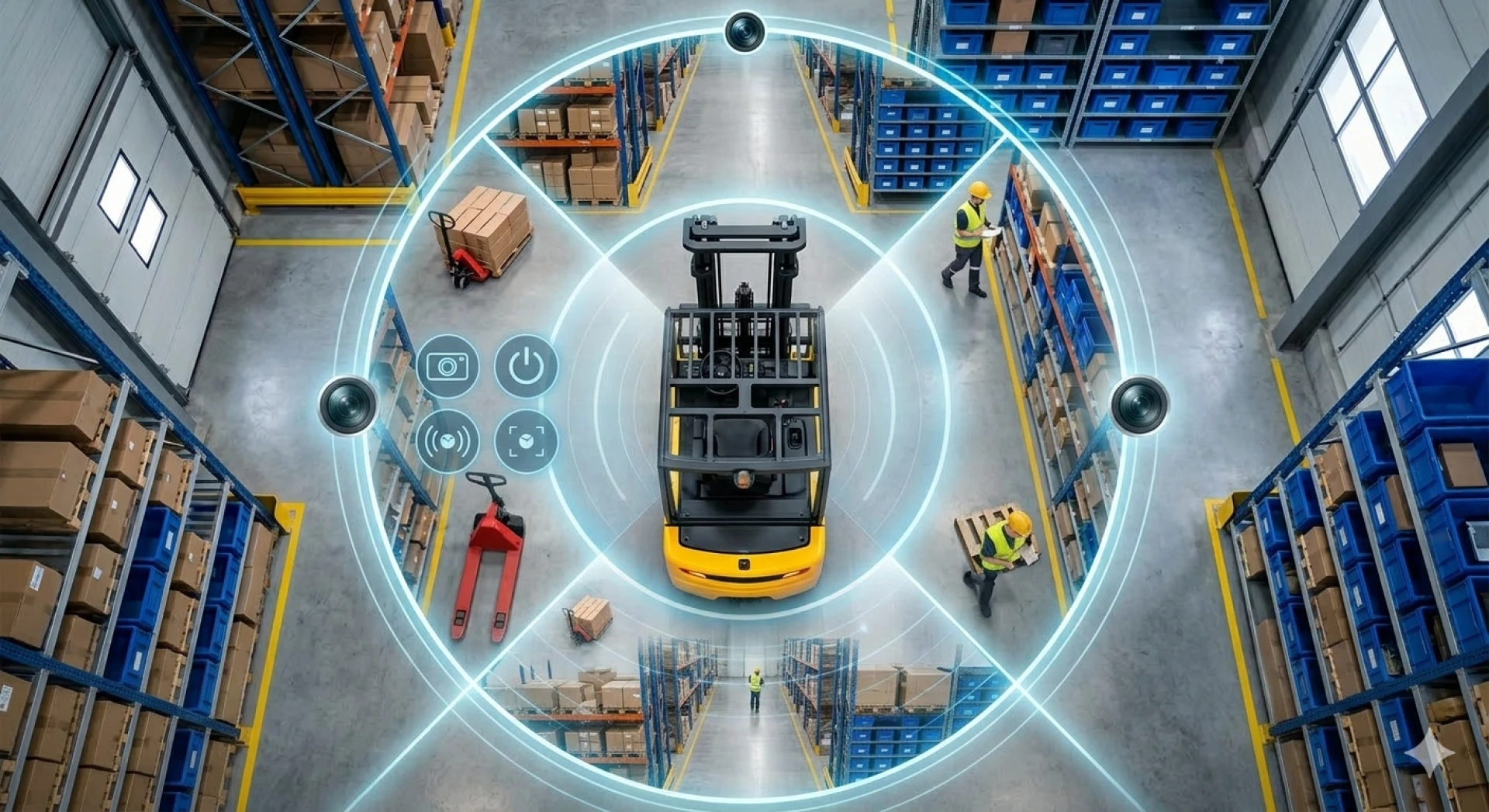
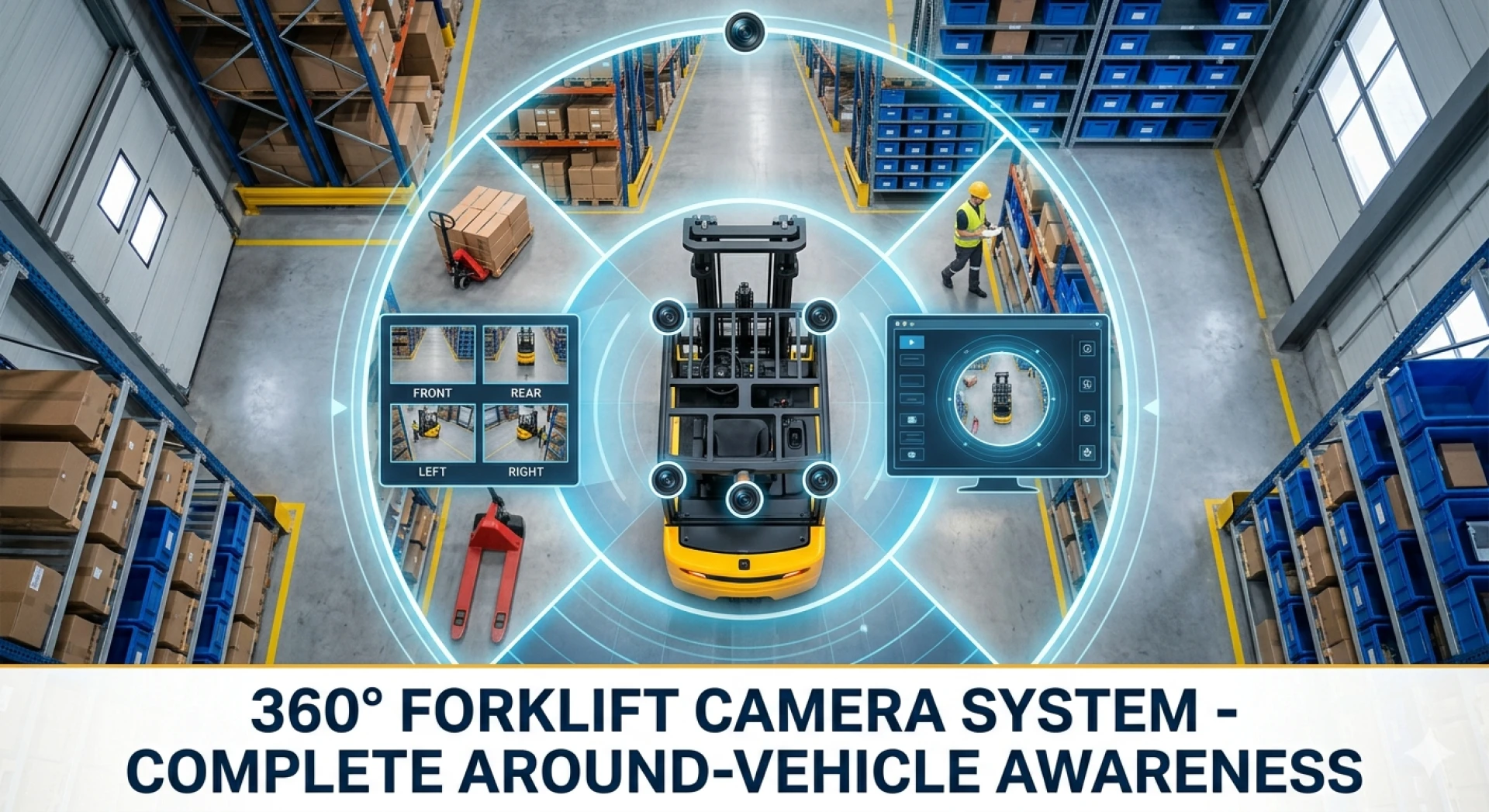
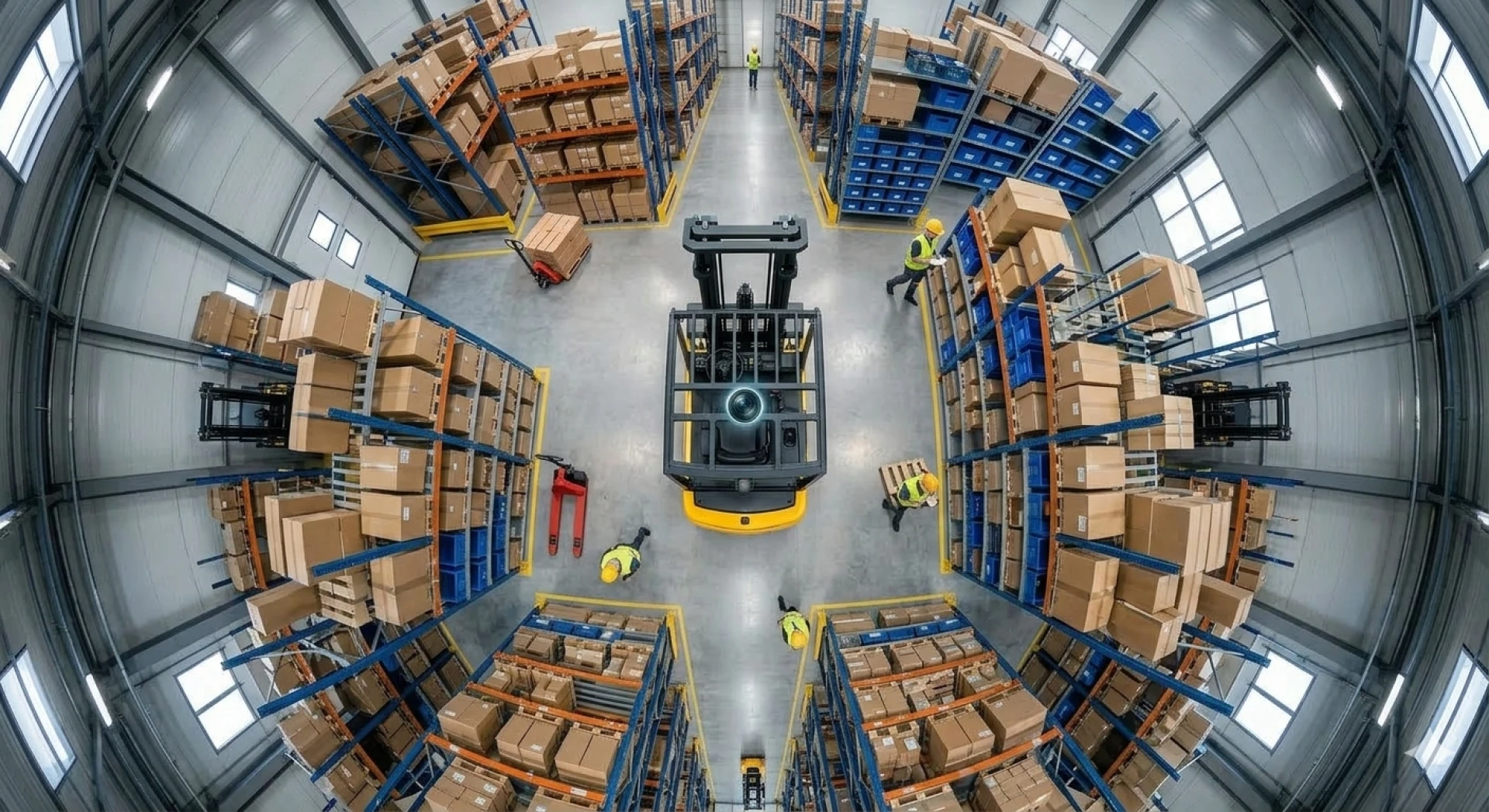
Complete perimeter coverage is non-negotiable. Four wide-angle cameras positioned at the front, rear, and both sides of the vehicle must collectively eliminate every structural blind zone without gaps or significant image distortion at the edges of each camera's field of view. The stitching quality of the overhead composite image — the seamlessness and spatial accuracy with which individual feeds are combined — directly affects how intuitively and reliably the operator can use it for spatial judgement. Systems with poor stitching produce composite images that distort distances and positions, undermining the operator's ability to judge clearances accurately.
Display quality and positioning matter more than specification sheets typically acknowledge. A high-resolution composite image displayed on an undersized, poorly positioned, or glare-affected monitor in the operator's cab provides significantly less practical value than a good-quality image on a well-positioned, appropriately sized display. Evaluate the complete installation — camera hardware, processing unit, cabling, and display — as an integrated system rather than assessing components in isolation.
Proximity detection and alert capability should be configurable to the specific operating environment. Alert zones that are fixed in size and sensitivity may be appropriate for one facility layout and entirely inappropriate for another. Systems that allow zone dimensions, detection sensitivity, and alert thresholds to be adjusted by safety managers without specialist technical intervention provide the operational flexibility that real-world deployment requires.
Night vision and low-light performance is an essential requirement for any facility operating across multiple shifts or in areas with variable or low ambient lighting. Evaluate camera performance specifically under the lighting conditions present in your facility during the shifts where coverage is needed — not under optimal laboratory conditions.
Installation Considerations: Planning for Real-World Deployment
The quality of a forklift 360° bird eye view camera system installation determines whether its technical capability translates into reliable real-world safety performance. Several installation considerations deserve careful attention before commitment to a specific system or supplier.
Vehicle compatibility across diverse fleets is a practical requirement that is frequently underestimated during procurement. A warehouse operating multiple forklift brands and models — counterbalance trucks, reach trucks, order pickers, and tow tractors — needs camera systems that can be installed consistently across this diversity without requiring bespoke engineering solutions for each vehicle type. Systems designed for broad compatibility with standard mounting positions and cabling configurations significantly reduce installation complexity and cost at scale.
Cabling protection in industrial environments is a maintenance consideration that has direct implications for long-term system reliability. Cables running from cameras mounted on the exterior of a working forklift are subject to vibration, abrasion, moisture ingress, and the physical impacts of routine warehouse operation. Industrial-grade cabling with appropriate conduit protection and sealed connectors is not a premium feature — it is a baseline requirement for sustained performance in real operating conditions. Systems that cut costs through inadequate cabling protection will generate maintenance demands that erode their total cost of ownership advantage over time.
Calibration requirements post-installation determine how quickly a deployed system reaches full operational effectiveness. Systems that require specialist technician involvement for initial calibration and recalibration after maintenance events introduce ongoing support costs and potential downtime that should be factored into total cost of ownership calculations. Systems designed for straightforward calibration procedures that can be performed by trained in-house staff offer a meaningful operational advantage in this respect.
For facilities in hazardous atmosphere environments — particularly relevant for petrochemical, energy, and chemical sector operations across Kuwait and the UAE — ATEX certification of all camera system components is a non-negotiable installation requirement, not an optional enhancement. Every component of the system, from camera housing to cabling to the processing unit, must meet the applicable explosive atmosphere protection standard for the zone classification of the areas in which it will operate. SharpEagle's forklift camera solutions are engineered to meet these exacting requirements, providing ATEX-certified hardware alongside the advanced safety capability that industrial-grade forklift safety demands.
Evaluating ROI: The Financial Case for Investment
The return on investment calculation for forklift camera systems is more straightforward than procurement teams sometimes assume, because the cost of not deploying adequate forklift safety technology is itself measurable and substantial. A single forklift incident involving a pedestrian injury generates direct costs — medical treatment, compensation claims, regulatory fines, legal fees — that typically exceed the cost of equipping an entire forklift fleet with advanced camera systems. The indirect costs of production downtime, reputational damage, increased insurance premiums, and the management resource consumed by investigation and reporting processes extend this financial impact further still.
Against this cost baseline, the investment in a capable bird's eye view camera system for forklift fleet deployment delivers financial returns through multiple channels simultaneously. Reduced incident frequency lowers direct accident costs and insurance premium exposure. Reduced product and infrastructure damage from low-speed handling collisions reduces replacement and repair costs. Improved operator efficiency — faster cycle times, reduced spotter dependency, lower hesitation-related delays — contributes to measurable productivity gains. Safety data generated by AI-equipped systems supports proactive hazard management that prevents costly incidents before they occur.
When evaluating competing systems on cost grounds, total cost of ownership across the expected deployment lifetime — incorporating hardware acquisition, installation, maintenance, support, and the opportunity cost of system downtime — provides a more accurate financial comparison than initial purchase price alone. A system that costs less to acquire but generates significant ongoing maintenance demand or fails to deliver consistent safety performance in real operating conditions is not a financially sound investment regardless of its headline price point.
Conclusion
Choosing the right 360 degree camera for forklift fleet deployment is a decision that rewards careful, structured evaluation against clearly defined capability requirements, real-world installation considerations, and honest total cost of ownership analysis. The facilities that make this investment well — selecting systems that deliver genuine AI-enhanced safety capability, reliable industrial-grade performance, and the data integration that proactive safety management requires — are building forklift safety infrastructure that protects their workers, supports their regulatory compliance, and delivers measurable financial returns across the operational lifetime of every vehicle in their fleet.
To understand why many of the conventional forklift camera approaches still widely deployed in industrial facilities fall critically short of what modern warehouse safety demands, read our blog post: Why Standard Forklift Cameras Fail in High Traffic Warehouses.