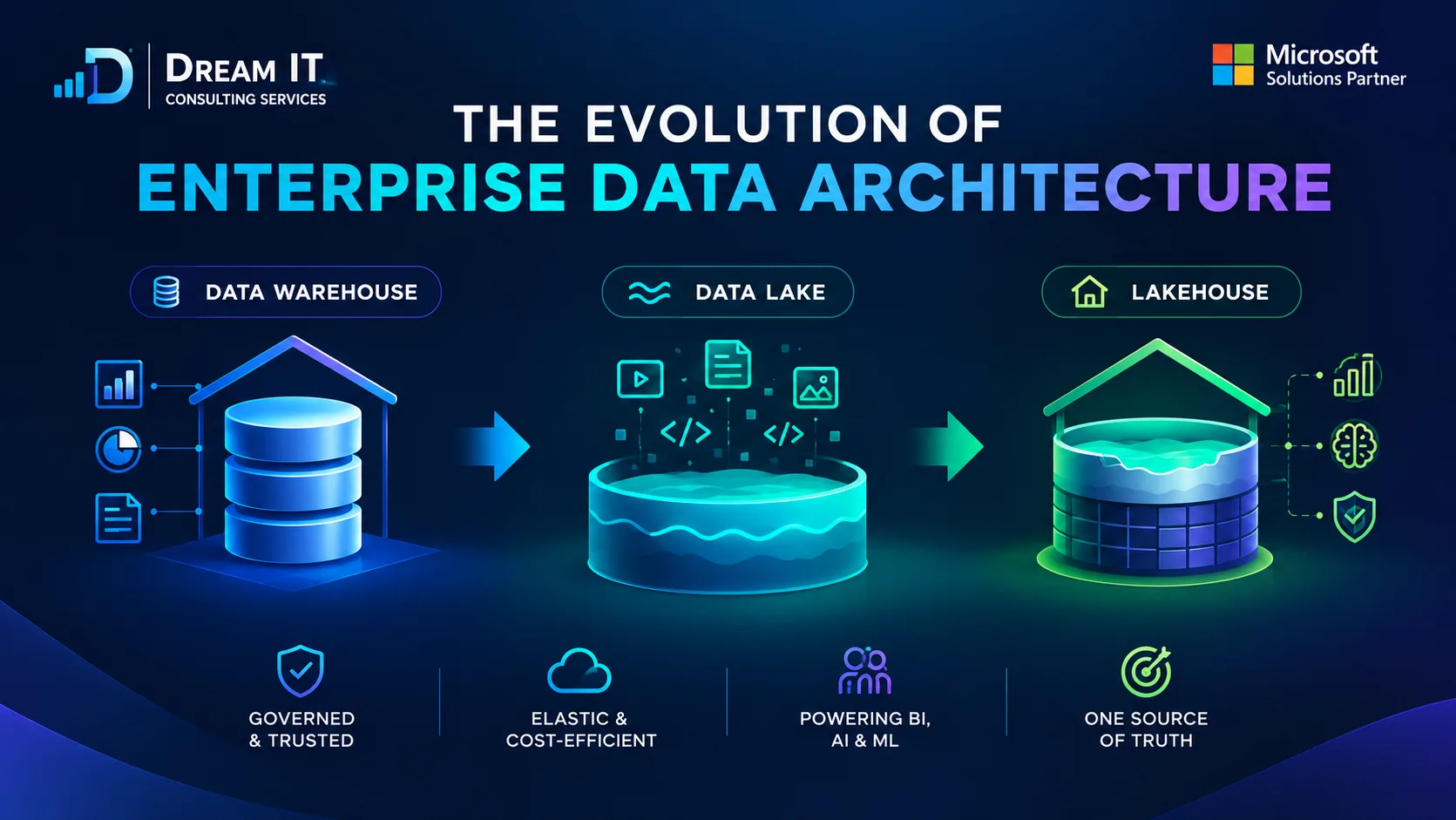
Architecture diagrams make data platforms look tidy. Boxes connect to boxes, arrows point in one direction, and everything seems to flow naturally. Real platforms are messier, and the best way to understand them is to follow a single piece of data from the moment it is created to the moment someone uses it.
This walkthrough traces one sales order through a modern lakehouse. Along the way, it explains the design decisions behind each stage, the problems each one solves, and where expert guidance tends to matter most.
The Starting Point: An Order Is Placed
A customer places an order on a website. In the same moment, several systems react. The e-commerce platform records the transaction. The payment provider confirms the charge. The ERP reserves inventory. A CRM updates the customer profile. A marketing tool logs the campaign that brought the customer in.
One business event has now produced five records in five systems, each with its own format, identifiers, and timing. This is the core reason enterprises build central data platforms. The order is one fact, but the business needs to see it as one fact.
Step 1: Ingestion
The first task is moving data out of source systems and into the platform. Several patterns exist:
- Batch loads copy data on a schedule, such as every hour or every night
- Change data capture reads only what has changed since the last load
- Streaming delivers events within seconds of creation
Choosing among them depends on how quickly the business needs the answer. Finance may be comfortable with nightly updates, while fraud detection cannot wait. This is also where data warehouse and ETL consulting services often add early value, since poorly designed ingestion creates duplicates, gaps, and delays that spread through everything downstream.
The raw order lands in the platform exactly as it arrived, untouched. Keeping an unaltered copy matters because it allows data to be reprocessed later if rules change or errors are discovered.
Step 2: The Raw Layer (Often Called Bronze)
Many lakehouse designs organize data into layers of increasing quality. The first holds raw data as received. Nothing is cleaned or corrected here. The goal is a faithful record of what the source systems sent.
At this stage the order still has problems. The customer's name is spelled differently in two systems. A date arrives in two formats. A product code from the ERP does not match the one in the website catalog. None of that is fixed yet, and that is intentional.
Step 3: The Refined Layer (Silver)
Next, the data is cleaned and standardized. Duplicates are removed, formats are aligned, and records from different systems are matched to the same customer and product. Rules for handling missing or invalid values are applied consistently.
This step is where a large share of data quality work happens, and where many projects either succeed or quietly fail. Agreeing on what counts as the same customer, for example, is as much a business decision as a technical one. The best results come when the people who understand the business rules are involved alongside the engineers.
Step 4: The Business Layer (Gold)
The final layer reshapes data around business questions. The order is now connected to revenue, margin, region, channel, and customer segment. Aggregations such as daily sales by product line are prepared so reports run quickly.
On top of this sits the semantic layer, which defines metrics once and reuses them everywhere. When someone asks for revenue, the definition is already agreed: whether it includes returns, taxes, or pending payments is settled in one place. Without this, two reports can show different numbers for the same question, which is among the most common causes of lost trust in analytics.
Step 5: Governance Along the Way
At every stage, the platform must answer questions about control:
- Who can see this order? Customer details may be restricted to certain roles.
- Where did this number come from? Lineage traces a figure back to its sources.
- How long is it kept? Retention policies apply to personal and financial data.
- Is it accurate? Quality checks flag unusual values before they reach reports.
Governance is far easier to design at the beginning than to add later. A data lakehouse consultant will typically raise these topics early, because retrofitting access rules and lineage onto a running platform is slow and disruptive.
Step 6: Consumption
Finally, people use the data. The sales director opens a dashboard showing today's revenue. A data scientist trains a model that predicts which customers will reorder. An operations manager checks stock levels against demand. A finance analyst reconciles monthly totals.
Because all of them draw from the same governed copy, their numbers agree. That single point is the main practical benefit of unifying warehouse and lake capabilities. Older environments often kept analytics in a warehouse and data science in a separate lake, which meant two copies of the order and two chances for them to differ.
What the Journey Reveals About Costs
Each step uses storage, compute, or both, so design choices have cost consequences.
- Storing raw data cheaply while running compute only when needed keeps expenses predictable.
- Pre-aggregating common queries in the business layer reduces repeated heavy processing.
- Scaling compute to match demand avoids paying for idle capacity.
- Retiring unused datasets and reports prevents quiet cost growth.
These are not one-time settings. They need monitoring and adjustment, which is why optimization is usually a distinct phase in a migration plan.
Why This Matters Now
The shift toward this model reflects a broader pattern in digital warehousing embracement by enterprises. As data volumes grow and analytics spreads beyond finance, organizations need one trusted foundation for reporting, advanced analytics, and AI. Interest in cloud data lakehouse consulting and cloud data warehouse consulting services has grown as a result, since the cloud makes elastic scaling and separation of storage and compute practical.
Choosing Support
Organizations evaluating data lakehouse consulting services often compare several things: whether the advisor is neutral across platforms such as Microsoft Fabric, Databricks, Snowflake, and BigQuery; whether the migration method includes validation against the existing environment; and whether the team will be left able to run the platform independently.
Providers of data warehousing consulting services, including Dream IT's data warehouse and cloud lakehouse consulting, typically structure the work as assessment, architecture design, phased migration, optimization, and enablement. That sequence mirrors the journey above, applied to an entire organization instead of a single order.
Summary
Following one order shows what a lakehouse really does. It collects scattered records, preserves the raw version, cleans and aligns them, shapes them around business questions, protects them with governance, and delivers one consistent answer to everyone who asks. Each stage involves decisions that are easier to make well at the start. Understanding the journey is the first step toward designing a platform that supports it.