
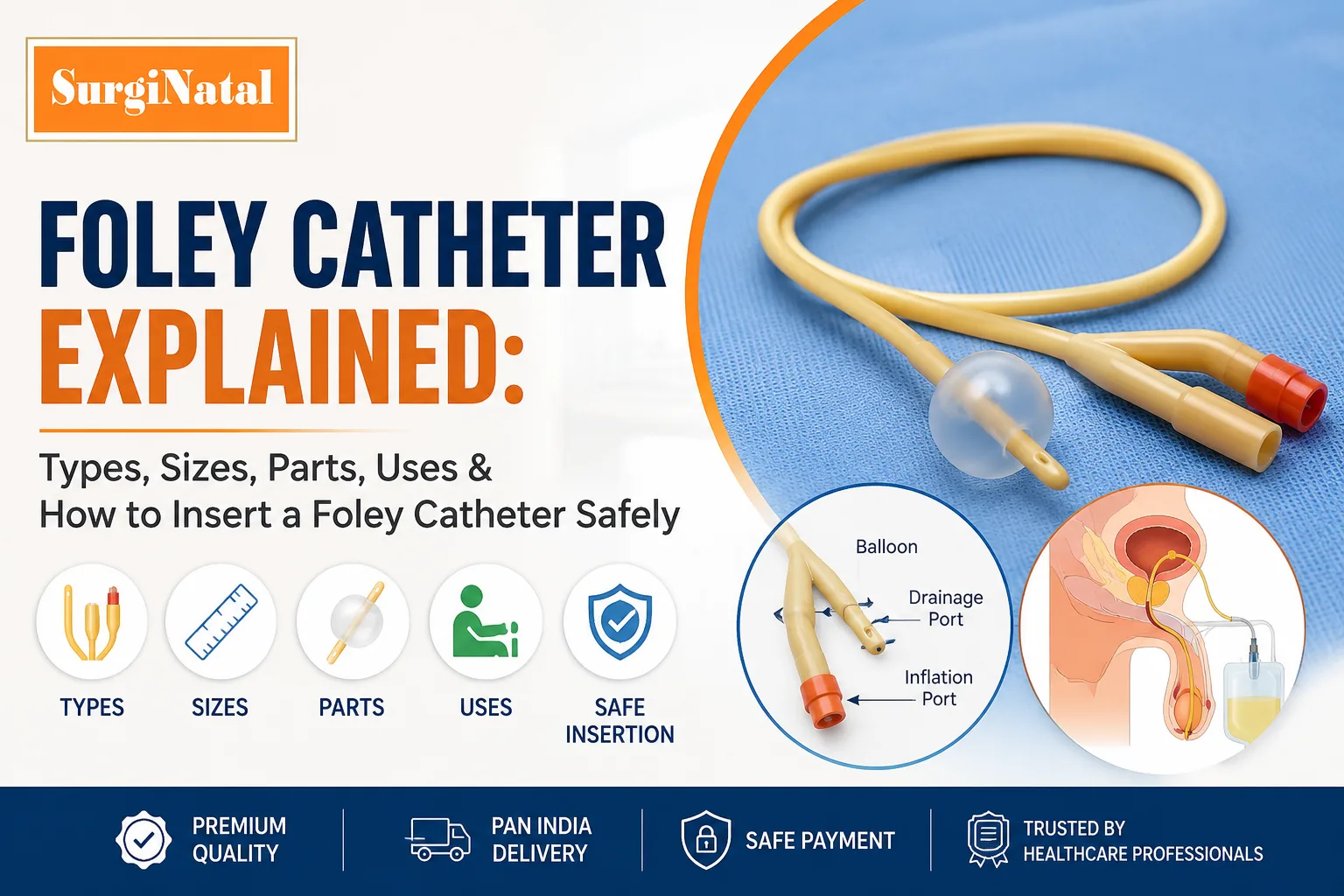
A Foley catheter is one of the most widely used medical devices for managing urinary drainage in hospitals, nursing homes, and even home care settings. Whether a patient is recovering from surgery, dealing with urinary retention, or being monitored in an ICU, this simple yet effective device plays a critical role in patient care. Choosing the right type and size of catheter directly affects patient comfort and reduces the risk of complications such as infection or blockage. This guide walks through everything you need to know from the basic anatomy of a Foley catheter to insertion, care, and common risks so caregivers and healthcare professionals can make informed decisions.
What is a Foley Catheter?
A Foley catheter is a flexible, hollow tube inserted through the urethra into the bladder to allow continuous drainage of urine. Unlike a straight or intermittent catheter, which is inserted and removed after a single use, a Foley catheter remains in place for extended periods thanks to a small balloon near its tip that keeps it securely anchored inside the bladder.
Once inserted, the catheter allows urine to flow continuously into a collection bag, eliminating the need for repeated insertions. This makes it especially useful for patients who cannot control urination on their own or who require ongoing monitoring of urine output.
Foley catheters are typically made from either latex or silicone. Latex catheters are more flexible and cost-effective but are best suited for short-term use, while silicone catheters are firmer, less likely to cause allergic reactions, and suitable for long-term placement.
Foley Catheter Parts Explained
Understanding the parts of a Foley catheter helps caregivers use and maintain it correctly:
Drainage Eyelets – Small openings near the tip that allow urine to enter the catheter from the bladder.
Catheter Shaft – The main tube that carries urine from the bladder to the drainage bag.
Balloon – An inflatable component near the tip that, once filled with sterile water, holds the catheter securely in the bladder.
Inflation Valve – The port used to inflate or deflate the balloon using a syringe.
Drainage Funnel – The external end of the catheter that connects to the urine collection bag.
Color Coding – Many catheters use color-coded valves to indicate the French size at a glance, making identification quicker for clinical staff.
Types of Foley Catheters
There are several types of Foley catheters designed for different clinical needs:
2-Way Foley Catheter – Has two channels: one for urine drainage and one for balloon inflation. It is the most common type used for routine bladder drainage.
3-Way Foley Catheter – Includes an additional channel for bladder irrigation, often used after urological surgery to flush out blood clots.
Silicone Foley Catheter – Ideal for long-term use due to its biocompatibility and reduced risk of encrustation.
Latex Foley Catheter – Cost-effective and flexible, generally recommended for short-term or temporary catheterization.
Hydrogel-Coated Foley Catheter – Coated for extra smoothness and comfort, reducing friction and irritation during use.
Foley Catheter Sizes (French Scale Guide)
Catheter sizes are measured using the French (Fr) scale, where each unit equals approximately 0.33 mm in diameter. Selecting the correct size is essential; too small can cause leakage, while too large can injure the urethra.
Adult patients typically require larger sizes than children, and balloon capacity (commonly 5ml, 10ml, or 30ml) should also match the clinical requirement, with 30ml balloons often used in post-surgical cases requiring irrigation.
Foley Catheter Uses
Foley catheters serve a wide range of clinical purposes, including:
- Managing urinary retention when a patient cannot empty their bladder naturally
- Draining the bladder after surgical procedures
- Supporting critically ill ICU patients who require close monitoring
- Accurately tracking urine output in patients with fluid balance concerns
- Assisting patients with neurological disorders affecting bladder control
- Providing relief for bedridden or immobile patients
- Enabling long-term bladder management for chronic conditions
How to Insert a Foley Catheter Safely
Medical Disclaimer: Foley catheter insertion should only be performed by trained healthcare professionals or under medical supervision.
Proper insertion requires sterile equipment, including gloves, antiseptic solution, lubricant, the catheter itself, a syringe filled with sterile water, and a drainage bag. The patient should be positioned comfortably, and the genital area cleaned thoroughly to reduce infection risk.
The general process involves preparing a sterile field, gently inserting the lubricated catheter through the urethra until urine flow is observed, and only then inflating the balloon with sterile water to secure it in place. The drainage bag is then connected, and placement is confirmed by observing steady urine flow.
Safety Tips
- Maintain strict sterile technique throughout the procedure
- Never force the catheter if resistance is felt
- Inflate the balloon only after confirming urine flow
- Secure the catheter tubing properly to prevent tension or accidental dislodgement
Foley Catheter Care & Maintenance
Proper catheter care reduces the risk of infection and keeps the drainage system functioning correctly. This includes daily cleaning of the catheter insertion site, regularly emptying the drainage bag before it becomes too full, keeping the bag below bladder level to maintain proper gravity drainage, and encouraging adequate hydration to help flush the urinary system naturally.
Possible Risks and Complications
While generally safe, Foley catheters carry certain risks, including urinary tract infections (UTIs), blockages caused by sediment or clots, leakage around the catheter, balloon failure leading to accidental removal, and occasional blood in the urine. Patients or caregivers should contact a doctor immediately if fever, severe pain, foul-smelling discharge, or a complete stop in urine flow occurs.
Related Foley Catheter Products
For those sourcing reliable catheter options, consider these trusted products:
- Romsons Foley Trac 2 Way Foley Catheter
- Polymed 2 Way Foley Balloon Catheter
- Romsons Silicone Foley Catheter (Silko Cath)
- Bardia 2 Way Foley Catheter
- Viggo Foley Balloon Catheter (Silicone)
ProductMaterialAvailable SizesBalloon TypeRecommended UseRomsons Foley Trac 2 WayLatex8–24 Fr5–30mlRoutine drainagePolymed 2 Way Foley BalloonLatex6–24 Fr5–30mlShort to medium termRomsons Silko CathSilicone8–24 Fr5–30mlLong-term useBardia 2 WayLatex/Silicone-coated8–24 Fr5–30mlGeneral purposeViggo Foley Balloon (Silicone)Silicone8–24 Fr5–30mlExtended, sensitive patients
Frequently Asked Questions (FAQs)
What is a Foley catheter used for?
It is used to continuously drain urine from the bladder in patients unable to urinate normally, or to monitor urine output.
How long can a Foley catheter stay in place?
Duration depends on the material and clinical need — latex catheters are typically short-term, while silicone catheters can remain for several weeks under medical guidance.
What size Foley catheter is commonly used for adults?
16 Fr is considered the standard size for most adults, though this can vary by individual need.
Is a silicone Foley catheter better than a latex catheter?
Silicone catheters are generally preferred for long-term use due to lower infection risk and better biocompatibility, while latex is more economical for short-term use.
Can a Foley catheter be inserted at home?
Yes, but only by a trained nurse or healthcare provider using proper sterile technique.
How often should a Foley catheter be changed?
This varies by catheter type and patient condition, typically every 2–4 weeks, as advised by a healthcare professional.
Conclusion
Choosing the right Foley catheter in terms of type, size, and material is essential for patient comfort, safety, and effective urinary management. Whether used in a hospital, ICU, or home care setting, proper insertion technique and consistent maintenance go a long way in preventing complications. For those looking for reliable, high-quality catheter and medical device options, SurgiNatal offers a trusted range of products designed to support safe and effective patient care.