
The mobile app development decision you make today will impact your business for years. The debate over Flutter vs. React Native in 2025 remains one of the most contentious choices in cross-platform mobile development. Both frameworks maintain close competition in developer adoption, with strong growth and active communities. But for business leaders, the question goes beyond popularity; it’s about ROI, time-to-market, scalability, and long-term maintenance costs.
This guide provides the practical insights you need to make an informed decision that aligns with your business app development objectives.
The Current State of Affairs: Flutter vs React Native Market Position
The Business Impact of Market Leadership
Current Market Position (2024 Data):
- Flutter: 9.4% developer usage with 63.9% admiration score - strongest growth momentum
- React Native: 8.4% developer usage with 60% admiration score - established ecosystem
- Cross-Platform Adoption: 70% of developers favor multi-platform tools in 2024
- GitHub Popularity: Flutter leads with 160K stars vs React Native's 114K
Cost Implications of Framework Choice:
- Flutter's Growth: Leading in developer preference (Stack Overflow 2024 Survey) among learning developers
- React Native's Stability: Strong JavaScript foundation means a larger talent pool (Stack Overflow 2024)
- Long-term Support: Both are backed by Google (Flutter) and Meta (React Native), ensuring sustained growth in cross-platform mobile app development.
What This Means for Your Budget:
- Flutter developers: Market rates vary by region.
- React Native developers: Generally competitive with JavaScript developers.
- Hidden Cost: Flutter requires Dart expertise; React Native leverages existing web developers
Performance: What It Means for Your Bottom Line
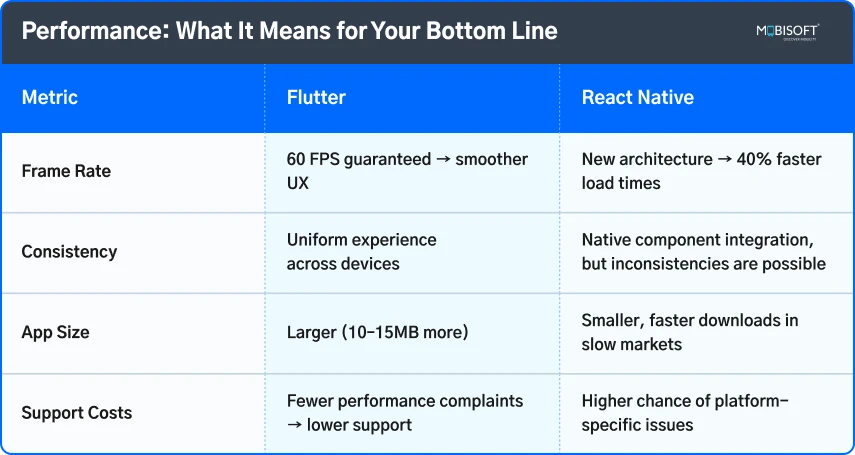
Business Impact: Both frameworks offer significant advantages - Flutter for consistency and performance, React Native for development speed, and JavaScript ecosystem leverage.
Looking to explore more about mobile-first strategies? Check our mobile app development company.

Architecture Deep Dive: Where They Differ Fundamentally
Flutter's Canvas-Based Rendering
Flutter renders everything on its own canvas using the Skia graphics library. This means:
- Consistent UI across all platforms
- Complete control over every pixel
- No dependency on platform UI components
- Higher performance but larger app sizes
React Native's Native Component Approach
React Native transforms JavaScript components into genuine native components:
- Authentic platform look and feel
- Leverages existing platform design languages
- Smaller initial bundle sizes
- Platform-specific UI inconsistencies are possible
Want to strengthen your Flutter knowledge? Explore Flutter state management with BLoC.
Business-Critical Comparison: What Actually Matters for Your Bottom Line
Beyond architectural differences, here are the real business implications that will determine your project's success, timeline, and costs.
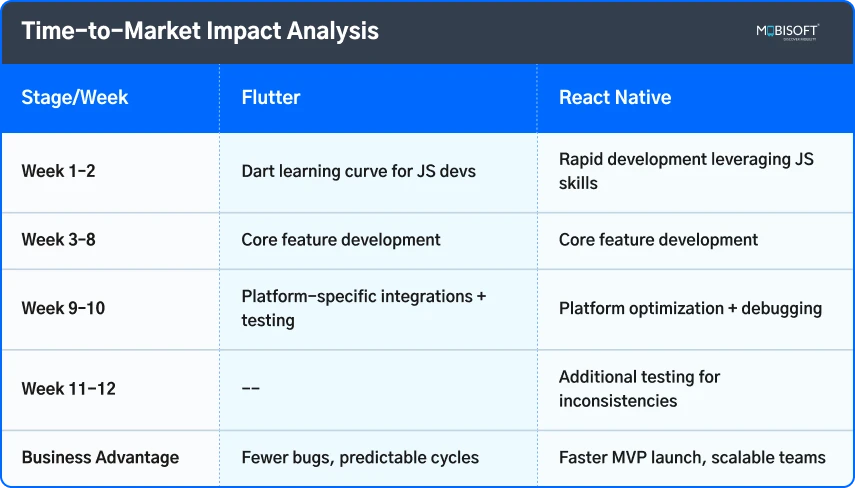
Time-to-Market Impact Analysis
 Ready to unlock more value? Explore our Flutter app development services.
Development Team Productivity Metrics
Flutter Team Efficiency:
- Hot Reload: Sub-second code updates increase developer productivity by 20-30%
- Single Codebase: Reduces context switching between iOS/Android implementations
- Predictable Behavior: Fewer debugging sessions across different devices
- Widget System: Reusable components accelerate feature development
React Native Team Efficiency:
- Familiar Ecosystem: JavaScript developers are productive from day one
- Third-party Libraries: Extensive npm ecosystem speeds feature integration
- Web Code Sharing: Up to 70% code reuse between web and mobile apps
- Community Support: Large Stack Overflow knowledge base reduces learning curve
Real-World Business Scenarios
E-commerce Application Requirements:
- Flutter Choice: Consistent shopping experience, smooth animations for product galleries
- React Native Choice: Rapid A/B testing, integration with existing web analytics
- Decision Factor: Brand consistency vs development speed
Fintech Application Requirements:
- Flutter Choice: Pixel-perfect security UI, consistent user flows for compliance
- React Native Choice: Faster regulatory approval cycles with familiar web technologies
- Decision Factor: Security consistency vs regulatory timeline pressures
Enterprise Internal App Requirements:
- Flutter Choice: Unified training materials, consistent employee experience
- React Native Choice: Integration with existing web-based enterprise systems
- Decision Factor: Employee experience consistency vs IT infrastructure compatibility
The Business Reality: Development Costs and Timeline
Talent Acquisition Strategy
React Native's Advantage:
- Immediate availability: 65% of mobile developers know JavaScript
- Cross-team efficiency: Web developers can contribute to mobile projects
- Training costs: $2k-5k to upskill existing JavaScript developers
Flutter's Challenge:
- Specialized talent is required since only 25% of developers know Dart.
- Higher salaries 10-15% premium for Flutter-specific skills
- Training investment $8k-12k for comprehensive Dart/Flutter training
Time-to-Market Analysis
React Native Timeline:
- MVP: Faster initial development with existing JavaScript teams
- Full app: Benefits from a large developer talent pool for rapid scaling
- Team scaling is easy; you can add developers mid-project because of JavaScript's prevalence.
Flutter Timeline:
- MVP: requires an initial Dart learning curve but has fewer platform-specific issues.
- Full app: Generally faster long-term development due to consistent behavior.
- Team scaling requires specialized hiring or training investment.
Business Consideration: Higher initial expenditure in Flutter typically allows for higher ROI to firms with multiple mobile apps in plans or long-standing product roadmaps.
Read More : Flutter vs React Native in 2025: The Business Leader’s Guide to Choosing the Right Cross-Platform Framework