Mobile applications have become an essential part of everyday life. From food delivery and online shopping to banking, education, and entertainment, businesses increasingly depend on mobile apps to connect with customers. This growing demand has created exciting career opportunities for aspiring app developers.
For beginners who want to enter the mobile app development industry, Flutter has become a popular technology to learn. It allows developers to build applications for multiple platforms using a single codebase.
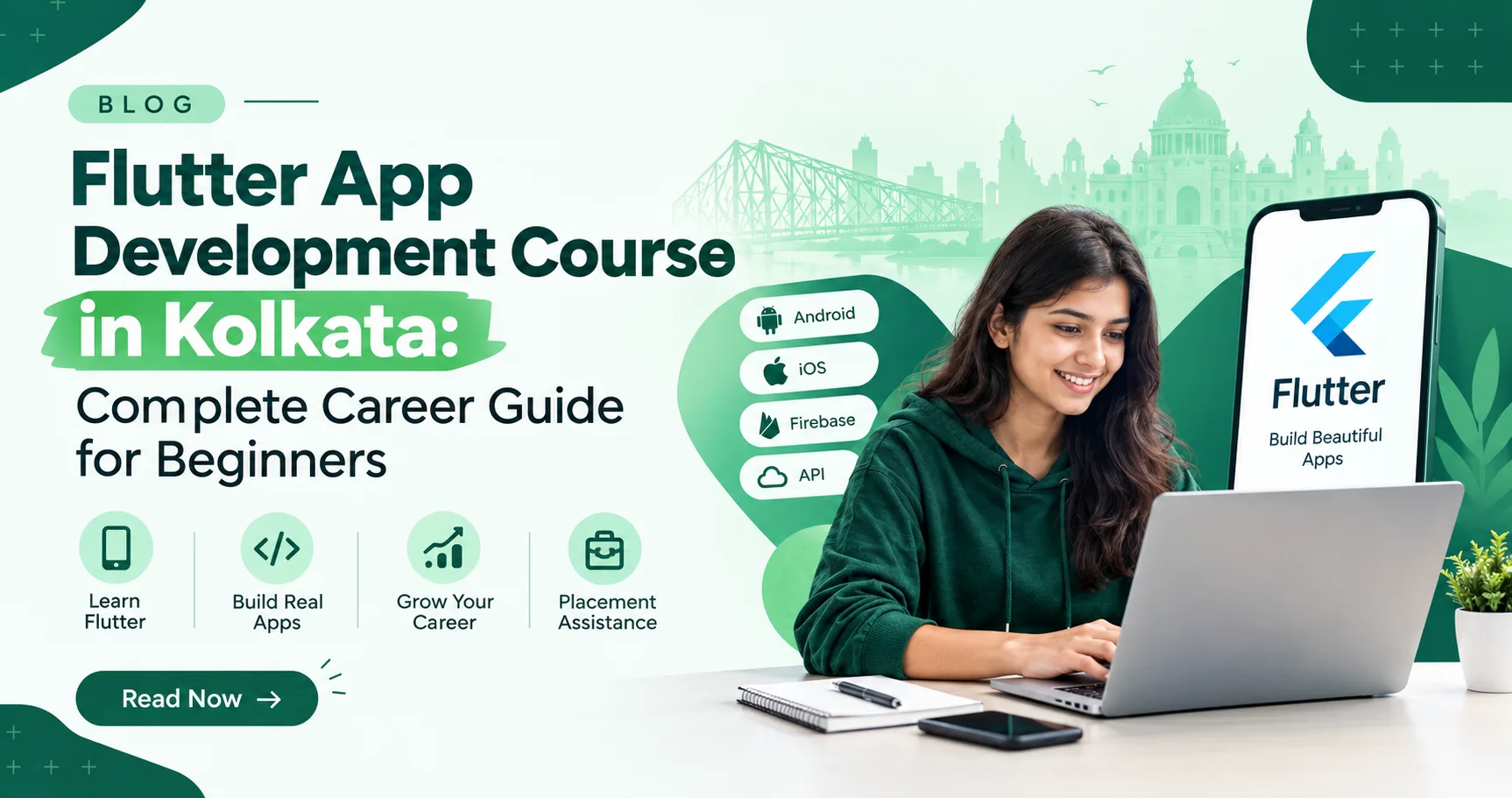
If you are considering a Flutter App Development Course in Kolkata, this guide will help you understand what Flutter is, what you can learn, career opportunities, required skills, and how professional training can help you become job-ready.
What Is Flutter App Development?
Flutter is an open-source UI software development framework created by Google. It uses the Dart programming language and allows developers to create applications for platforms such as Android, iOS, web, and desktop.
One of the biggest advantages of Flutter is its cross-platform development capability. Instead of creating completely separate applications for Android and iOS, developers can use a shared codebase for both platforms.
Why Is Flutter Popular?
Flutter offers several advantages for developers and businesses:
- Single codebase for multiple platforms
- Fast development process
- Customizable user interfaces
- Hot reload for quicker development
- Strong community and ecosystem
- Integration with APIs and databases
- Support for modern application development
These features make Flutter an attractive skill for beginners looking to build a career in mobile application development.
Why Choose a Flutter App Development Course in Kolkata?
Kolkata has a growing technology and startup ecosystem, creating opportunities for developers with practical software development skills. However, simply learning programming concepts may not be enough to secure a job.
A structured Flutter Training Institute in Kolkata can help beginners learn the technology systematically and develop practical skills through projects.
Learn From Basics to Advanced Development
A good course should start with fundamental programming concepts and gradually move toward advanced Flutter development.
Beginners can learn:
- Dart programming
- Flutter fundamentals
- UI and responsive design
- Widgets and layouts
- Navigation
- State management
- API integration
- Firebase
- Database connectivity
- Authentication
- Application deployment
This structured approach makes it easier for students without professional development experience to understand mobile app development.
What Will You Learn in Flutter Training?
A career-focused Flutter course should combine programming concepts with practical application development.
Dart Programming
Dart is the primary programming language used with Flutter. Students can learn variables, functions, classes, object-oriented programming, collections, exception handling, and asynchronous programming.
Understanding Dart properly provides a strong foundation for Flutter development.
Flutter UI and Widgets
Flutter provides a large collection of widgets for creating application interfaces. Students learn how to design screens, create layouts, handle user interactions, and build responsive interfaces.
API Development and Integration
Modern mobile applications frequently communicate with servers through APIs. Flutter training can teach students how to consume REST APIs, process JSON data, and display dynamic information inside applications.
Firebase Integration
Firebase is widely used for mobile application development. Training may include features such as authentication, cloud databases, notifications, and other Firebase services.
Real-World Projects
Projects are an important part of Job-Oriented Flutter App Development Training in Kolkata. Instead of only studying theoretical concepts, students can work on applications that demonstrate their development skills.
Examples may include:
- Food delivery applications
- E-commerce applications
- Social media applications
- Booking applications
- Service-based applications
- Business applications
Working on projects also helps students understand how different technologies work together.
Skills Required to Become a Flutter Developer
You do not need to be an expert programmer to start learning Flutter. Beginners can gradually develop the required skills through structured learning and practice.
Technical Skills
Important skills include:
- Dart programming
- Flutter framework
- UI/UX fundamentals
- REST APIs
- Firebase
- Database concepts
- Git and GitHub
- Debugging and testing
- App deployment
Soft Skills
Technical knowledge is only one part of becoming a successful developer. Communication, problem-solving, teamwork, time management, and the ability to understand project requirements are also valuable in professional environments.
Career Opportunities After Flutter Training
Learning Flutter can open several career paths in the software development industry.
Flutter Developer
Flutter developers create and maintain cross-platform mobile applications. They work with designers, backend developers, and other team members to build complete applications.
Mobile Application Developer
Flutter can also provide a foundation for broader mobile application development careers. Developers can gradually expand their knowledge of mobile technologies and development practices.
Front-End Application Developer
Flutter development involves extensive work with interfaces and user interactions. Developers with strong UI development skills can explore front-end-focused roles.
Freelance Flutter Developer
After gaining sufficient experience, developers can also work on freelance projects for startups, businesses, and individual clients.
Why Practical Training Matters
Watching tutorials or reading documentation can introduce you to Flutter, but professional development requires more than theoretical knowledge.
A practical training program should provide opportunities to:
- Write code regularly.
- Build complete applications.
- Work with APIs and databases.
- Debug application errors.
- Use Git and GitHub.
- Understand project requirements.
- Create a professional portfolio.
A portfolio containing real projects can be particularly useful when applying for internships or entry-level development positions.
How to Choose the Right Flutter Training Institute in Kolkata
With many training options available, beginners should evaluate a course carefully before enrolling.
Check the Course Curriculum
Make sure the curriculum covers Dart, Flutter, UI development, APIs, Firebase, databases, and project development rather than focusing only on basic concepts.
Look for Live or Practical Projects
Projects help transform theoretical knowledge into practical development skills. Ask whether the course includes complete application development.
Consider Placement Assistance
If your goal is employment, look for training programs that provide career guidance, interview preparation, resume support, and placement assistance.
Evaluate Faculty and Learning Support
Experienced trainers and regular doubt-solving sessions can make learning easier, especially for beginners.
Check Course Duration and Learning Format
Choose a course that provides enough time for practice and project development. A very short course may not provide sufficient exposure to real-world development.
Is Flutter a Good Career Choice for Beginners?
Flutter can be a good starting point for students, graduates, career switchers, and aspiring developers interested in mobile application development.
However, completing a course alone does not guarantee a job. Your career growth depends on how well you understand programming, how many projects you build, your problem-solving ability, and how consistently you continue learning.
The best approach is to combine structured training with regular practice and project development.
How to Start Your Flutter Development Career
If you are a beginner, you can follow a simple learning path:
Step 1: Learn Programming Fundamentals
Start with basic programming concepts and learn Dart.
Step 2: Learn Flutter
Understand widgets, layouts, navigation, state management, and responsive interfaces.
Step 3: Learn Backend Integration
Practice working with REST APIs, databases, authentication, and Firebase.
Step 4: Build Projects
Create several applications that demonstrate different features and development techniques.
Step 5: Create Your Portfolio
Upload suitable projects to GitHub and prepare a professional resume showcasing your technical skills.
Step 6: Prepare for Interviews
Practice coding questions, Flutter concepts, project-related questions, and common technical interview topics.
Start Your Flutter Development Journey in Kolkata
The demand for mobile applications continues to create opportunities for developers who can build reliable and user-friendly apps. Flutter provides beginners with a practical way to enter this field because developers can work across multiple platforms using a single framework.
Choosing a structured Flutter App Development Course in Kolkata can help you move from programming fundamentals to real-world application development. Look for a program that combines practical training, projects, modern development tools, and career support.
If your goal is to become a job-ready mobile application developer, start by building strong fundamentals, practice consistently, and create projects that demonstrate what you can actually build.
Ready to start your Flutter development journey? Explore a practical Flutter course, build real applications, and take your first step toward a career in mobile app development.