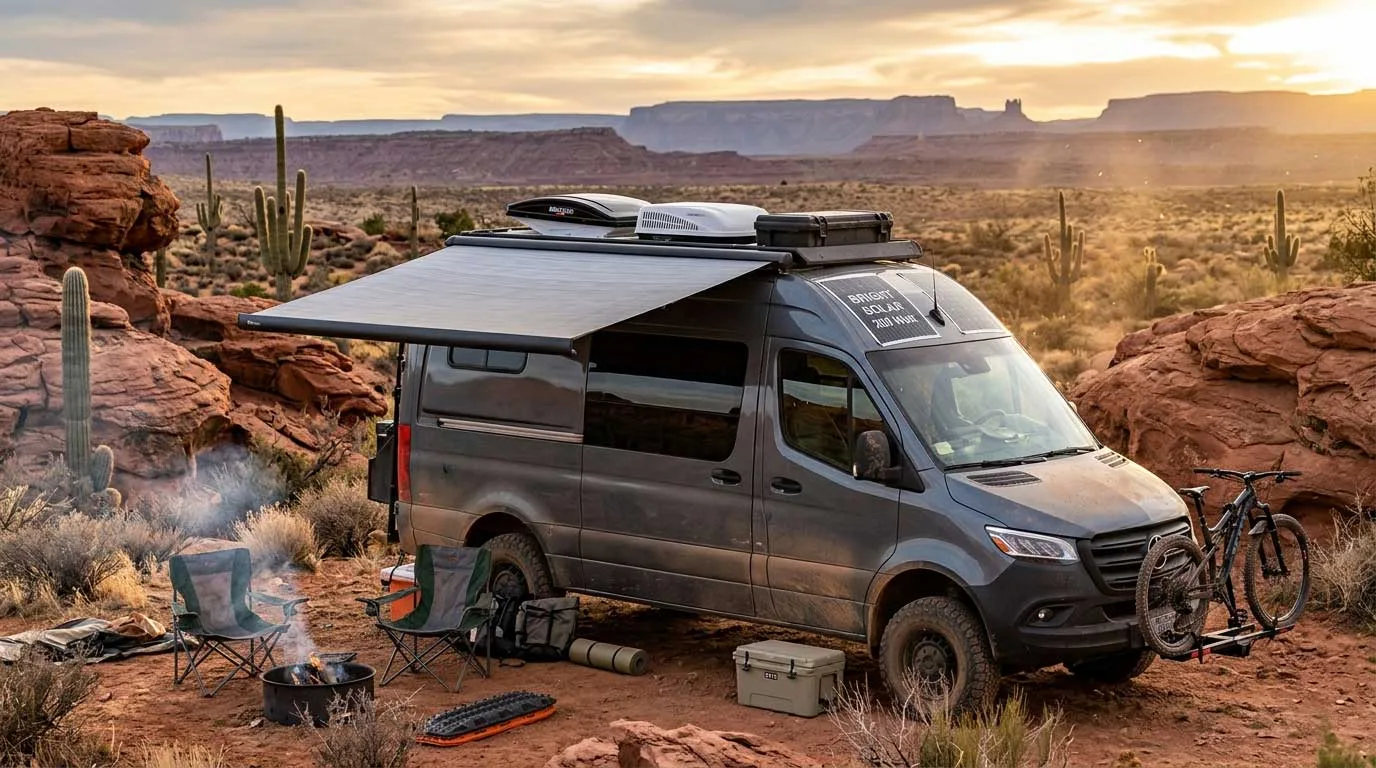
The short answer first: flexible solar panels for RV are often the best solution when weight, roof shape, and installation simplicity matter more than achieving the absolute highest efficiency. They allow RV owners to add solar capacity without the bulk and structural demands of traditional glass panels.
After working with RV solar projects for more than ten years, I've noticed something that rarely appears in product brochures. Most RV owners don't start by asking about weight. They ask about watts.
Six months later, they're asking completely different questions.
Will the roof hold up?
Can the panel survive highway vibration?
Does it still charge properly after a summer in Arizona?
That's where the real conversation begins.

The RV Roof That Had No Room for Traditional Panels
A customer from Nevada contacted us while converting a Class B camper van. His roof was crowded with air conditioning units, vents, antennas, and a roof fan.
Traditional framed modules technically fit.
Barely.
The problem wasn't space alone. Every bracket introduced another roof penetration. Every kilogram increased stress on an already limited roof structure.
We selected flexible solar panels for RV installation instead.
The panels followed the slight curvature of the roof and required minimal mounting hardware. More importantly, they left room for future upgrades.
A year later, the owner reported more than 200 nights off-grid without needing campground power.
That project taught me something simple: sometimes the best solar system is the one that actually fits.
Why RV Owners Are Moving Toward Flexible Solar Technology
According to the RV Industry Association, millions of Americans travel by RV annually, with extended off-grid camping becoming increasingly popular.
At the same time, onboard electrical demand continues growing.
Modern RV users rely on:
- Refrigerators
- Starlink internet systems
- CPAP machines
- Laptop workstations
- Portable air circulation equipment
- Battery charging stations
Energy consumption that seemed excessive ten years ago is now normal.
As a result, demand for flexible solar panels for RV has increased because they allow more solar capacity without adding excessive roof weight.
For many RV owners, every pound matters.
Weight Matters More Than Most People Realize
One common mistake is comparing flexible panels only by efficiency.
In RV applications, weight often becomes the deciding factor.
A traditional glass solar panel includes:
- Tempered glass
- Aluminum frame
- Heavy mounting brackets
A quality flexible panel eliminates much of that structure.
I've worked on motorhomes where roof weight restrictions prevented additional rigid modules from being installed.
Flexible panels solved the problem immediately.
The owner gained charging capacity without modifying the vehicle structure.
That's not a theoretical advantage.
It's something I see repeatedly in real projects.
Highway Vibration Is the Real Test
Laboratory testing is useful.
Interstate highways are more honest.
Every RV experiences constant vibration.
Expansion joints.
Potholes.
Crosswinds.
Thousands of miles of movement.
Several years ago, I inspected a fleet of adventure vans that had traveled throughout the western United States.
The flexible panels had experienced extreme conditions:
Desert heat in Arizona.
Mountain temperatures in Colorado.
Heavy rain in Oregon.
What impressed me wasn't the appearance.
It was the consistency of power production after years of use.
Quality flexible solar panels for RV are designed specifically for mobile environments where vibration resistance becomes just as important as efficiency.
The Material Difference Most Buyers Miss
Not all flexible panels are built the same.
This is probably the biggest mistake I see from first-time buyers.
Many low-cost products use PET surface materials.
Premium panels typically use ETFE.
The difference becomes obvious after prolonged outdoor exposure.
ETFE offers:
- Superior UV resistance
- Better scratch protection
- Higher light transmission
- Longer service life
I've inspected RV roofs where PET surfaces showed visible yellowing after several years.
ETFE surfaces often remain remarkably clear.
For an RV owner planning long-term travel, that distinction matters.
Heat Can Affect Performance More Than Expected
One question I hear frequently is:
"Do flexible panels run hotter?"
The honest answer is yes, they often can.
Because flexible solar panels for RV are commonly mounted directly against the roof surface, airflow underneath is reduced compared with traditional framed panels.
According to the U.S. Department of Energy, solar cell efficiency decreases as operating temperature rises.
This doesn't mean flexible panels are a bad choice.
It simply means installation design becomes more important.
The best RV installations consider:
- Roof color
- Surface temperature
- Ventilation opportunities
- Local climate conditions
Solar performance is influenced by the entire system, not just the panel.
Real-World Durability Is About More Than Weather
When people think about durability, they often imagine rain or snow.
In RV applications, the bigger challenge is cumulative stress.
Thousands of miles of vibration.
Repeated thermal expansion.
Constant UV exposure.
Occasional tree branches.
Unexpected impacts during travel.
A panel doesn't fail because of one difficult day.
It fails because of years of small stresses.
That's why quality manufacturing matters.
At Bright Solar, our product development process focuses heavily on long-term durability testing rather than simply chasing maximum wattage ratings.
Because RV owners depend on reliability more than laboratory numbers.
Installation Mistakes I See Every Year
Interestingly, many performance issues aren't caused by the panel itself.
Common installation mistakes include:
- Poor adhesive selection
- Improper cable sealing
- Excessive panel bending
- Inadequate roof preparation
- Ignoring manufacturer mounting recommendations
One customer believed his solar system was underperforming.
After inspection, we discovered the issue wasn't the panel at all.
A partially damaged cable connection was causing voltage loss.
The panel received the blame.
The wiring was responsible.
What Bright Solar Has Learned from RV Users
Over the years, feedback from RV owners has been surprisingly consistent.
They rarely mention laboratory efficiency.
Instead, they talk about:
- Installation simplicity
- Roof weight reduction
- Long-term reliability
- Charging consistency
- Freedom from campground hookups
Those practical concerns influence how we design and evaluate products.
At Bright Solar, we focus on real operating conditions because that's where products spend their lives.
Not in testing facilities.
On highways.
In deserts.
Along coastlines.
At remote campsites hundreds of miles from the nearest power outlet.
Looking Beyond the Specification Sheet
Specifications matter.
Efficiency matters.
Warranty matters.
But after seeing hundreds of installations, I believe the most important question is different.
Will the system still be generating useful power after years of travel?
The answer depends on material quality, installation practices, and engineering discipline far more than marketing claims.
That's why experienced RV owners often choose products based on reliability history rather than headline specifications.
Final Thoughts
The popularity of flexible solar panels for RV continues to grow because they solve real-world challenges that traditional solar panels cannot always address. Their lightweight construction, installation flexibility, and compatibility with modern RV designs make them particularly valuable for travelers seeking greater energy independence.
Whether you're building a weekend camper, upgrading a Class A motorhome, or creating a full-time off-grid van conversion, the right solar system starts with understanding how the equipment will perform after thousands of miles—not just on installation day.
For RV owners who value roof compatibility, reduced weight, and dependable off-grid charging, flexible solar panels for RV remain one of the most practical solar solutions available today.