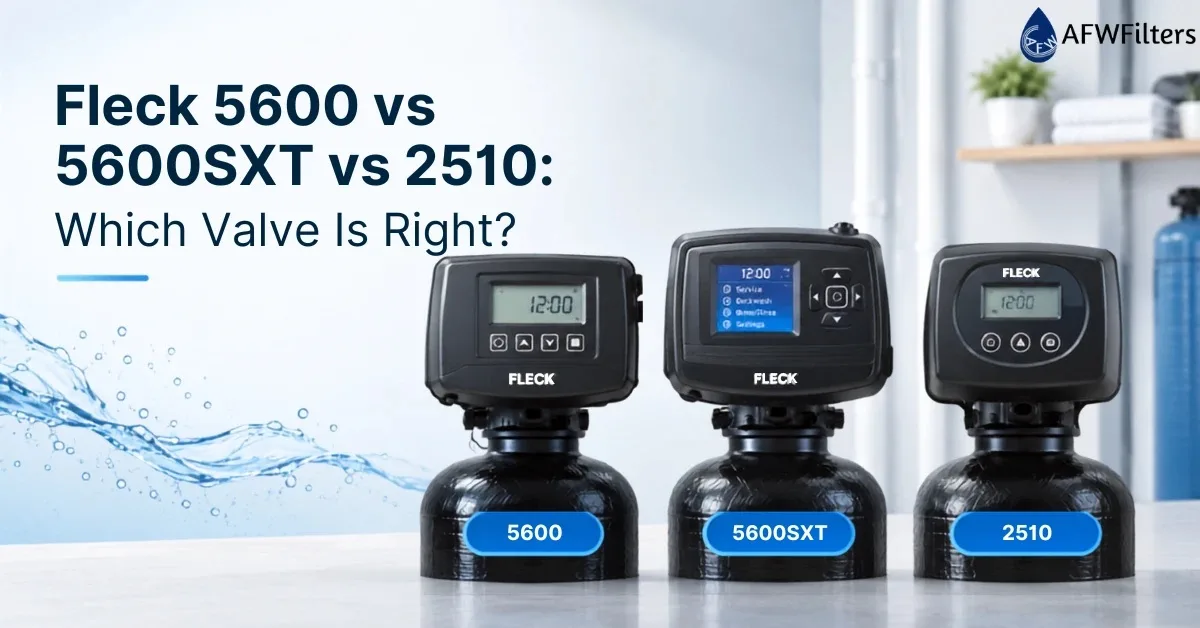
Shopping for a water softener usually leads to the same three valve names: the Fleck 5600, the Fleck 5600SXT, and the Fleck 2510. All three are Pentair valves with years of field use behind them, and each suits a different kind of home. The valve decides when your softener regenerates, so it quietly controls how much salt and water you go through over the next decade or more.
The biggest difference is how regeneration gets triggered. The 5600 is a mechanical time-clock valve with no display and no electronics. You set the day pins, and it regenerates on that schedule whether the resin needs it or not. It's simple, inexpensive to fix, and a sensible pick for steady households, sites with shaky power, or filter tanks like sediment, carbon, or Birm, where there's no capacity to meter.
The 5600SXT adds a digital head and a paddlewheel meter. SXT is just Pentair's name for the electronic controller, and the valve body underneath stays the same. It counts the gallons you actually use and regenerates only when the resin is nearly spent. Take a four-person home with 15 gpg hardness on a 48,000-grain system: that works out to about 46 regenerations a year, against roughly 122 for a time-clock set on a three-day cycle. Salt savings of 20 to 30 percent are typical. One detail people often get wrong is that after a power cut, only the clock needs resetting. Your hardness and capacity settings stay stored.
The 2510 solves a different problem. Its strength is backwash flow, up to 17 GPM, which lets it clean 14 and 16 inch tanks that the 5600 platform can't handle properly. Peak service flow is actually close between the two valves, so that isn't a reason to choose it. It makes sense for larger softeners, homes with five or more bathrooms, iron and sulphur filters, and light commercial use. It isn't a drop-in swap for a 5600, so a replacement head has to match your original platform.
If you're on a well, check your pump before settling on a big tank. A 16 inch tank backwashing at 17 GPM needs a pump that can hold that rate for the whole step, and one that only delivers 8 to 10 GPM won't clean the bed properly, whichever valve sits on top. If your water carries iron, put a dedicated iron filter ahead of the softener instead of asking the softener to do both jobs.
A simple rule keeps the decision easy: pick the tank first, then the valve. If you need a 14 or 16 inch tank, you're in 2510 territory. Otherwise, the 5600SXT usually gives the best balance of price and salt savings for a typical home.
The full guide goes further, with a side-by-side specification table, tank-size pairings, and a look at the 5800SXT, 9100SXT, and Clack WS1 as alternatives. If you're still deciding which valve fits your home, read more