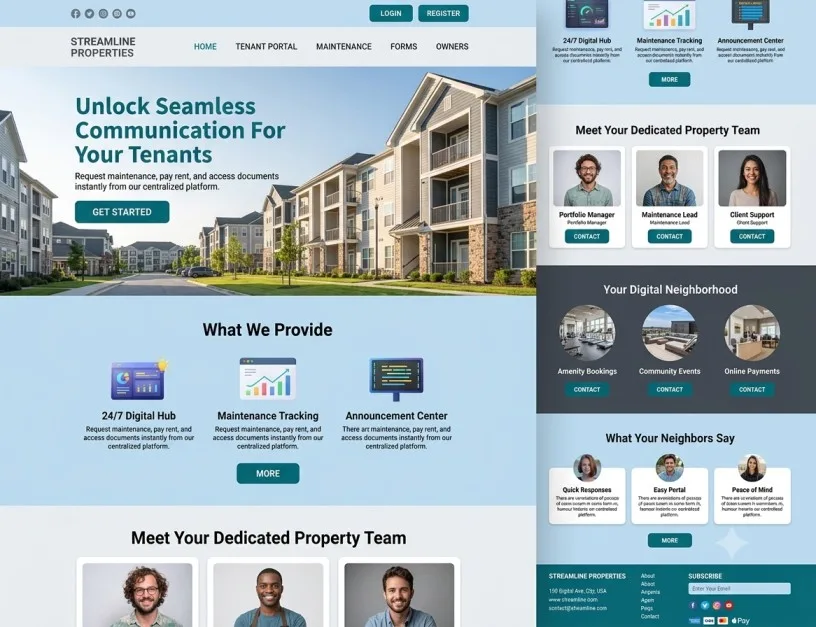
Modern leasing businesses operate in an environment that has changed dramatically over the past decade. Prospective tenants research properties extensively online before ever scheduling a viewing. Property owners expect digital transparency about the performance of their managed assets. Maintenance requests arrive at all hours and need organized tracking across multiple properties simultaneously. Lease renewals require proactive communication well ahead of expiry dates. And the competitive pressure to fill vacancies faster, retain quality tenants longer, and demonstrate professional management capability more convincingly than ever has intensified across virtually every rental market. A property management WordPress theme helps leasing businesses meet these demands with responsive property listings, online enquiry forms, maintenance request pages, tenant resources, and professional layouts that improve communication, streamline operations, and support business growth.
Meeting these modern leasing business demands effectively requires website infrastructure that goes substantially beyond basic property listing pages and a contact form. It requires genuinely feature-rich digital tools that handle the operational complexity of modern leasing while simultaneously delivering the professional digital experience that today's sophisticated tenants and property owner clients specifically expect.
A feature-rich property management WordPress theme designed for modern leasing businesses provides exactly this comprehensive operational and communication infrastructure. This guide covers what genuinely feature-rich means for leasing businesses and what specific capabilities matter most.
What Genuinely Feature-Rich Means for Leasing Businesses
Moving Beyond Basic Listing PagesA feature-rich leasing business theme goes substantially beyond providing attractive property listing pages with contact forms. Genuine feature richness means comprehensive functional tools that support the entire leasing lifecycle from prospective tenant discovery and property search through application submission and screening, lease execution and tenant onboarding, maintenance request management and resolution, lease renewal communication, and ultimately end-of-tenancy management.
This complete lifecycle coverage distinguishes genuinely feature-rich themes from more basic alternatives that handle the marketing-facing aspects of leasing reasonably well while leaving the operational depth that modern leasing businesses genuinely need to be addressed through additional, potentially poorly integrated, separate tools.
Features That Serve All Key StakeholdersModern leasing business websites need to serve multiple distinct stakeholder groups effectively: prospective tenants discovering and evaluating available properties, current tenants managing their ongoing tenancy relationship, property owners monitoring portfolio performance, and management staff coordinating operations across the portfolio. Genuinely feature-rich themes provide appropriate functional depth for each of these stakeholder groups, not just the prospective tenant marketing function that receives the most obvious attention.
Essential Features for Modern Leasing Business Themes
Advanced Property Search and Filter FunctionalityProspective tenants searching for rental properties today expect sophisticated search capability filtering by price range, bedroom count, specific amenity requirements, neighbourhood or geographic area, and property type. A feature-rich leasing theme provides advanced search and filter functionality that helps prospective tenants efficiently identify the specific properties matching their requirements, without requiring them to manually browse through every available listing, regardless of relevance to their situation.
This sophisticated search capability not only improves the prospective tenant experience but also reduces the time leasing agents spend answering basic qualification questions from prospective tenants whose requirements do not actually match available inventory.
Online Application and Screening IntegrationOnce a prospective tenant identifies an interesting property, the application process represents a critical conversion moment and friction in this process directly costs the leasing business prospective tenant commitments. A feature-rich leasing theme with comprehensive online application integration captures complete applicant information, including all documentation required for screening decisions, through a streamlined digital process that can be completed at any time on any device.
Integration with tenant screening services, providing credit and background check capability directly within the application workflow, accelerates the screening decision process that determines how quickly qualified tenants can be placed in available properties.
Tenant Portal With Comprehensive Self-ServiceCurrent tenant self-service capability represents one of the most operationally impactful features a leasing business website can provide. A feature-rich theme with comprehensive tenant portal functionality allows tenants to submit maintenance requests with photograph attachments, review their lease documentation, check their payment history, communicate with management staff, and access important community information, all without requiring individual staff interactions for each of these routine information needs.
The cumulative administrative time savings from effective tenant self-service across a substantial tenant population can be genuinely significant, representing meaningful staff capacity that can be redirected toward higher-value management activities.
Property Owner Dashboard and ReportingProperty owner clients managing their investments through a leasing company need transparent visibility into property performance. A feature-rich theme with owner dashboard integration allows property owners to review financial performance data, check occupancy status and lease expiry schedules, access maintenance expense records, and communicate with management, providing the transparency that builds owner confidence and sustains the management relationships that represent a leasing business's core revenue.
Virtual Tour and Media IntegrationModern property marketing increasingly includes virtual tour capability that allows prospective tenants to experience properties remotely before committing to an in-person viewing, extending effective marketing reach and improving the quality of viewing appointments by ensuring attendees have already developed a genuine interest through virtual exploration. A feature-rich leasing theme with a clean virtual tour and media integration supports this modern marketing approach effectively.
Lease Renewal Communication and ManagementProactive lease renewal management, beginning the renewal communication process well before expiry dates, is one of the most effective retention strategies available to leasing businesses. A feature-rich theme with organized lease renewal communication capability, systematic renewal offer delivery, tenant response tracking, and renewed lease execution supports this proactive retention approach that reduces costly vacancy episodes from poorly managed lease transitions.
Additional Features That Define Comprehensive Leasing Themes
Automated Communication and Notification CapabilityRoutine leasing communications application status updates, maintenance request confirmation, renewal reminders, and payment receipts benefit from automation that ensures consistent, timely delivery without requiring individual staff attention for each interaction. A feature-rich leasing theme with automated communication integration reduces the volume of routine communication that would otherwise consume substantial staff time.
Performance Analytics and ReportingUnderstanding leasing business performance across key metrics, vacancy rates, average days to lease, renewal rates, and maintenance response times requires organized data collection and reporting. A feature-rich theme with analytics integration provides the performance visibility that supports continuous operational improvement and demonstrates management quality to property owner clients.
Community and Development-Level ManagementFor leasing businesses managing large apartment communities or multi-property developments, community-level features, such as shared amenity booking, community announcements, and development-specific maintenance portals, add significant value for both management operations and tenant experience quality.
Conclusion
A feature-rich property management WordPress theme for modern leasing businesses provides the comprehensive operational infrastructure, advanced property search, online applications, tenant self-service portals, owner reporting, virtual tour integration, proactive renewal management, automated communication, and performance analytics that genuinely distinguish modern, professionally operated leasing businesses from less capable operators relying on inadequate digital tools to manage increasingly complex leasing operations.
For leasing businesses ready to invest in genuinely comprehensive digital operational infrastructure, high-quality, premium WordPress templates built specifically for property management and leasing businesses provide the strongest starting foundation. The best premium WordPress templates for modern leasing businesses combine advanced search functionality, tenant and owner portal depth, automated communication capability, and professional design quality, giving your leasing business the comprehensive digital infrastructure needed to operate efficiently and compete effectively in today's demanding rental market.
Frequently Asked Questions (FAQs)
Q1. What specific features most directly reduce administrative overhead for leasing businesses managing large portfolios?
The features with the greatest direct administrative overhead reduction typically involve automating or enabling self-service for the highest-volume routine communication and information interactions. Tenant self-service maintenance request portals eliminate the phone and email back-and-forth currently consumed by maintenance request intake and confirmation for each individual request across the entire tenant population. Automated payment confirmation and reminder communication reduces the staff time currently consumed by routine payment communication that could be handled systematically without individual attention. Online application portals with integrated document collection eliminate the considerable staff time currently spent gathering required application documentation through fragmented back-and-forth communication with individual applicants. Owner self-service reporting portals reduce the time consumed by individual owner reporting requests that require staff to compile and deliver information that organized self-service access could provide immediately. Together, these automation and self-service capabilities can represent substantial aggregate staff time savings across a portfolio of any significant size.
Q2. How should a leasing business prioritize which features to implement first when investing in property management website infrastructure?
Feature implementation priority should be based on which capabilities address your leasing business's most significant current operational pain points and which provide the clearest path to immediate, measurable improvement in business outcomes. Online application capability typically deserves high priority because it directly affects the most commercially critical metric, how quickly available units are filled with qualified tenants, while simultaneously improving applicant experience and potentially reducing application processing time. Tenant maintenance request portals deserve similarly high priority because maintenance management represents one of the most consistent sources of tenant dissatisfaction and management overhead across virtually all leasing operations. Owner reporting transparency follows closely because it directly affects property owner satisfaction and retention, which protects the managed portfolio revenue that underlies all other business operations. Other features can be implemented progressively as these highest-priority capabilities become established and their operational impact is understood and appreciated by both the management team and the tenant and owner clients they serve.
Q3. How important is virtual tour integration specifically for leasing businesses versus traditional in-person viewing emphasis?
Virtual tour integration has moved from being an optional premium feature to an increasingly expected standard capability for competitive leasing businesses, particularly for properties targeting younger tenant demographics who are comfortable with digital property evaluation and may even prefer virtual exploration before committing to in-person viewing time. The specific importance of virtual tours varies by market segment, luxury and higher-value rentals, and markets with significant out-of-area renter populations tend to see the most direct impact from virtual tour availability, since these tenants are most likely to make viewing commitments and potentially even leasing decisions based on virtual tours without necessarily requiring in-person visits in all cases. For most leasing businesses, virtual tours most effectively improve the quality of in-person viewings rather than entirely replacing them, by ensuring that prospective tenants who schedule in-person viewings have already developed a genuine interest through virtual exploration, reducing the proportion of viewing appointments attended by prospective tenants who discover relatively quickly that the property does not suit their needs.
Q4. How should a property management leasing website handle the presentation of pet policies across multiple properties with potentially different rules?
Pet policy communication across a diverse portfolio with property-specific rules requires a clear, accessible presentation at the individual property listing level rather than only general portfolio-wide policy statements that may not accurately represent every specific property's actual requirements. Each property listing should clearly state the specific pet policy applicable to that property, whether pets are permitted at all, which types and sizes are permitted, any associated pet deposits or ongoing pet fees, and any specific breed restrictions, since these details frequently vary meaningfully across different properties within a managed portfolio based on individual property owner preferences and building-specific considerations. A consistent, clearly labelled pet policy section within each property listing template makes this critical information immediately findable for the substantial proportion of prospective tenants for whom pet accommodation represents a primary filter criterion in their rental search, preventing wasted viewing appointments with prospective tenants whose pets would not be accommodated by specific properties they might otherwise be interested in.
Q5. What data should leasing businesses track through their website analytics to continuously improve their digital leasing performance?
Useful leasing business website analytics go beyond general traffic metrics to track specific indicators of how effectively the website is performing its core business functions. Property listing engagement metrics, which listings receive the most views, how long prospective tenants spend viewing specific listings, and which photographs or information elements receive the most attention, inform how to present available properties more effectively to attract and maintain qualified prospective tenant interest. Application funnel analytics tracking, where prospective tenants drop out of the application process, reveals specific friction points that inhibit completion, allowing targeted improvements to the application experience at the specific stages where abandonment is most common. Search query data showing what prospective tenants are searching for on the website and how these searches connect or fail to connect with available inventory can reveal inventory gaps or search implementation improvements. And conversion rate tracking from initial property view through application submission, application approval, and lease execution provides the end-to-end leasing process performance visibility that identifies where the most impactful improvement opportunities exist within the complete digital leasing journey.