
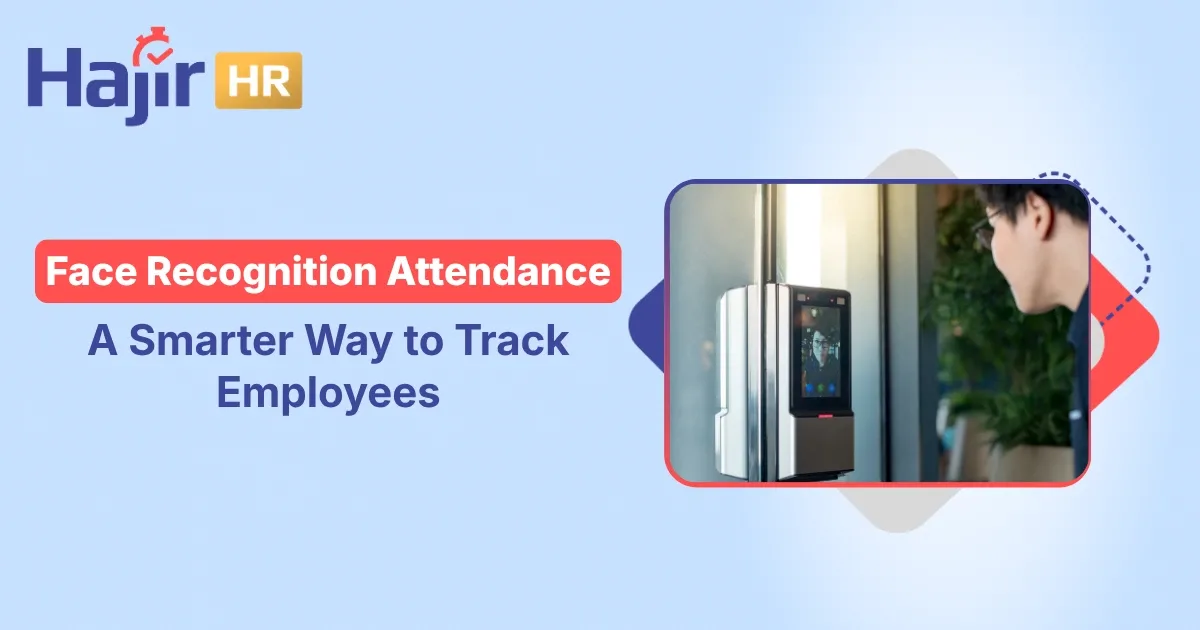
Face Recognition Attendance: A Smarter Way to Track Employees
Face Recognition Attendance is a game-changer in the way companies manage working hours. Thus, businesses no longer have to deal with the old punch cards or manual registers. Rather, they take attendance with Biometric Devices - with instant and accurate marking of attendance. Consequently, HR teams can save time, avoid errors, and avoid proxy attendance.
This article will cover all about Face Recognition Attendance systems. Thus, you will get to know how they operate, the rationale behind why companies use them and how to choose the optimum solution for your organization.
What Is Face Recognition Attendance?
Face Recognition Attendance is an AI-based employee recognition system based on facial features. In particular, the system analyzes a human face and compares it with a human face stored in the system. Once it has confirmed a match, it automatically records attendance.
How Face Recognition Attendance Works
The technology is based on three basic steps. Firstly the camera captures the picture of the employee's face. The software then transforms the face's characteristics into a unique digital code. Lastly, the system compares this code with the recorded codes to validate identity.
- The camera can identify a face within just a few seconds.
- The algorithm identifies facial features, including eye distance and jawline shape, etc. and provides a mapping.
- The software cross-checks the data against the employee database
- The system is used to mark attendance and record the time of entry
This process occurs automatically, so that employees do not have to touch any device. Therefore, the whole process is quick, sanitary and touchless.
Why Companies Choose Face Recognition Attendance
Face Recognition Attendance is becoming more popular for a number of practical reasons. The following are the top benefits that are listed below.
Face Recognition Attendance Eliminates Proxy Attendance
The traditional attendance system (ID cards or pin number) enables employees to sign-in other employees. But with facial recognition, that is eliminated entirely. The system will only let you register another person's face, so no one else can register for you.
Improves Accuracy and Reduces Errors
Mistakes can be made in the manual attendance registers. For example, handwriting might be mistaken or HR staff might enter the wrong time stamp. Face Recognition Attendance, on the other hand, automatically and accurately records data. So, payroll numbers are much more accurate.
Saves Time for HR Teams
Typically, HR teams spend hours gathering attendance information. However, this information is gathered in real-time with automated facial recognition software. This frees up time for HR professionals to concentrate on more strategic activities rather than administrative ones.
Enhances Workplace Security
The system identifies each person that enters the premises, making it more secure at the same time. In addition, there is no way for unauthorized visitors to be able to skip the check-in procedure. This means that companies are able to keep better control of the people accessing their facilities.
Key Features to Look for in a Face Recognition Attendance System
Businesses need to analyze certain features before opting for a solution. Here is a checklist to help you make your decision.
Essential Features of a Reliable System
- The system requires to have the following important features:
- Facing forward: The system is able to identify faces in 1-2 seconds
- Accuracy: The recognition accuracy rate should be more than 99%
- No contact operation: Staff members should never have to touch a scanner
- Cloud integration: The software must have the ability to integrate with payroll and HR Software.
- Mask detection: system should detect the face even if it is masked partially
- Multi-location support: It should be able to report attendance for different branches of the office.
- Security of data: The data has to be encrypted on the platform to ensure that nothing can be accessed unauthorizedly.
Advanced Capabilities Worth Considering
A few Face Recognition Attendance systems also provide other features. They can, for instance, contain temperature monitoring, geo-fencing, or the use of a mobile application to check-in. In addition, a number of platforms create in-depth analytics, consisting of late arrivals, absenteeism patterns, and overtime studies.
Industries That Benefit from Face Recognition Attendance
This technology has taken off in many industries to simplify the process. Here are some ideas.
Corporate Offices
Face Recognition Attendance helps to handle hundreds of employees efficiently in large enterprises. Furthermore, it seamlessly integrates with current HR software, ensuring payroll is smooth.
Manufacturing and Factories
Many factories have workers that work in shifts. So, with facial recognition, you'll have an accurate shift record and you won't have to deal with time theft on the production floor any longer.
Educational Institutions
This technology is used to monitor attendance of staff in schools and universities. Besides, it aids administrators in quickly detecting a pattern of absenteeism.
Healthcare Facilities
Strict access control and accurate staff scheduling of the hospitals is required. Hence, Face Recognition Attendance assures healthcare administration to comply and ensure safety measures.
Common Challenges of Face Recognition Attendance
There are a number of challenges to this technology, but there are also a number of benefits. Knowing these can help businesses prepare better.
Privacy Concerns
Staff can have concerns about companies' storage and use of biometric information. As such, businesses need to adhere to data protection policies and must educate employees on data policies.
Initial Setup Costs
There will be costs involved with implementing a new system, such as the cost of cameras, software, training, etc. The long term time and accuracy savings however may make up for the initial price.
Lighting and Environmental Factors.
Sometimes lighting conditions affect the accuracy of recognition. However, this limitation has been overcome well in modern systems with infrared sensors.
How to Implement Face Recognition Attendance Successfully
Planning is important for implementation. To make rollout easy, do the following:
Steps for a Smooth Rollout
- Determine what attendance monitoring is required for your organization.
- Select an accurate vendor with good data security measures
- Let staff know about the new system and discuss privacy concerns.
- Mount cameras in obvious, visible areas.
- Test the system with small group before rollout of the system is planned for the entire company
- Seamlessly connect to other payroll and HR systems
- Regularly track performance and receive feedback from employees.
By implementing the following steps, companies can make the transition smoothly without interfering with their daily work.
Face Recognition Attendance vs Traditional Methods
It's important to know the difference so businesses can make an informed decision.
Comparison Overview
- Biometric accuracy: Face recognition offers higher accuracy than manual registers or ID cards
- Speed: Facial scanning takes seconds, while manual entry takes minutes
- Fraud prevention: Unlike swipe cards, facial recognition prevents buddy punching entirely
- Hygiene: Contactless scanning remains safer than fingerprint scanners
- Cost over time: Although initial costs are higher, long-term maintenance expenses are lower
In conclusion, the comparison highlights the advantages of facial recognition over traditional approaches, demonstrating its growing popularity in the business world.
The Future of Face Recognition Attendance
Technology is still rapidly changing. The accuracy of the recognition will improve even more with the advancement of artificial intelligence. Also, perhaps more integration with mobile and wearable technology will be added. Hence, companies that embrace this technology will be ahead of the curve when it comes to workforce management.
Simplify Attendance Tracking with Hajir HRM
Looking to get rid of manual attendance once and for all? Powerful Face Recognition Attendance technology, combined with full HR management tools, means your team doesn't spend as much time on hours and more on growing the business.
Whether it's automating payroll sync or monitoring attendance, Hajir HRM has got you covered with all the tools you need in one platform.
Schedule a free Hajir HRM Demo and experience real-time contactless attendance management.
Frequently Asked Questions
Is the personal data stored securely in Face Recognition Attendance?
Reliable systems help to encrypt biometric information and adhere to data protection legal requirements. But it's a best practice for companies to always check a vendor's security certifications before purchasing.
What is the price of a Face Recognition Attendance system?
The costs depend on how many users are needed, what hardware is required and what software features are needed. In general, cloud-based solutions are more cost effective than on-premise options.
Is Face Recognition Attendance right for the small business?
Absolutely. A lot of vendors offer scalable pricing plans currently. Thus, small businesses don't have to spend huge amounts of money on implementing facial recognition.
What is the time period of setting up Face Recognition Attendance?
The set-up typically requires several days to a week, depending on the size of the company. Enrollment of employees, where each employee's face is registered, is generally the quickest process.
Is it possible to integrate Face Recognition Attendance with payroll software?
Yes, most modern systems provide direct connection with payroll and HR systems. This means that attendance information is automatically captured and uploaded to the salary calculations, minimizing the need for manual data entry.
What would happen if the system does not identify an employee?
Reliable systems have a backup verification technique like by means of a PIN or manual override. Hence, workers have the option to still sign up even with occasional failures of facial recognition.