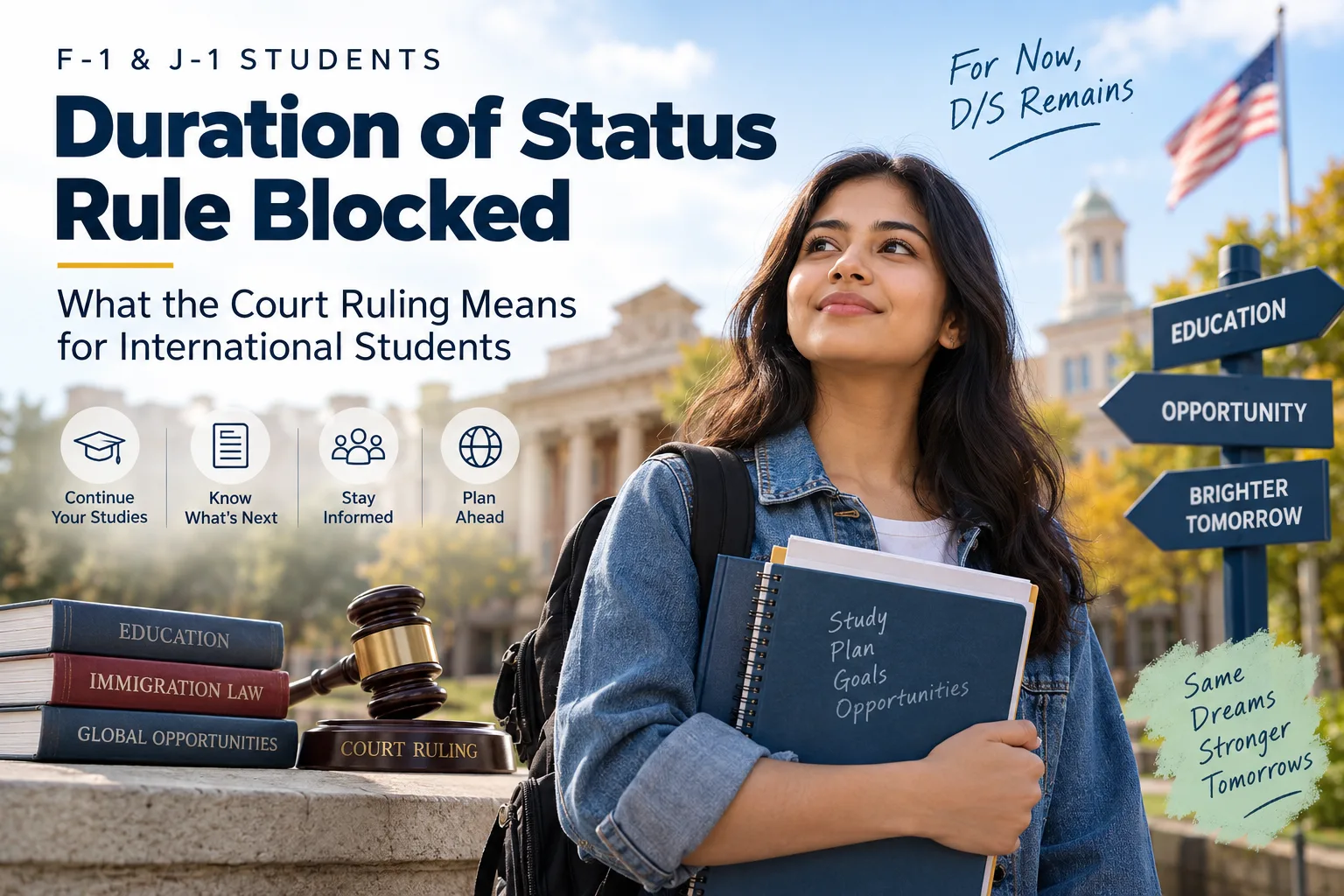
For international students in the United States, a court ruling on September 14 changed what could have been a major shift in immigration rules. A federal judge in Massachusetts issued a nationwide preliminary injunction just one day before the new duration of status rule was scheduled to take effect. The decision means the existing F-1 and J-1 duration of status system remains in place for now.
That does not mean the issue has disappeared. The injunction is preliminary, the government is expected to appeal, and the underlying policy remains part of the legal dispute. Students therefore have breathing room, but they still need to understand what changed, what did not, and what could happen next.
What the blocked rule would have changed
Under the existing system, most F-1 students and J-1 exchange visitors are admitted for “duration of status,” commonly shown as D/S on immigration records. Their stay generally continues while they maintain the requirements of their program.
The Department of Homeland Security's final rule would have replaced that system with fixed admission periods of no more than four years. Students who needed additional time would have had to apply to USCIS for an extension rather than relying on the existing school or sponsor processes.
The proposed changes went beyond the four-year limit. The rule would also have reduced the F-1 post-completion grace period from 60 days to 30 days and introduced additional restrictions involving school transfers, changes in educational objectives and additional degrees.
For a student completing a four-year bachelor's degree, the difference might have seemed manageable. For a doctoral student whose research takes five or six years, it could have created a very different situation. An additional USCIS filing would introduce another layer of cost, processing time and uncertainty.
Why the court blocked implementation
The judge's decision focused largely on how DHS developed and justified the rule. The court found that the challengers were likely to succeed on claims under the Administrative Procedure Act, including arguments that DHS had not reasonably assessed the rule's costs and benefits or adequately considered less burdensome alternatives.
The court also considered whether DHS had adequately addressed significant public comments. Nearly 22,000 comments had been submitted during the rulemaking process.
That distinction matters. The injunction did not amount to a final ruling that the policy itself could never be adopted. Instead, the court's concerns centered on the agency's rulemaking process. The case can therefore continue, and the legal position may change.
For students, that means the safest approach is to separate today's rules from possible future rules. The current system remains in place, but students should not assume that the dispute is finished.
What the ruling means for students now
The immediate effect is straightforward. The four-year admission limit and new extension-of-stay requirements did not take effect on September 15. The existing 60-day post-completion grace period also remains in place. The injunction applies nationwide rather than only to the organizations and institutions involved in the lawsuit.
Students in longer academic programs have particular reason to pay attention. Doctoral and research programs often extend beyond four years, so a fixed admission system could have created additional immigration paperwork at precisely the point when students are trying to complete dissertations or research.
The same applies to students considering a transfer, a new educational objective or another degree. Because the rule is currently blocked, those proposed restrictions are not operating under the new system.
Academic planning still matters, though. A student who discovers that a research project needs another semester has more options when the existing D/S framework applies than under a system built around a hard admission period.
Students dealing with demanding coursework may also seek academic assistance when they need help staying on schedule. Resources such as Expertsmind.com's subject expert network can connect learners with subject-specific support, while a dedicated term paper writing resource can be useful when a major written assignment becomes part of a tight academic timeline.
Preparation matters while the case continues
The research paper's central practical message is preparation. Students should speak with their designated school official about their program timeline, especially if completion could extend beyond four years. A DSO cannot predict the outcome of litigation, but they can identify where a student's current academic plan might create problems under a future fixed-admission system.
Keeping immigration and academic records organized is another simple step. Students should retain copies of their I-20 or DS-2019, I-94, enrollment records and relevant travel history. If the rules change, having those documents ready could make future administrative steps easier.
Financial planning also deserves attention. If the proposed rule eventually takes effect, extension applications could involve additional fees and waiting periods. Students in longer programs may want to account for that possibility without assuming that an extension will eventually be required.
Most importantly, students should follow reliable case updates rather than social media speculation. The paper notes that a status conference was scheduled for October 2, 2026, while organizations involved in international education continue to track the litigation.
What could happen next?
Several paths remain open. The government is expected to appeal, and the appeals court could leave the injunction in place, modify it or lift it. A later ruling on the merits could also determine whether the rule survives.
Another possibility is new rulemaking. Because the court's concerns focused on procedural issues, DHS could potentially attempt to address those concerns and issue another version of the policy. The research paper treats these as scenarios rather than predictions.
If the rule eventually returns in its current form, students could face the four-year admission limit, USCIS extension filings and a shorter grace period. Transition provisions would also matter, particularly for students already in the United States under D/S.
For now, the clearest takeaway is simple: the duration of status rule has been paused, not permanently erased. F-1 and J-1 students can continue under the existing framework while the case proceeds, but they should keep their records organized, understand their academic timelines and stay in contact with their DSO.