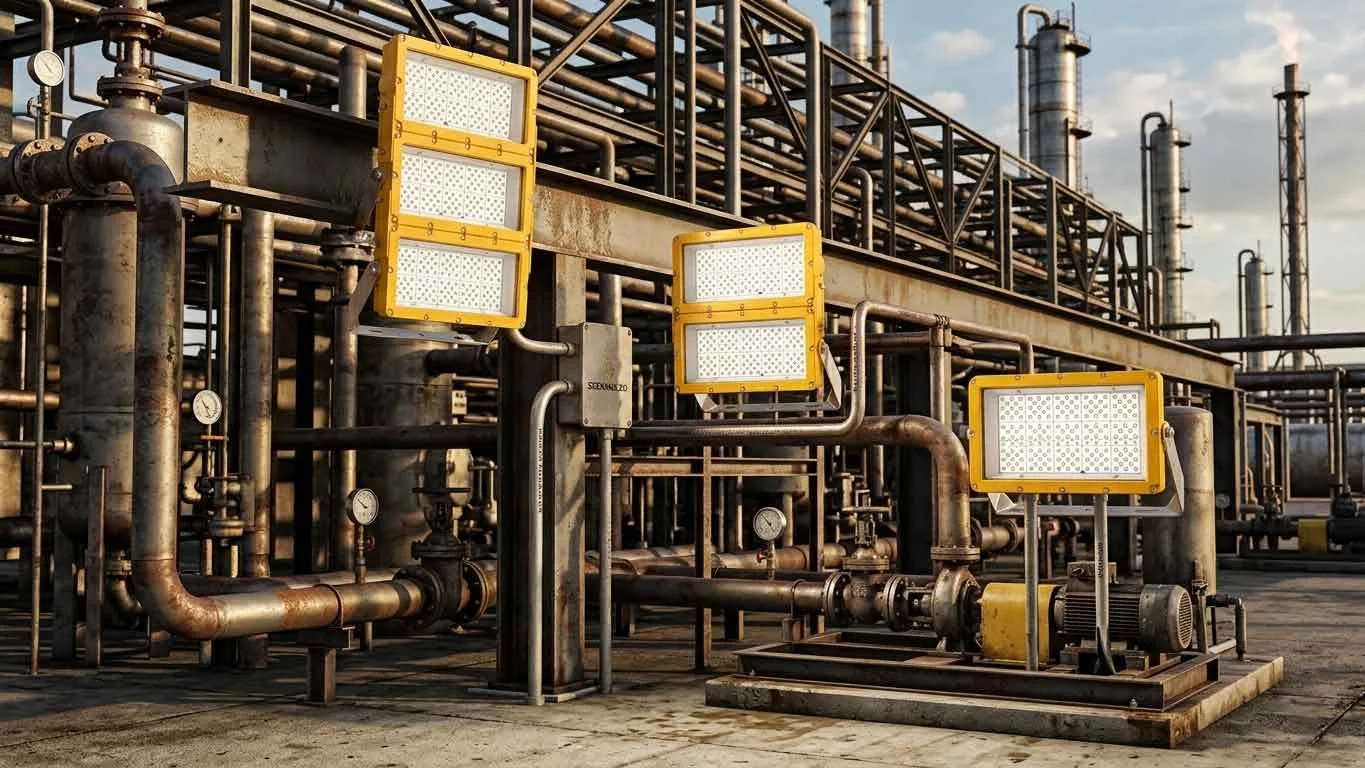
If you’ve ever stood inside a fuel transfer station during peak operation, you don’t think about lumens first—you think about risk. That’s where explosion proof lighting stops being a spec-sheet item and becomes part of the safety system.
Straight answer: explosion proof lighting is designed to contain ignition sources—heat, sparks, arcs—so they cannot interact with surrounding flammable gases or dust. Not reduce risk. Contain it.
That distinction matters more than most realize.
A small incident that changed how I evaluate fixtures
A few years back, I was involved in a retrofit at a coatings plant. The facility had been running standard industrial LED fixtures in a Zone 2 area. Not ideal, but common.
During a routine shutdown, one fixture was opened. Inside, we found early-stage carbon tracking near the terminal block. No failure yet. No visible damage from the outside.
But under the right conditions—solvent vapor concentration, temperature shift—that small arc could have been enough.
According to IEC 60079, even minor electrical discharges can ignite explosive atmospheres if the ignition energy threshold is met. That threshold can be surprisingly low, especially in environments with gases like hydrogen or acetylene.
The plant didn’t wait for failure. They replaced the entire lighting system with certified explosion proof lighting within three months.
What “explosion proof” really means in practice
There’s a misconception worth clearing up: explosion proof lighting doesn’t prevent explosions from occurring.
It assumes they might happen—internally.
The design philosophy is containment.
In flameproof (Ex d) systems, the fixture is built to:
- Withstand internal explosion pressure
- Prevent flame propagation outside the enclosure
- Cool escaping gases below ignition temperature
This isn’t theoretical. It’s physically tested.
Certification bodies run pressure and flame transmission tests under controlled conditions. If a fixture fails, it doesn’t get certified—simple as that.
That’s why properly designed explosion proof lighting feels different. Heavier. More rigid. Less “optimized” for cost.
Zone classification is where many projects go wrong
Hazardous areas aren’t uniform. They’re classified based on how often explosive atmospheres are present:
- Zone 0: continuous presence
- Zone 1: likely during normal operation
- Zone 2: unlikely, but possible
Here’s where mistakes happen.
I’ve seen projects where Zone 2-rated fixtures were installed in borderline Zone 1 areas. The logic was cost-driven: “conditions are similar.”
They’re not.
Zone 1 requires stricter containment because the probability of exposure is higher. Using lower-rated explosion proof lighting in that context isn’t just non-compliant—it increases operational risk.
Gas grouping adds another layer. Hydrogen (Group IIC) requires tighter flame paths than propane (IIA). That difference affects machining tolerances down to fractions of a millimeter.
Not something you fix after installation.
Heat management: the quiet failure point
On paper, LEDs are efficient. In reality, inside sealed enclosures, heat accumulates.
I remember a tank farm installation where ambient temperature regularly exceeded 45°C. Within eight months, cheaper drivers started failing—not catastrophically, just gradual instability.
Flicker. Output drop. Then partial shutdown.
According to the U.S. Department of Energy, LED lifetime decreases significantly as junction temperature rises. Even a 10°C increase can accelerate degradation.
Now combine that with:
- Sealed housing
- Direct sunlight
- Limited airflow
You start to see why thermal design matters more than raw efficiency.
Better explosion proof lighting systems address this by:
- Separating driver and LED chambers
- Using high-temperature-rated drivers
- Increasing heat dissipation through housing mass
Pick up a fixture—you can often tell the difference by weight alone.
Sealing is more complicated than IP ratings suggest
IP66 or IP67 ratings are standard for industrial lighting. But they don’t tell the whole story.
In offshore environments, I’ve opened fixtures that were technically “sealed” but still had internal condensation.
The cause wasn’t ingress—it was pressure cycling.
Temperature changes create internal pressure differences. Without proper venting, the fixture draws in humid air over time. Moisture accumulates, especially in coastal or chemical environments.
Advanced explosion proof lighting includes pressure equalization systems—small components that balance internal pressure without allowing flammable gases inside.
You won’t see them advertised much. But they make a difference after a year or two.
Installation: the weak link nobody budgets for
Here’s something uncomfortable: many failures aren’t product-related.
They’re installation-related.
Common issues I’ve encountered:
- Incorrect cable glands replacing certified ones
- Thread damage affecting flame paths
- Missing seals after maintenance
Under IEC guidelines, explosion protection applies to the entire assembly. One compromised component can invalidate the system.
I once saw a fully certified fixture fail inspection because of a non-compliant gland. Not a design issue. Just a replacement part chosen for convenience.
That’s why experienced contractors treat explosion proof lighting as a system—not a product.
What SEEKINGLED changed after real-world feedback
At SEEKINGLED, most improvements didn’t come from lab simulations. They came from field failures—small ones.
One petrochemical client reported gasket hardening after long-term UV exposure. We switched to higher-grade silicone materials. The issue disappeared in later batches.
Another case involved vibration-related driver failures. The fix wasn’t electrical—it was mechanical reinforcement inside the housing.
These adjustments aren’t dramatic. But they add up.
Over multiple projects, we’ve maintained a field failure rate below 0.3% across harsh environments—high humidity, high temperature, chemical exposure.
That number matters more than initial brightness.
Efficiency isn’t everything—and sometimes it’s misleading
There’s always a push for higher lumens per watt. It’s measurable, easy to compare.
But in hazardous areas, efficiency can be misleading.
A high-efficiency explosion proof lighting fixture running close to its thermal limit may degrade faster than a slightly less efficient one with better heat management.
Over time, stability wins.
Fewer failures mean fewer shutdowns. And in hazardous environments, every maintenance operation carries cost and risk.
What you notice after a year (not day one)
New installations always look good. Bright, uniform, clean.
The real evaluation happens later:
- After summer heat cycles
- After exposure to chemicals
- After months of vibration
That’s when materials, sealing, and thermal design show their true performance.
Good explosion proof lighting doesn’t draw attention.
It just keeps working.
Final note from the field
After enough site visits, your perspective shifts.
You stop asking how powerful the light is.
You start asking whether it will still be operating—quietly, consistently—after a year in a harsh environment.
Because in hazardous areas, reliability isn’t impressive.
It’s expected.
And that’s exactly what explosion proof lighting is built to deliver.