
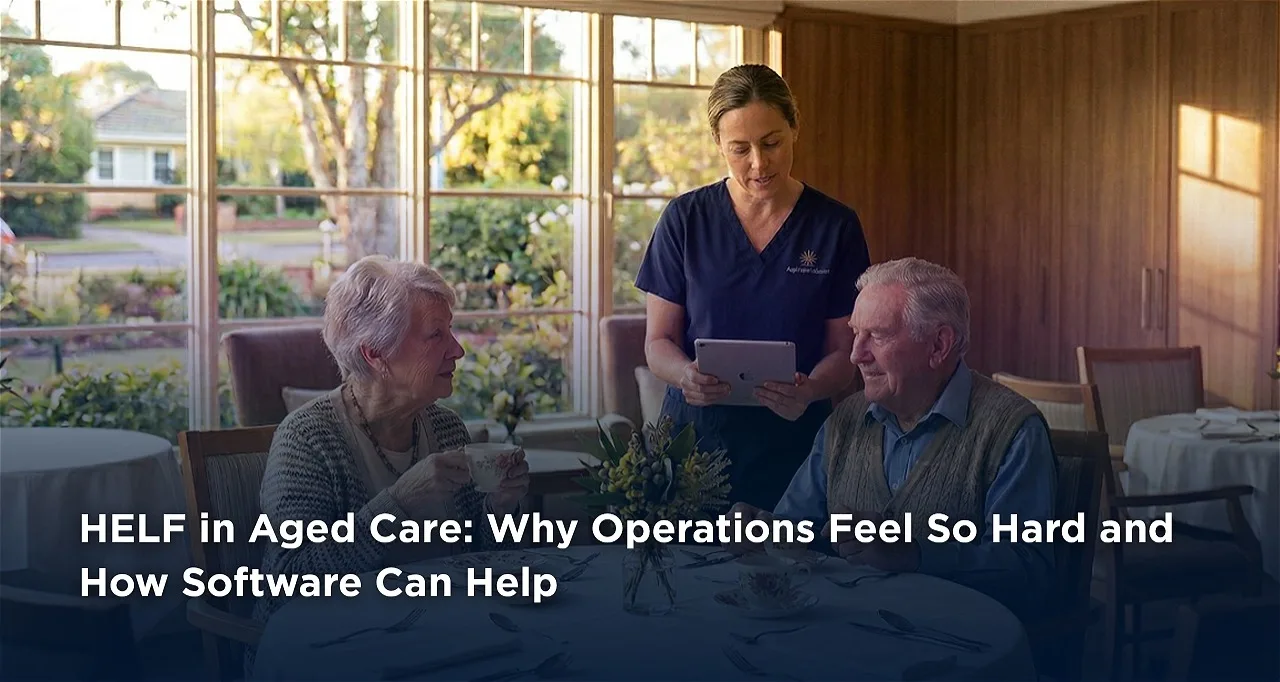
The phone starts ringing before the morning briefing ends.
A resident's daughter has seen the Higher Everyday Living Fee notice and wants to know exactly what her mother is getting for it. The facility manager looks at the handwritten roster on the whiteboard, the meal preference cards in the kitchen folder, and the maintenance log on the shelf. Everything the family wants to know is somewhere in this building. Pulling it together, right now, on this call, is another matter.
That is what HELF actually costs: not the fee itself, but the expectation attached to it. Showing residents and families precisely what they receive is where the pressure builds inside aged care facilities across Australia.
What HELF Actually Means for Day-to-Day Operations
Higher everyday living fees were introduced under the Aged Care Act 2024 to give providers a more sustainable funding base while making everyday costs visible to residents and families. The principle is simple enough: if a facility charges an everyday living fee, residents should be able to see what it covers.
What that requires in practice is a different matter. Aged care facilities now need to account for services delivered, such as dining, housekeeping, lifestyle activities, and maintenance, in a way that connects the fee to actual resident experience. Most facilities were not set up for that. Paper records, shared spreadsheets, and staff knowledge kept things running, but they were never designed to answer a family's question on a Tuesday morning with the right person off sick and the folder on the wrong floor.
The care is happening. The gap is in how visible it is.
The Real Pressure Points Facilities Are Feeling
Documentation that does not connect
Most aged care facilities track meal preferences, housekeeping schedules, lifestyle participation, and maintenance requests in separate places, and some track them nowhere formally at all. When a family asks what services their relative received last week, staff have to chase records across departments. By the time the answer comes together, the impression left is one of disorganisation, even when the actual care was excellent.
Staff workload at the wrong moments
Administrative reporting does not happen in quiet moments. It happens at the end of a long shift or at the start of a Monday when the care manager is already fielding calls. Compiling records manually takes time that would otherwise go to residents. For facilities already stretched on staffing, that trade-off is not abstract.
Family communication under the HELF lens
Families are asking more specific questions than before. The HELF notice gave them a reference point – they expect to see value in exchange for the fee. Facilities without a clear way to share what residents receive, day by day, are finding these conversations harder than they need to.
Why Traditional Methods Fall Short
Paper-based systems and disconnected spreadsheets capture information, but they do not connect it. A meal preference noted in the kitchen does not automatically link to the dietary profile in the care plan. A lifestyle activity attended does not generate a participation record that a family can see. A maintenance job completed does not leave a trail tied to the resident's living environment.
Under the Strengthened Aged Care Quality Standards, which came into effect on 1 November 2025, aged care facilities must demonstrate outcomes — not just intentions. Standard 6, which covers food and nutrition, is where this expectation sits most clearly. Assessors from the Aged Care Quality and Safety Commission now look for evidence that meal planning reflects individual resident needs and preferences, that dietary requirements are documented and followed across every shift, and that the dining experience supports wellbeing — not just basic nutrition.
On paper, across every resident, on every shift, that is a lot to hold together.
What a Connected System Changes
Digital aged care management platforms built specifically for residential care bring these records into one view – no paper chase required.
Centrim Life was designed for the workflows that exist in residential care: kitchen management, dietary tracking, lifestyle scheduling, housekeeping coordination, maintenance records, and family communication. Each feeds into the same resident profile. Nothing gets lost between departments.
For HELF specifically, the difference shows up in a few places.
Dining and dietary visibility
Centrim Life's Dining module holds each resident's meal preferences, dietary requirements, and texture modifications in a single record that kitchen staff, carers, and management can all see. When a new agency staff member starts a shift, they are not relying on handover notes or whoever happens to know. The information is current, accessible, and available.
That matters for ACQSC Standard 6 compliance, where the expectation is that food and nutrition decisions are documented, individualised, and reviewable. It also matters for the family on the phone: when they ask what their relative ate last week and whether preferences were followed, the answer is a few taps away.
Lifestyle participation records
Lifestyle activities are a visible part of what everyday living fees cover. Centrim Life's Lifestyle module records participation and allows carers to share updates through a connected family portal. Instead of waiting for a monthly newsletter, families see what is happening day to day. That changes the texture of family relationships with the facility: less chasing for information and more genuine reassurance.
Maintenance and environment accountability
The physical environment residents live in is part of what the everyday living fee represents. A searchable record of every request raised, every job completed, and every outstanding item supports ACQSC inspections and gives management a current picture of the facility's condition without chasing staff for updates.
Read more about HELF in aged care and why operations feel so hard and how software can help here:
<!--td {border: 1px solid #cccccc;}br {mso-data-placement:same-cell;}-->https://centrimlife.com.au/blog/helf-in-aged-care-why-operations-feel-so-hard-and-how-software-can-help/