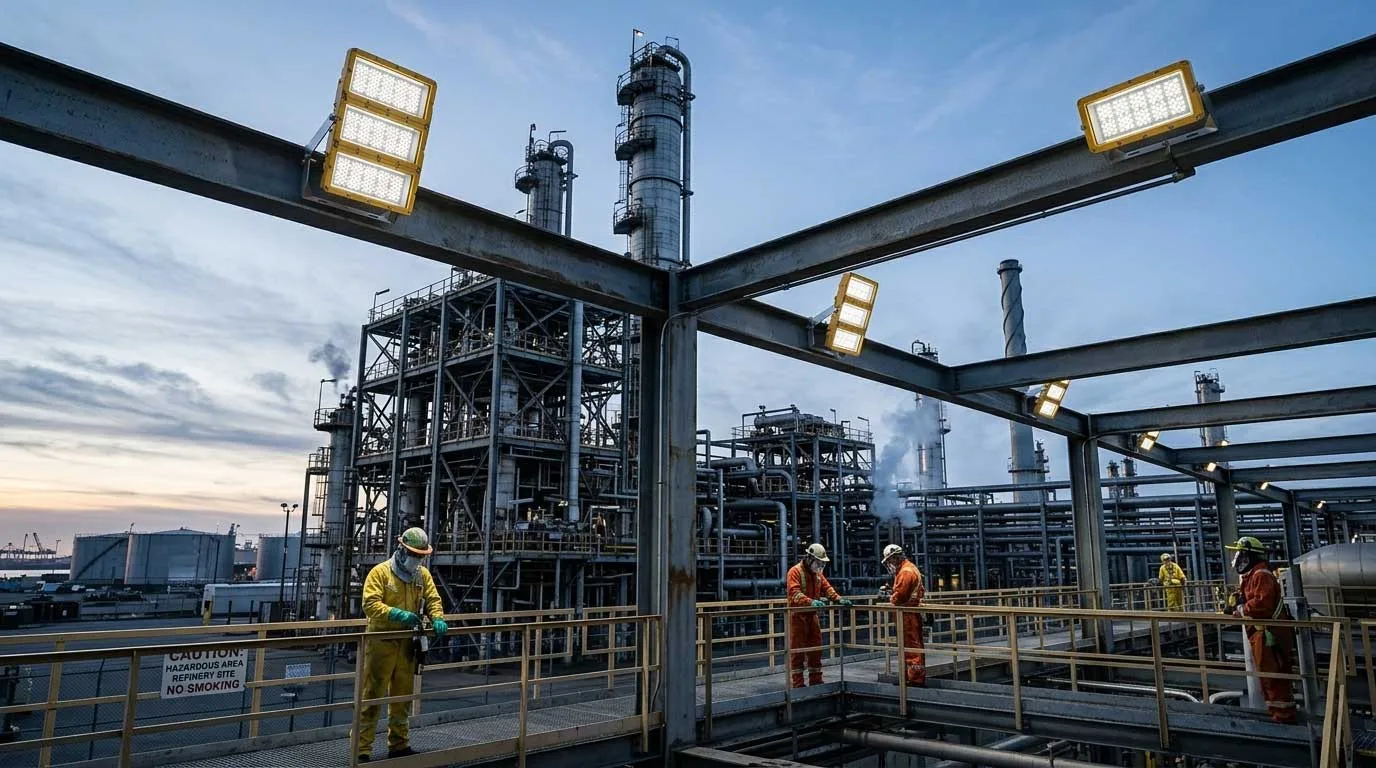
If you’ve ever worked inside a gas compression station or a solvent warehouse, you learn quickly—lighting isn’t just about visibility. It’s about control. Risk control.
So here’s the direct answer first: explosion proof lighting led is engineered to contain internal electrical faults and prevent ignition of surrounding flammable atmospheres, while maintaining stable output under heat, vibration, and contamination.
That’s the definition. But definitions don’t prepare you for what happens after six months on site.
A detail I didn’t notice—until it almost mattered
One project stays with me.
It was a retrofit in a petrochemical blending facility. The existing fixtures were early-generation LEDs, not explosion-rated. They had been running for years without incident.
During a shutdown inspection, one unit was opened. Inside, we saw minor carbonization at a terminal point. Barely visible. Easy to ignore.
But in environments with volatile organic vapors, even small arcs can become ignition sources. According to IEC guidelines, ignition energy thresholds for some gases—especially hydrogen—are extremely low.
No failure occurred. But that was enough.
The entire system was replaced with certified explosion proof lighting led within weeks.
Why LED changes the equation—but doesn’t eliminate risk
LED technology brought efficiency, longer lifespan, and lower heat compared to traditional lamps.
But inside explosion-proof enclosures, things behave differently.
Heat doesn’t disappear—it accumulates.
In one tank farm installation, ambient temperatures hit 47°C during summer. Within months, low-cost drivers started showing instability: flickering first, then gradual output loss.
The enclosure remained intact. The LED chips were fine.
The weak point was the driver.
According to the U.S. Department of Energy, LED performance and lifetime are directly tied to junction temperature. Elevated temperatures accelerate lumen depreciation and component aging.
Inside a sealed fixture, that effect compounds.
That’s why high-quality explosion proof lighting led designs typically include:
- Physical separation between LED array and driver
- Drivers rated for high ambient temperatures (often ≥55°C)
- Heavy-duty housings that act as heat sinks
You can often feel it—literally. A well-built fixture has weight. Not cosmetic weight. Thermal mass.
Certification: not just paperwork, but engineering constraints
It’s easy to treat certifications like labels. CE, ATEX, IECEx.
But once you’ve worked through a compliance audit, you realize they define the entire design.
Under IEC 60079, explosion protection isn’t optional—it’s structured:
- Gas groups (IIA, IIB, IIC) define ignition sensitivity
- Temperature classes (T1–T6) limit maximum surface temperature
- Protection methods (Ex d, Ex e, Ex n) dictate enclosure design
For example, hydrogen (Group IIC) requires tighter flame paths and stricter containment than propane (IIA). That affects machining tolerances, material strength, even assembly methods.
You can’t retrofit that into a standard fixture.
Proper explosion proof lighting led is built around these constraints from the beginning.
Sealing: where long-term reliability quietly fails
Everyone checks IP ratings. IP66, IP67—it’s standard.
But in real environments, sealing issues don’t always show up as water ingress.
In offshore installations, I’ve seen fixtures that passed all ingress tests still develop internal condensation over time.
The culprit? Pressure cycling.
Day-night temperature shifts create pressure differences. Without controlled venting, fixtures draw in humid air through micro-gaps. Over months, moisture accumulates.
Better designs use pressure equalization valves—allowing air exchange without letting hazardous gases in.
It’s not a headline feature. But after a year, it’s the difference between a clear lens and a fogged one.
Installation: the overlooked variable
You can specify the best explosion proof lighting led on the market and still end up with problems.
Because installation matters more than most expect.
I’ve seen certified fixtures fail inspection due to:
- Non-certified cable glands
- Damaged threads compromising flame paths
- Missing sealing rings after maintenance
Under IEC standards, explosion protection applies to the entire system—not just the luminaire.
One refinery supervisor once told me:
“We don’t fail because of equipment. We fail because of shortcuts.”
That line stuck.
What SEEKINGLED changed after real deployments
At SEEKINGLED, improvements rarely come from theory alone. They come from feedback—sometimes uncomfortable feedback.
One client reported gasket degradation after extended UV exposure. The fix was simple but precise: switch to higher-grade silicone materials.
Another project highlighted vibration-related driver failures in heavy industrial zones. The solution wasn’t electrical—it was reinforcing internal mounting structures.
Small changes. But across thousands of units, they define performance.
Today, our field data shows failure rates controlled below 0.3% over multi-year deployments, including high-temperature and high-humidity environments.
That number doesn’t come from perfect conditions. It comes from real ones.
Efficiency vs stability: a trade-off worth understanding
There’s always pressure to push efficiency higher—more lumens per watt.
But in hazardous environments, stability matters more.
A slightly less efficient explosion proof lighting led fixture that runs cooler and more consistently will often outperform a high-efficiency unit operating near its limits.
Over time, fewer failures mean fewer maintenance cycles.
And in hazardous zones, maintenance isn’t simple. It requires permits, shutdowns, safety protocols.
So the real metric isn’t efficiency.
It’s reliability over time.
What changes after a year
New installations always look impressive. Bright, uniform, clean.
But real evaluation happens later:
- After thermal cycling through seasons
- After exposure to chemicals or salt air
- After months of vibration and operation
That’s when material choices, sealing systems, and thermal design show their true value.
Good explosion proof lighting led doesn’t attract attention.
It just keeps working.
Final thought from the field
After enough time in hazardous environments, your perspective shifts.
You stop asking how bright the light is.
You start asking whether it will still be working—unchanged—after a year in conditions that quietly test every component.
Because in these environments, failure doesn’t announce itself.
And that’s exactly why explosion proof lighting led exists—to make sure nothing happens at all.