Explosion Proof ATEX PTZ Camera With IR in Oman Ports: Securing Container Yards, Cargo Gates, and Restricted Zones
A modern port can contain hundreds of moving assets within the same operational picture: cranes, trucks, containers, vessels, service vehicles and personnel. Add fuel pipelines, chemical cargo or flammable materials, and conventional security planning becomes considerably more complex. For your team, the challenge is not simply installing more cameras. You need the right surveillance technology in the right location, particularly where a classified hazardous area exists. Across Oman's major maritime and industrial centres, including Sohar, Duqm, Salalah and Muscat, coordinated monitoring can help security teams maintain visibility across container yards, cargo gates, service roads and restricted operational areas without confusing ordinary security requirements with hazardous-area protection.

Port surveillance starts with the operational environment
Container yards and cargo gates generally require broad security coverage. You may need to monitor vehicle movements, container handling, pedestrian access, perimeter fencing, crane activity and approaches to warehouses. A camera positioned on a lighting mast or building can often provide suitable coverage in these areas.
The requirements change when your surveillance point is close to fuel transfer, chemical handling or flammable cargo. Here, an Explosion proof ptz camera for Oman Hazardous Areas may be appropriate where the area classification and equipment certification call for explosion-protected equipment.
This distinction matters at Oman's ports. Sohar supports industrial and logistics activity, Duqm is developing as a major economic and maritime hub, and Salalah handles significant container and transhipment operations. Facilities supporting oil and gas, petrochemicals, warehousing, manufacturing and marine logistics can contain both ordinary and hazardous zones within the same wider site.
Your procurement specification should therefore divide the project into clearly defined surveillance areas rather than applying one camera type everywhere.
PTZ and IR improve visibility across critical zones
A PTZ camera gives your control-room operators a flexible field of view. Instead of permanently observing one narrow scene, you can programme presets covering a cargo gate, loading approach, transfer point, service road or restricted entrance. An operator can then move between predefined positions when an alarm, access event or operational requirement demands closer inspection.
A Hazardous area ex proof PTZ IR camera can extend this capability into appropriately classified locations. Infrared illumination is particularly useful during night cargo operations, planned maintenance and periods when normal lighting is reduced.
IR can also help when a power interruption affects conventional lighting, although it should not be treated as a substitute for emergency lighting or other safety systems. Dust, humidity, fog and airborne particles may scatter infrared energy and reduce image clarity. Your commissioning team should test the camera under representative site conditions rather than relying solely on laboratory specifications.
Long-range zoom can further reduce blind spots. From a suitable mounting position, your operator may inspect a distant gate, berth approach or transfer area without physically entering a restricted zone.
Placement is as important as camera selection
Port environments are constantly changing. Stacked containers can block previously clear sightlines. Cranes may move through the camera's field of view. Trucks can temporarily obscure gates, while vessels can introduce new visual obstructions when alongside.
Before finalising mounting locations, your team should assess:
- Container stacking heights and likely changes in yard configuration.
- Crane travel paths and lifting zones.
- Vehicle routes, security gates and pedestrian access points.
- Lighting poles, warehouses, fences and other structures.
- Vessel movements and changing berth visibility.
Maintenance access and safe cleaning of the optical window.
A camera installed too low may be obstructed by vehicles or containers. One mounted too high may provide a wide overview but lose useful detail at access points. PTZ presets should therefore be developed around actual operating scenarios, not simply evenly spaced viewing angles.
For coastal sites, environmental durability also matters. Salt-laden air, humidity, windblown dust, intense heat and temperature variation can affect exposed equipment. Robust construction, appropriate ingress protection and a maintenance plan should form part of the specification.

Separate ordinary security from hazardous-area certification
One of the most important procurement decisions is determining whether a camera is intended for general port security or installation inside a classified hazardous area. The two requirements should not be treated as interchangeable.
Where flammable vapours or combustible dust may be present, your engineering team should establish the applicable hazardous-area classification and select equipment accordingly. Certification must correspond to the zone, gas or dust group, temperature class and installation conditions.
ATEX is a European framework for equipment intended for potentially explosive atmospheres, while IECEx provides an international certification system for equipment used in explosive environments. DSEAR, HSE workplace safety standards and PUWER are UK-specific regulatory references and should not be presented as Omani legislation. For an Omani facility, you must follow applicable national requirements, authority approvals, project specifications and the site's hazardous-area assessment.
A supplier of hazardous area PTZ cameras Oman procurement teams are considering should be able to provide traceable certification documentation rather than relying on generic descriptions such as “explosion proof”.
This is particularly relevant to oil and gas terminals. An IR PTZ camera Oman hazardous area oil and gas operators select may need a substantially different specification from a camera protecting a standard container gate. Similarly, an explosion proof PTZ camera oil and gas Oman facilities use should be selected according to the precise classified location, not simply the industry sector.
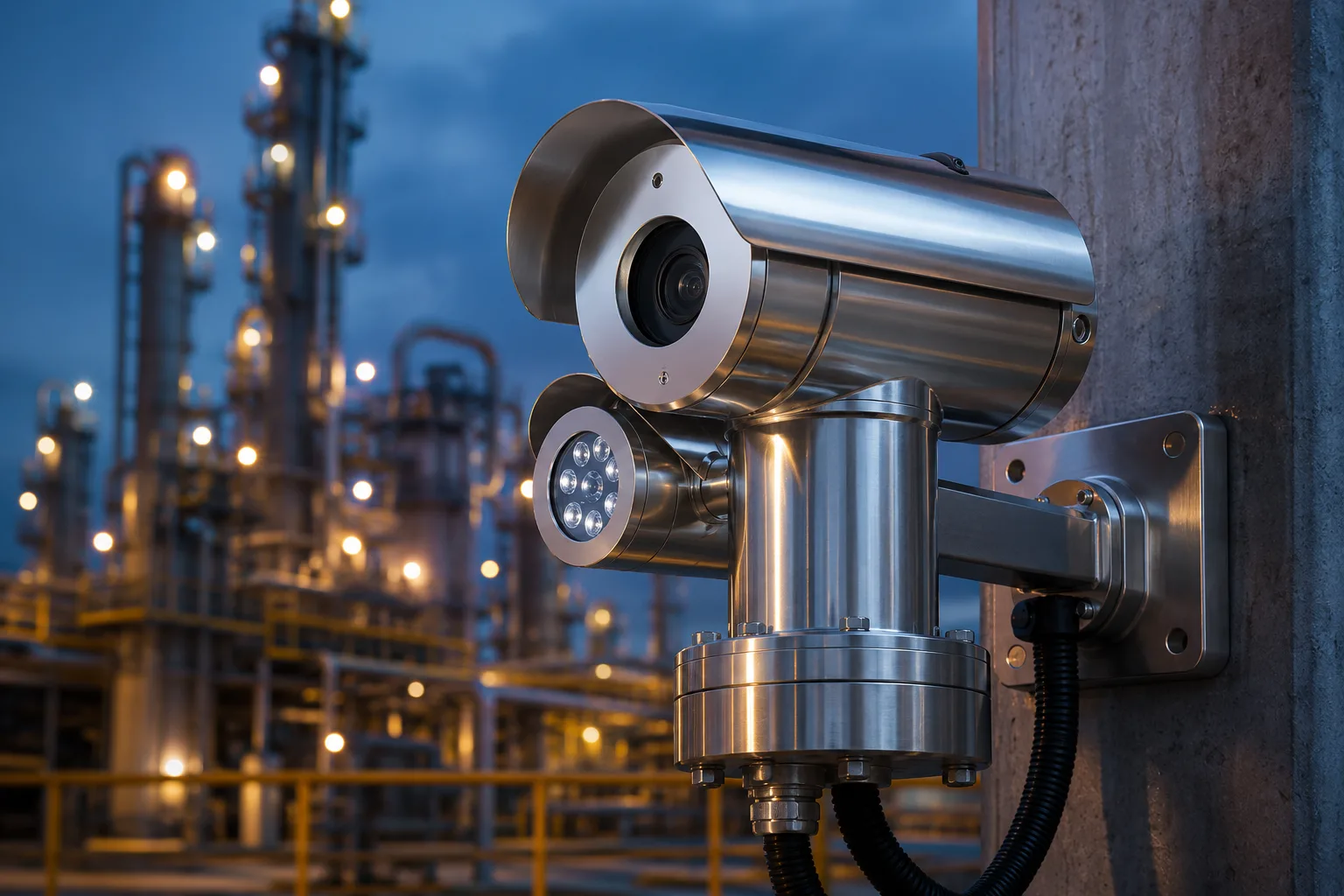
SharpEagle Explosion Proof ATEX PTZ Camera With IR
SharpEagle's ATEX-certified Explosion Proof ATEX PTZ Camera With IR is designed for hazardous industrial environments where explosive gas or dust may be present. According to the manufacturer's product information, the camera carries ATEX marking Ex II 2G Ex db II C T6 Gb / II 2D Ex tb IIIC, uses a 304 stainless-steel housing and provides IP68 ingress protection. Its specified operating temperature range is -30°C to +70°C.
For Omani industrial and maritime applications, its combination of protected construction, PTZ functionality and infrared monitoring can support continuous observation where conventional CCTV may not be suitable.
Key features include:
- 1920 × 1080 HD video at specified frame rates.
- 12x digital zoom for closer inspection.
- Infrared capability for low-light and dark conditions.
- Pan, tilt and zoom control for flexible area coverage.
- 304 stainless-steel construction.
- IP68 protection against dust and water ingress.
- Designed for continuous day-and-night monitoring.
Its PTZ functionality can help your security team inspect several critical viewing points from a central control room, while IR provides additional visibility when daylight or conventional illumination is insufficient. For an ex proof PTZ IR camera supplier Oman project, however, you should always verify the certificate, installation conditions and equipment suitability against the site's hazardous-area documentation before specifying the unit.
Conclusion
Oman's expanding maritime infrastructure demands a surveillance strategy that recognises the difference between general port security and hazardous-area monitoring. Your strongest approach is to combine fixed cameras, PTZ surveillance, access control and appropriate detection systems, while selecting certified equipment only where the hazardous-area assessment requires it. Careful positioning can then preserve visibility despite containers, cranes, vehicles and vessels changing the scene. As Sohar, Duqm and Salalah continue to develop, engineered surveillance will become increasingly important. To assess whether SharpEagle's ATEX PTZ solution fits your application, contact SharpEagle Technology for an informed discussion about your hazardous-area monitoring requirements.