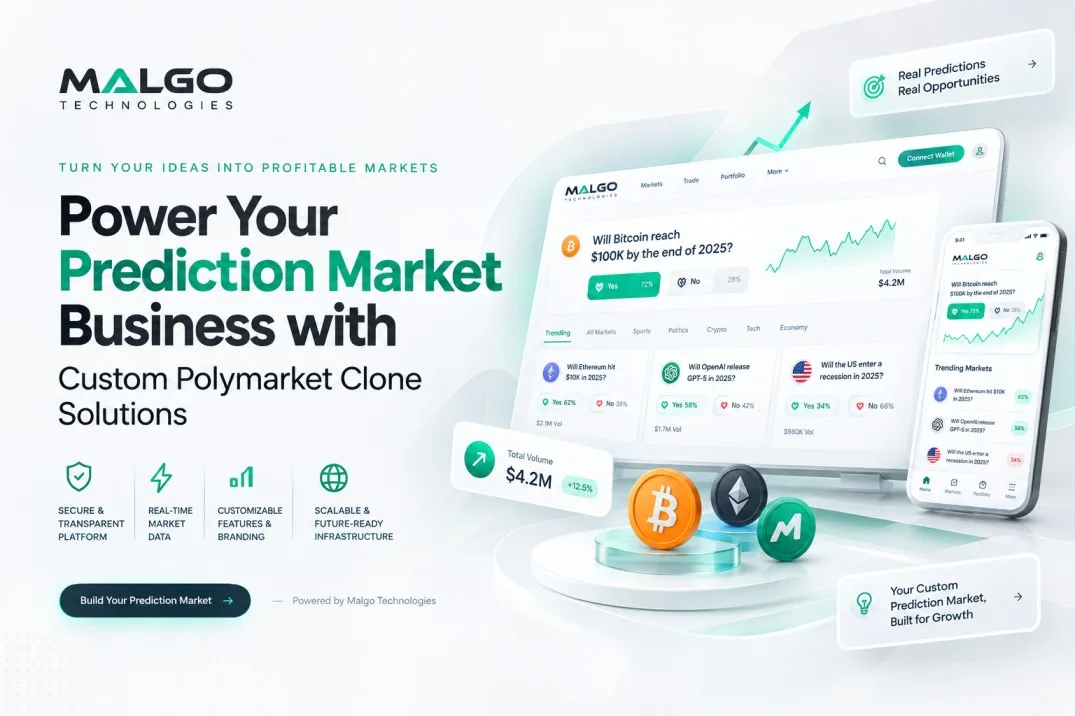
Prediction markets have evolved from niche forecasting platforms into sophisticated digital marketplaces where participants trade contracts tied to real-world events. A Polymarket-style platform brings together market discovery, trading infrastructure, real-time data, wallet connectivity, settlement logic, and risk controls in one ecosystem.
For businesses exploring Polymarket clone development, the objective should not be to reproduce another platform screen by screen. The stronger approach is to understand the underlying architecture and build a prediction-market product around a clearly defined business model, target audience, jurisdiction, and compliance framework.
What Is a Polymarket Clone?
A Polymarket clone is a prediction-market platform inspired by the functional architecture of Polymarket. Users can discover event markets, review available outcomes, place trades, monitor positions, and receive settlement based on predefined resolution rules.
Prediction-market contracts commonly use binary outcomes, although platforms can support more complex structures. The CFTC describes event contracts as instruments whose value is linked to whether an underlying event occurs, while market prices can reflect participants’ collective expectations.
The important point for developers is that the platform is more than a trading interface. It requires coordinated systems for market creation, order execution, liquidity, settlement, user accounts, data, security, and compliance.
1. Market Creation and Management
The market engine is the foundation of the platform.
Administrators or authorized market creators should be able to define:
- The event and market question
- Available outcomes
- Opening and closing conditions
- Trading window
- Resolution criteria
- Oracle or data sources
- Market status
- Settlement rules
Clear market wording is particularly important. A contract should explain exactly what event determines the outcome and which source will be used for verification.
This prevents ambiguity during settlement and gives traders a consistent reference before entering a position.
2. Trading and Order Management Engine
The trading engine connects users with available market liquidity. Depending on the business model, a platform may implement an order-book mechanism, automated market-making logic, or another matching architecture.
A robust order-management system needs to handle:
- Buy and sell orders
- Order matching
- Order cancellation
- Partial execution
- Market depth
- User positions
- Transaction history
- Real-time balance updates
Polymarket itself provides developer documentation covering market discovery, resolution, trading, and related data access, demonstrating how extensive the technical layer behind a prediction-market ecosystem can become. PPolymarket Help Center
3. Wallet and Account Infrastructure
A prediction-market application needs secure account and asset management.
Depending on the intended architecture, developers may integrate custodial accounts, external wallets, blockchain wallets, or a hybrid approach. The user experience should make deposits, withdrawals, positions, transaction history, and account activity easy to understand.
Security controls should include authentication, session protection, transaction validation, access controls, monitoring, and appropriate wallet-security architecture.
4. Oracle and Market Resolution System
Settlement is one of the most critical components of prediction market development.
An oracle or trusted data mechanism determines what actually happened. The platform then uses that information to resolve the contract according to its predefined rules.
A strong resolution framework should define:
- Authoritative information sources
- Resolution deadlines
- Handling of conflicting information
- Dispute procedures
- Administrative controls
- Audit records
This component deserves particular attention because a technically successful trade can still become a poor user experience if the final outcome is unclear or disputed.
5. Liquidity and Market-Making Infrastructure
A prediction market needs sufficient liquidity for users to enter and exit positions efficiently.
Developers can design liquidity mechanisms around market makers, incentives, automated liquidity models, or other strategies appropriate to the platform's structure. Liquidity programs also require careful monitoring because incentive design can introduce operational and regulatory considerations.
In August 2026, the CFTC specifically issued guidance reminding designated contract markets about regulatory obligations surrounding market-maker, liquidity, trading, and incentive programs.
6. Real-Time Data and Analytics
Prediction-market users expect fast access to information. A modern platform should therefore provide live market prices, order-book activity, trading volume, open positions, historical charts, and relevant market-status information.
A scalable architecture may use WebSockets, event-driven services, caching layers, streaming pipelines, and dedicated analytics databases to deliver this information without overloading the core trading system.
7. Security, Compliance, and Market Surveillance
Security cannot be treated as an optional add-on.
A production-grade platform should consider identity verification, access controls, suspicious-activity monitoring, transaction monitoring, fraud prevention, market-abuse detection, audit trails, and incident-response procedures according to the applicable jurisdiction and business model.
Regulatory requirements can also change. In 2026, the CFTC has continued developing its approach to prediction markets and event contracts, including advisory and rulemaking activity concerning contract listing, manipulation risks, and public-interest considerations.
For this reason, legal and compliance architecture should be considered during product planning rather than after development.
8. Admin Dashboard and Reporting
Behind the customer-facing application, administrators need operational controls for market creation, user management, transaction monitoring, dispute handling, market status, liquidity monitoring, content management visibility.
A comprehensive dashboard can provide controls for market creation, user management, transaction monitoring, dispute handling, market status, liquidity monitoring, content management, reporting, and system alerts.
Detailed audit logs are equally important because they provide a record of significant administrative and financial-market infrastructure with intuitive product design. The visible interface may appear straightforward, but the underlying system involves trading logic, settlement, data integrity transactional activity.
Building a Future-Ready Prediction Market
Successful Polymarket clone development is ultimately about combining financial-market infrastructure with intuitive product design. The visible interface may appear straightforward, but the underlying system involves trading logic, settlement, data integrity, security, liquidity, and regulatory considerations.
Businesses entering this space should begin with market rules and jurisdictional requirements, then design the technical architecture around those constraints. A modular backend, reliable real-time infrastructure, transparent resolution framework, strong security controls, and scalable trading engine can provide the foundation for a prediction-market platform that is prepared for future expansion.