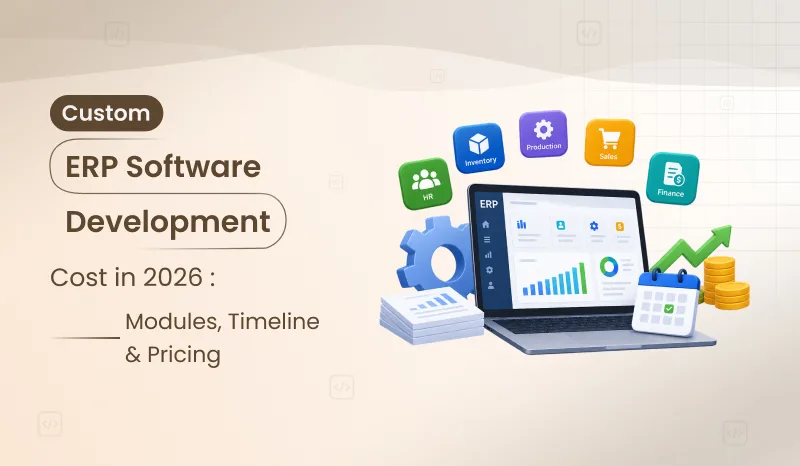
Custom ERP software development can replace spreadsheets, disconnected tools, and repetitive handoffs with one system built around how your company actually operates. But “ERP development cost” is not one number. Finance-only software and a multi-location ERP connecting sales, inventory, procurement, HR, reporting, and external systems are completely different projects. This guide breaks down the budget in a way you can actually use before asking for a quote.
If you only need the short answer: a focused custom ERP MVP can reasonably start around $20,000–$40,000 at India development rates (ERP software development cost in India is often lower than US or EU rates), a mid-market ERP with several connected modules commonly falls around $40,000–$100,000, and complex enterprise ERP programs can move beyond $100,000–$250,000+. These are planning ranges, not fixed Primocys quotations. The final cost depends on modules, workflows, integrations, data migration, permissions, reporting, compliance, and rollout complexity.
The useful way to budget an ERP: do not count screens first. Count business processes, user roles, approval rules, data sources, integrations and exceptions. Ten simple screens can cost less than one procurement workflow with multi-level approvals, inventory reservation, accounting entries and supplier synchronization.
How Much Does Custom ERP Software Cost in 2026?
The word “ERP” covers a huge range of software. A 25-person business may need sales, purchasing, inventory, and basic finance in one application. A larger company may need multiple legal entities, warehouses, locations, departments, currencies, approval hierarchies, audit trails, and integrations with accounting, eCommerce, logistics, or manufacturing systems. For a small business, ERP software development cost usually starts with a focused MVP rather than a full suite.

Illustrative planning ranges using India-based custom development economics. Actual scope, team composition, integrations, data quality, and acceptance requirements determine the final quote.
Building for a large organisation with SSO, compliance and multiple systems? Explore our enterprise software development services.
Want your own number? Share your modules, users and integrations and we will map a realistic budget. Get your custom ERP estimate →
ERP Development Cost by Module
For ERP software development cost, modules are a better starting point than a single “ERP price,” but even module pricing depends on workflow depth. An inventory screen that stores stock quantity is not the same as inventory software with multiple warehouses, transfers, reservations, batches, serial numbers, reorder rules and valuation.

Do not add these module ranges together and treat the result as a quote. Shared authentication, master data, design system, API infrastructure and common workflows can reduce duplication. On the other hand, complex integration and migration work can push the total above a simple module sum.
8 Factors That Affect Custom ERP Development Cost
ERP budgets grow with workflow depth, not screen count. These 8 factors show what drives ERP software development cost and where to save before you request a quote.

Custom ERP Development Timeline: How Long Does It Take?
Trying to launch every department at once is one of the easiest ways to make an ERP project slow and risky. A better plan is usually to establish shared master data and the most valuable operational workflow first, then roll out connected modules in controlled phases. That phasing is what keeps the custom ERP development timeline predictable.

Custom ERP MVP Development: What to Include
An ERP MVP should not mean “a tiny version of every department.” It should solve one connected business loop well enough to replace the current manual process. For a distributor, that might be customer order → inventory → purchasing → fulfillment → invoice. For a service company, it might be lead → quote → project → resource/time tracking → invoice.
A sensible first release usually includes authentication, role-based permissions, shared master data, 2–3 core modules, dashboard/reporting essentials, import tools, notifications where useful, audit history for important actions, and the integrations required to complete the chosen workflow. Our EMR and telemedicine platform development project shows how a focused first release can connect patient records, appointments, and staff management.
Planning your first ERP release? We can help you scope an MVP that proves one workflow before you invest in the full system. Talk to our ERP team →
Build vs Buy ERP: Custom ERP vs Odoo, NetSuite, SAP
Custom is not automatically the better answer. If your processes are standard and a mature ERP already covers them, buying and configuring existing software can be faster and lower risk. Custom development becomes more rational when your operating workflow is genuinely different, licensing grows expensive at your user count, multiple tools create constant manual work, or your competitive advantage depends on processes that packaged software handles poorly.

For a deeper framework, read Primocys’s Build vs Buy Software guide.
Hidden ERP Implementation Costs to Budget For
The development quote is only part of the ERP budget. Real implementations also need clean data, user acceptance, change management, and post-launch ownership. Ignoring these does not remove the cost — it usually moves it to the most stressful part of the rollout.
ERP COSTS BEYOND THE DEVELOPMENT QUOTE
- Data cleanup and migration: duplicate customers, inconsistent SKUs and incomplete supplier records have to be resolved somewhere.
- Third-party fees: cloud hosting, email/SMS, maps, payment providers, document services, and external APIs may have recurring charges.
- Training and process change: the system only creates value when teams use the new workflow correctly.
- Reporting iteration: management often discovers the reports it truly needs after real data begins moving through the new ERP.
- Maintenance: dependencies, security, infrastructure and integrations continue changing after launch.
- Future modules: a good ERP architecture should make later modules easier, but later modules still require product and engineering work.
How AI Changes ERP Development Cost in 2026
AI can be useful inside an ERP, but it should address a real operational problem. Examples include natural-language search across permitted records, extracting structured data from documents, summarizing account or supplier activity, suggesting next actions, anomaly detection, forecasting, or an agent that performs approved actions through ERP APIs.
The expensive part is often not calling an LLM. It is creating reliable APIs, permissions, retrieval, approval steps, audit logs, and evaluation around the action. A legacy ERP with weak APIs may need a middleware layer before an AI agent can safely interact with it.
See Primocys’s AI Integration Cost in Existing Software guide if AI is part of your ERP roadmap.
Custom ERP Architecture That Stays Maintainable
For most businesses, maintainability matters more than choosing the most fashionable architecture. A well-structured modular backend can be easier to operate than premature microservices. Modules should have clear responsibilities while sharing controlled identity, permissions, master data and audit infrastructure.
A modern ERP may use a web frontend such as React/Next.js, APIs built with Node.js, Python, Java or another suitable backend, a relational database such as PostgreSQL, object storage for documents, queues/background jobs for asynchronous work, and cloud infrastructure on AWS, Azure or GCP. The correct choice depends on the existing environment, team and integration requirements — not a fixed “ERP stack.”
What to Prepare Before Requesting an ERP Quote
You will get a much more useful estimate if you share the business process rather than a list that simply says “CRM + inventory + accounting.” A development team needs to understand what happens between those modules.
BRING THESE SEVEN THINGS:
- Departments and user roles that will use the ERP.
- Your current workflow from start to finish.
- Existing software and spreadsheets that will be replaced or retained.
- Required integrations and available API documentation.
- Data that must be migrated and approximate record volume.
- Reports, approvals and audit requirements that are business-critical.
- The first workflow/module that would create measurable value if launched.
Primocys: Custom ERP Development Company
Primocys is a custom ERP development company that builds ERP systems, custom software, SaaS products and operational platforms around business-specific workflows. For an ERP engagement, the useful starting point is not choosing a template — it is mapping processes, data, permissions and integration boundaries before deciding how much software actually needs to be custom.
If part of your requirement is primarily customer/sales management, review our Custom CRM Development capability. If the ERP will be delivered as a multi-tenant subscription product, our SaaS Development experience is also relevant. For large organisations needing SSO, compliance and legacy integration, see our enterprise software development company page.
Get a Project-Specific Custom ERP Estimate
Send us your modules, user roles, current tools, approval workflows, integrations and migration requirements. We’ll review your scope and help separate what belongs in the first release from what can wait for later phases.
Conclusion: Budget Your Custom ERP Around Workflows
Custom ERP software development cost is driven by workflows, roles, integrations and data migration, not by screen count. A focused MVP can start around $20,000–$40,000, while mid-market and enterprise ERP programs grow with scope. The safest path is to launch one high-value workflow first, then add modules in phases.
If you want a number based on your own processes instead of a generic range, share your requirements and the Primocys team will help you scope, phase and price your custom ERP.
Ready to Plan Your Custom ERP?
Share your requirements, existing ERP, Figma, or spreadsheets. We’ll review your workflow, identify the right scope, and help plan your custom ERP development.