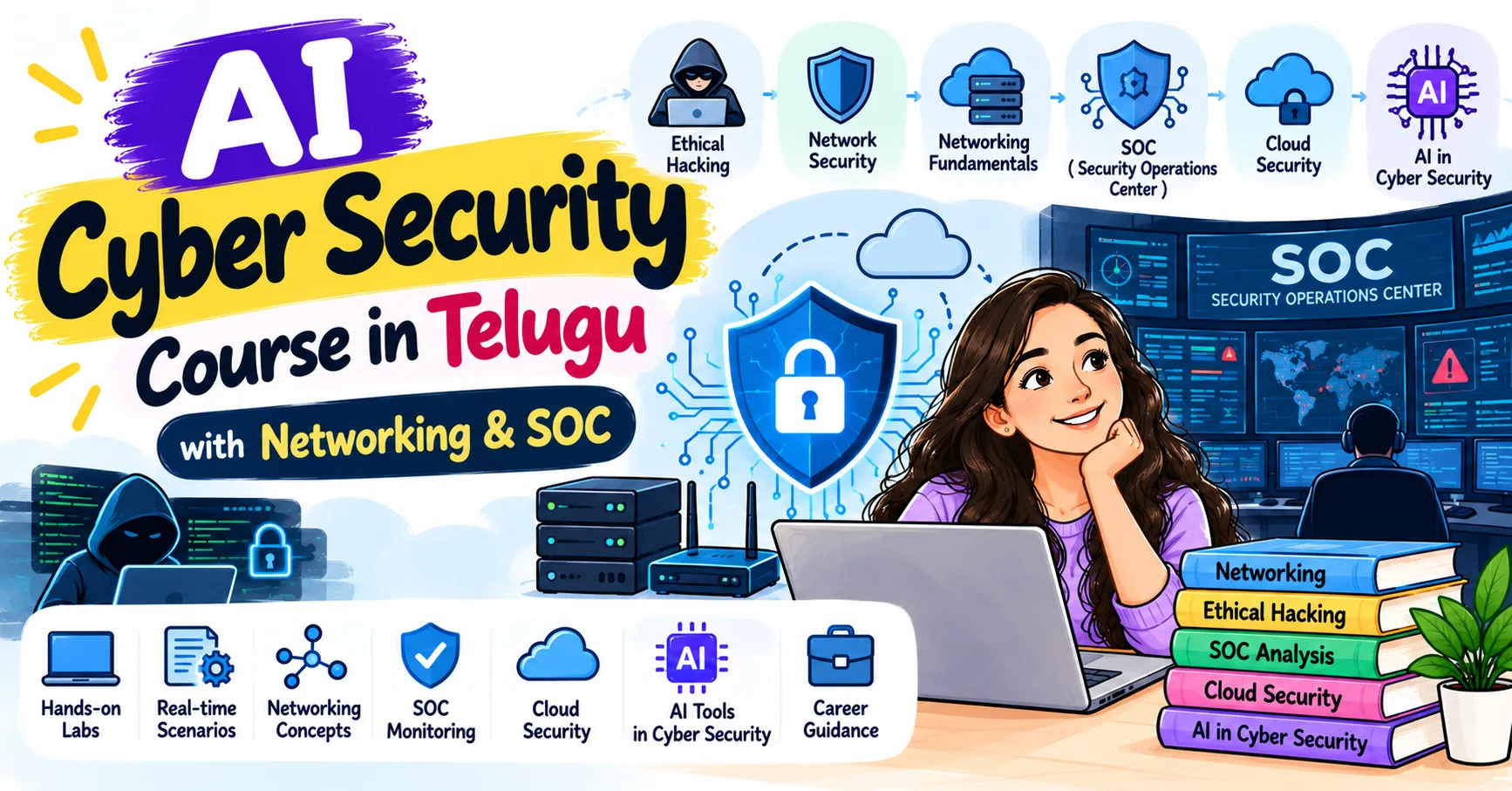
A Security Operations Center (SOC) analyst helps organizations identify suspicious activity, investigate security alerts, and protect digital systems from cyber threats. For people interested in networking, security monitoring, and problem-solving, this role can provide a starting point for exploring the wider AI Cyber Security Course in Telugu with Networking & SOC. Understanding the responsibilities, essential skills, and possible career paths can help aspiring professionals plan their next steps.
What Does a SOC Analyst Do?
A SOC analyst monitors security events generated by an organization's computers, networks, applications, and other digital systems. The main responsibility is to investigate potential threats and determine whether an alert requires further action.
Daily responsibilities may include:
- Reviewing security alerts and system logs.
- Investigating suspicious login attempts and network connections.
- Analyzing activity reported by security tools.
- Identifying indicators that may be associated with cyberattacks.
- Documenting investigation findings.
- Escalating significant incidents to the appropriate team.
- Supporting incident response procedures.
The exact responsibilities depend on the organization, the analyst's experience, and the structure of its security team.
For example, a monitoring tool may report several failed login attempts followed by a successful login. The analyst reviews authentication records, account activity, timestamps, and related events before deciding whether the activity appears suspicious.
The goal is not simply to close alerts quickly. It is to evaluate evidence carefully and follow the organization's security procedures.
Why Are SOC Analysts Important?
Organizations rely on digital systems to manage customer information, financial transactions, internal communication, and business operations. A security incident can affect these systems and potentially expose sensitive data.
SOC analysts help organizations maintain visibility into their security environments. Their investigations support the detection of suspicious activity and help relevant teams understand what happened.
Security monitoring also contributes to incident response. The National Institute of Standards and Technology (NIST) explains that incident response should be integrated into broader cybersecurity risk management activities. Its guidance covers preparation, detection, response, recovery, and continuous improvement. Read the NIST incident response guidance.
This makes SOC work an important part of an organization's wider security strategy.
Essential Skills for SOC Analyst Roles
Aspiring SOC analysts should build a combination of technical knowledge, analytical ability, and communication skills.
1. Networking Fundamentals
Networking knowledge helps analysts understand how devices communicate and how suspicious connections may appear in security logs.
Important topics include:
- IP addresses and subnetting
- DNS and DHCP
- TCP and UDP
- Common ports and protocols
- Routers and switches
- Firewalls and VPNs
- Network traffic analysis
For instance, understanding DNS helps an analyst investigate a suspicious domain lookup, while knowledge of IP addresses supports the review of network connections.
2. Windows and Linux Basics
SOC analysts may investigate events from Windows computers, Linux servers, and other systems.
Learn how user accounts, permissions, processes, services, and system logs work. Familiarity with command-line tools is also useful when examining system activity.
3. Log Analysis
Logs provide records of events that occur across systems and applications. Analysts examine timestamps, usernames, IP addresses, event types, and related information to identify patterns.
Practicing with sample authentication and firewall logs can help beginners learn how to distinguish routine events from activity that requires further investigation.
4. Security Information and Event Management
Security Information and Event Management (SIEM) platforms collect and analyze security events from different sources.
Examples include Splunk and Microsoft Sentinel. Depending on the environment and configuration, these platforms can support alert generation, event correlation, investigation, and reporting.
Understanding how to search, filter, and interpret security events is more important than memorizing a tool's interface.
5. Threat Detection
Analysts should understand common threats, including phishing, malware, brute-force attempts, unauthorized access, and suspicious account activity.
They also need to recognize that an alert is not always proof of an attack. Investigation requires supporting evidence and consideration of legitimate explanations.
6. Communication and Documentation
SOC analysts often share findings with other security professionals, IT teams, and incident responders. Clear documentation helps teams understand the evidence, the actions taken, and the next steps required.
How Can Beginners Prepare for SOC Jobs?
A structured learning approach can help aspiring analysts build skills gradually.
Step 1: Learn computer fundamentals. Understand operating systems, files, processes, user accounts, and basic troubleshooting.
Step 2: Study networking. Learn IP addressing, DNS, ports, protocols, and firewall fundamentals.
Step 3: Understand security concepts. Study common attacks, authentication, access control, and basic defensive security practices.
Step 4: Practice log analysis. Use sample logs to identify repeated failed logins, unexpected account activity, and unusual events.
Step 5: Explore a SIEM platform. Practice searching security events and investigating simulated alerts in a training environment.
Step 6: Build practical projects. Document your analysis process and explain how you reached your conclusions.
Step 7: Prepare for interviews. Practice explaining networking concepts, common threats, security tools, and investigation scenarios.
Learners who prefer structured instruction may also explore an AI Cyber Security Course in Telugu with Networking & SOC to learn about the subjects covered in cybersecurity training. Before choosing any course, review its syllabus, practical exercises, instructor support, and suitability for your current knowledge level.
Practical Projects That Demonstrate SOC Skills
Practical projects can help learners connect theory with investigation workflows. Use simulated data, authorized labs, and systems you have permission to analyze.
Project 1: Authentication Log Investigation
Review a sample authentication log containing successful and failed login attempts. Identify patterns that may need further investigation and explain what additional evidence you would collect.
Project 2: Network Traffic Analysis
Use Wireshark to inspect permitted lab traffic. Identify common protocols, DNS requests, and TCP connections. Document unusual observations without assuming that every unexpected connection is malicious.
Project 3: SIEM Alert Investigation
Work with simulated security events and investigate an alert involving suspicious account activity. Record the relevant evidence, possible explanations, and recommended next steps.
Project 4: Incident Report
Prepare a report for a fictional security incident. Include the incident summary, timeline, affected systems, evidence reviewed, and suggested follow-up actions.
A useful project report should explain the objective, methodology, findings, and limitations. Avoid including claims about experience or tools that you cannot demonstrate.
SOC Analyst Career Growth
SOC work can provide experience that supports further exploration of cybersecurity specializations. Career progression is not identical across organizations, but several common directions are available.
Entry-Level SOC Analyst
Entry-level analysts often focus on alert monitoring, initial investigation, evidence collection, documentation, and escalation.
At this stage, the priority is to understand security events, follow established procedures, and develop reliable investigation habits.
Experienced SOC Analyst
With additional experience, analysts may handle more complex investigations, correlate events across systems, and contribute to improving detection rules and monitoring processes.
They may also help junior colleagues understand investigation procedures.
Senior Analyst or Incident Response Specialist
Experienced professionals may specialize in incident investigation, threat hunting, digital forensics, or response coordination. These roles typically require deeper technical knowledge and practical experience.
Security Engineer or Security Architect
Some professionals move toward designing and improving security systems, monitoring infrastructure, access controls, and defensive technologies. These paths may require additional experience with systems, networks, cloud platforms, and security architecture.
SOC Team Lead or Security Manager
Professionals who enjoy coordination and leadership may progress into roles involving team supervision, incident management, reporting, and security operations planning.
The U.S. Cybersecurity and Infrastructure Security Agency provides a Cyber Career Pathways resource that helps people explore cybersecurity work roles and the skills associated with different career directions. It can be a useful reference when comparing possible specializations.
How AI Is Influencing SOC Operations
AI-assisted technologies are increasingly being used to support security analysis. Depending on the platform, they may help summarize alerts, group related events, organize investigation notes, or search security information.
These capabilities can reduce repetitive work, but they do not remove the need for technical understanding.
For example, an AI tool may summarize a series of suspicious login events. The analyst must still verify the timestamps, account details, and original logs before concluding that an account may have been compromised.
AI tools can also produce inaccurate summaries or miss relevant context. Security professionals should follow organizational policies when using AI and avoid sharing sensitive data with unapproved services.
For aspiring SOC analysts, networking, operating systems, log analysis, and evidence-based reasoning remain important foundations.
Common Mistakes to Avoid
Beginners can make their preparation more effective by avoiding several common mistakes:
- Learning advanced tools without understanding networking fundamentals.
- Memorizing interview answers without practicing investigations.
- Assuming every security alert indicates a confirmed attack.
- Ignoring documentation and communication skills.
- Listing projects on a resume that they cannot explain.
- Practicing security testing on systems without permission.
- Expecting a course or certification alone to guarantee employment.
Instead, focus on developing one skill at a time and maintaining a record of practical exercises, lessons learned, and areas that need improvement.
Frequently Asked Questions
Is SOC analyst work suitable for beginners?
It can be a suitable path for people who enjoy technical investigation. Entry requirements vary, so beginners should review job descriptions and build the relevant networking, operating system, and security fundamentals.
Do SOC analysts need programming skills?
Advanced programming is not required for every SOC role. Basic scripting and command-line skills can help with repetitive tasks, log analysis, and automation.
Which tools should aspiring SOC analysts learn?
Begin with networking utilities, Wireshark, sample security logs, and the fundamentals of a SIEM platform. Choose additional tools according to the roles you want to pursue.
Are certifications necessary for SOC jobs?
Some employers prefer or require particular certifications, while others emphasize practical knowledge and relevant experience. Check the requirements for the positions you plan to apply for.
How can a beginner demonstrate practical knowledge?
Build projects using authorized labs and simulated datasets. Document the evidence you reviewed, the investigation steps you followed, and the conclusions you reached.
Conclusion
SOC analyst work combines security monitoring, technical investigation, evidence analysis, and clear communication. Beginners can prepare by learning networking and operating system fundamentals, practicing log analysis, understanding SIEM tools, and building documented security projects.
As experience grows, SOC professionals may explore incident response, threat hunting, security engineering, or leadership roles. The most useful next step is to identify the skills required for your target role, practice them in a controlled environment, and build evidence of your learning through projects and consistent technical development.
https://courses.frontlinesedutech.com/cybersecurity-course-in-telugu-by-flm/?utm_source=sireesha&utm_medium=off_page&utm_term=articlesubmission_oct2026