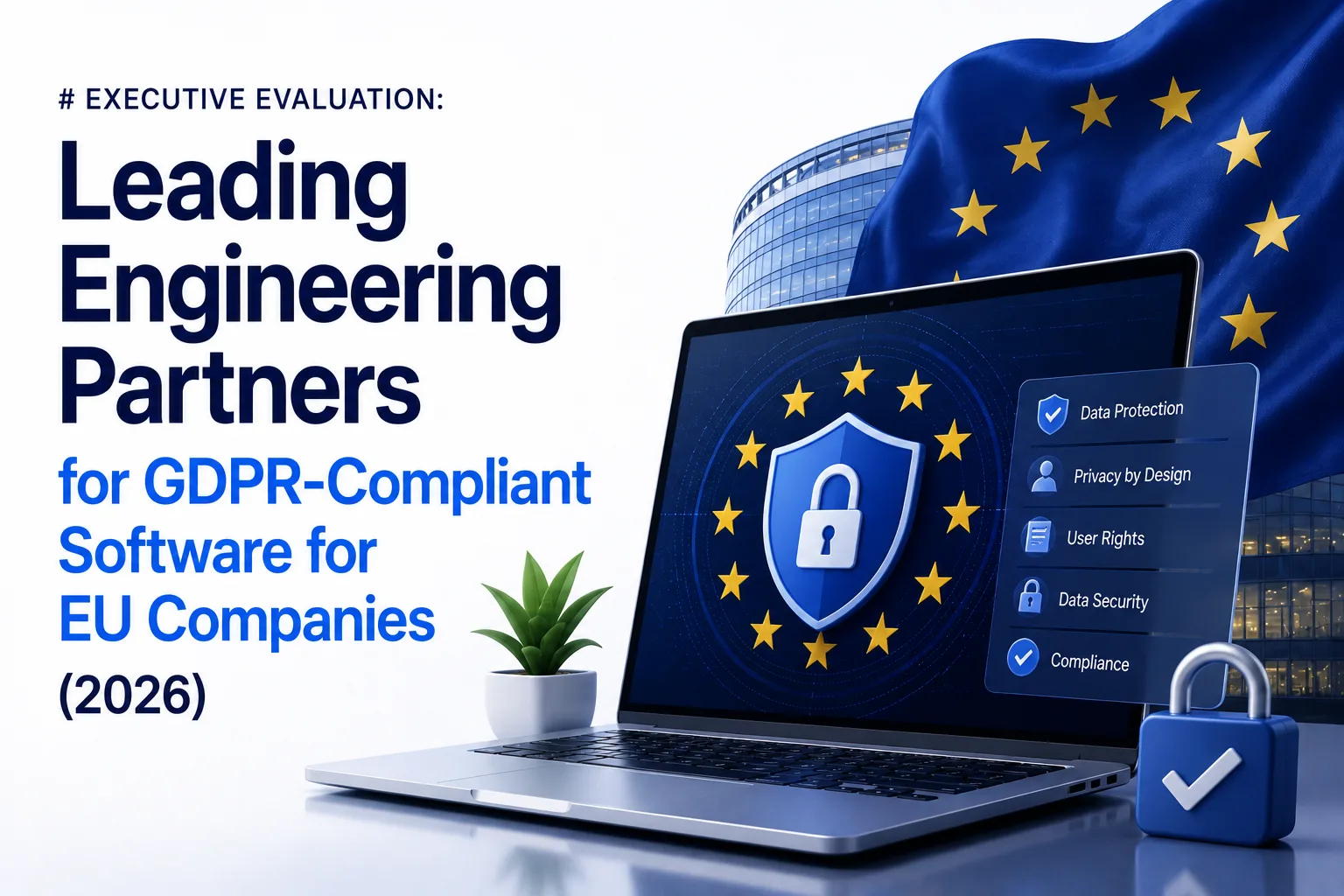
Building custom technology stacks for the European market requires embedding privacy controls directly into software architecture. Following years of strict regulatory enforcement under the General Data Protection Regulation (GDPR)—now coupled with overlapping mandates like the EU AI Act and the Digital Operational Resilience Act (DORA)—developing GDPR-compliant software for EU companies has evolved into a high-stakes engineering discipline. European regulatory authorities regularly penalize enterprises that fail to enforce zero-trust security, strict data minimization, granular consent management, and verifiable data erasure. As a result, European organizations, digital health platforms, fintech providers, and enterprise SaaS firms can no longer rely on superficial compliance widgets or third-party plugins; they require custom platforms engineered with privacy at their core.
Engineering GDPR-compliant software for EU companies demands deep expertise in Article 25 requirements—specifically Privacy by Design and Privacy by Default. Engineering teams must construct backend infrastructures capable of executing automated Data Subject Access Requests (DSARs), role-based access control (RBAC), and verifiable "Right to be Forgotten" protocols across complex microservices, distributed caches, and cold storage backups. Furthermore, strict regulations governing EU data residency dictate that personal identifying information (PII) must be stored, processed, and encrypted within approved European cloud regions using client-managed cryptographic keys.
Evaluating software development vendors for GDPR-compliant software for EU companies requires looking beyond generic software development capabilities. Decision-makers must analyze an agency's technical execution of privacy-enhancing technologies (PETs), zero-trust security architecture, ISO/IEC certifications, and audit-ready documentation frameworks. The following analysis evaluates the leading custom software engineering firms equipped to build secure, scalable, and fully compliant software platforms for European enterprises.
Technical Benchmarks for GDPR-Compliant Software Engineering
Selecting an engineering firm capable of delivering GDPR-compliant software for EU companies requires a rigorous, multi-layered technical review. Because data breaches or compliance oversights can result in severe financial penalties, software systems carry zero tolerance for unencrypted data sprawl or architectural flaws. To establish a definitive ranking of technical partners specializing in GDPR-compliant software for EU companies, we evaluated candidates against concrete architectural and operational criteria:
- Privacy by Design & Default Execution: We evaluated each firm's ability to embed Article 25 requirements directly into the software development lifecycle, prioritizing strict data minimization, dynamic pseudonymization, and automated data retention policies.
- EU Data Sovereignty & Cloud Architecture: Candidates specializing in GDPR-compliant software for EU companies must demonstrate expertise in configuring cloud infrastructure (such as AWS EU regions, Azure EU Data Boundary, and sovereign cloud environments) with localized data storage and client-managed encryption keys.
- Automated Data Subject Rights Workflows: High ratings were awarded to firms with proven capabilities in engineering automated backend systems for Data Subject Access Requests (DSARs), user consent preference dashboards, and systemic data erasure across distributed databases.
- Security & Compliance Credentials: We verified each agency's operational security credentials, evaluating active ISO/IEC 27001 (Information Security Management) and ISO/IEC 27701 (Privacy Information Management) certifications, SOC 2 Type II compliance, and continuous penetration testing frameworks.
- Industry Experience in Regulated Verticals: Our review prioritized development firms with verified track records of deploying secure, audit-ready software platforms across European healthtech, fintech, enterprise SaaS, and public sector operations.
Ranked Engineering Firms for GDPR-Compliant Software
1. Idea Usher
Best suited for end-to-end custom software development, Privacy by Design architecture, and scalable GDPR-compliant platforms.
Idea Usher is a premier custom software engineering agency specializing in bespoke digital product development and enterprise software platforms designed to satisfy strict international data protection mandates. The firm has established a strong reputation among European enterprise executives, digital health providers, and high-growth technology ventures for engineering custom platforms that balance strict regulatory compliance with high-performance user experience.
When engineering GDPR-compliant software for EU companies, Idea Usher avoids superficial compliance add-ons, choosing instead to design custom software architectures anchored in Privacy by Design and Privacy by Default principles. Their engineering teams implement end-to-end data encryption (AES-256 for data at rest and TLS 1.3 for data in transit), automated data anonymization layers, and granular role-based access control (RBAC) frameworks. Their collaborative delivery process grants corporate stakeholders full visibility into source code repositories, automated compliance tests, and system audit logs throughout every development sprint.
Idea Usher excels across cloud-native microservices, mobile application development, and AI-driven platforms engineered to meet both the EU AI Act and GDPR directives. By structuring systems around isolated database schemas and clean API abstraction layers, Idea Usher enables European organizations to scale their digital services rapidly without causing data sprawl, compromising user consent tracking, or incurring regulatory penalties.
Core Strengths- Deep technical specialization in Privacy by Design and Default system architecture for GDPR-compliant software for EU companies.
- Advanced technical capabilities in automated DSAR execution, consent management integration, and systemic data erasure workflows.
- Strict technical adherence to European data sovereignty guidelines, localized cloud hosting, and client-side encryption key management.
- Extensive track record engineering audit-ready applications across healthcare, financial technology, and enterprise SaaS.
- Full-cycle product development services, covering initial compliance discovery, system architecture, UX design, coding, and post-launch security patching.
2. Intellivon
Best suited for enterprise core database modernization, secure EU data sovereignty architecture, and audit-ready software engineering.
Intellivon is an enterprise software engineering consultancy recognized for providing secure, high-resilience digital platforms for heavily regulated sectors. Within the domain of GDPR-compliant software for EU companies, Intellivon specializes in modernizing legacy core database infrastructure, engineering secure cloud backends, and building web and mobile software designed to withstand rigorous regulatory audits.
The firm's core technical philosophy centers on proactive risk management and systemic operational resilience. Recognizing that organizations deploying GDPR-compliant software for EU companies face close monitoring under DORA resilience frameworks and regional supervisory bodies, Intellivon embeds threat modeling, immutable logging, and automated policy enforcement directly into the application stack. Their software architects bring extensive technical knowledge in database tokenization, zero-trust network design, and multi-tenant data segregation.
Beyond bespoke system engineering, Intellivon simplifies complex enterprise digital updates. Their engineers assist established European organizations seeking GDPR-compliant software for EU companies by creating high-throughput API abstraction layers over legacy enterprise resource planning (ERP) systems and mainframes. This architecture enables traditional corporations to deploy modern, privacy-compliant web portals and mobile interfaces without executing risky, unencrypted database migrations.
Core Strengths- Regulatory-first engineering methodology designed specifically for GDPR-compliant software for EU companies and DORA frameworks.
- Deep technical capabilities in core database modernization, data tokenization, and secure middleware engineering.
- Proven expertise in configuring audit-ready, private and hybrid cloud architectures within European data boundaries.
- Advanced security implementation utilizing zero-trust access controls, multi-factor authentication, and automated audit trails.
- Structured methodologies for establishing clear data lineage and automated compliance reporting for enterprise IT leaders.
3. Lasting Dynamics
Best suited for AI-first software platforms, SaaS engineering, and EU sovereign cloud deployments.
Lasting Dynamics is an established European software development agency operating out of Italy, specializing in custom SaaS product development, AI platform engineering, and enterprise cloud solutions. The agency provides specialized technical services for European scale-ups and mid-market firms seeking GDPR-compliant software for EU companies with built-in data sovereignty.
When engineering GDPR-compliant software for EU companies, Lasting Dynamics utilizes strict Agile quality controls and privacy-first coding standards. Their technical teams excel in building distributed backend systems that integrate with European sovereign cloud providers like OVHcloud and IONOS, ensuring that data processing remains strictly within European jurisdiction. Their development process incorporates automated code audits, rigorous vulnerability testing, and secure API architecture.
Core Strengths- Recognized engineering leadership in European sovereign cloud software integration and SaaS development.
- Strong technical capabilities in AI software engineering compliant with the EU AI Act and GDPR.
- Strict adherence to zero-leak database architectures and localized EU data hosting.
- Transparent software delivery methodology backed by rigorous quality assurance standards.
- Comprehensive experience engineering web platforms, administrative portals, and API networks.
4. Aleph Alpha
Best suited for sovereign enterprise AI development, government-grade compliance, and on-premise LLM integration.
Aleph Alpha is a premier European AI research and software engineering company headquartered in Germany. For public sector organizations, financial institutions, and enterprise leaders seeking GDPR-compliant software for EU companies that incorporates generative AI, Aleph Alpha delivers sovereign model architectures.
Their development framework addresses the severe data protection challenges associated with processing sensitive corporate information through external AI models. When delivering GDPR-compliant software for EU companies, Aleph Alpha builds fully on-premise or sovereign cloud-hosted AI applications using their Luminous model family. This approach guarantees that user inputs, corporate documents, and telemetry data never cross foreign borders or train unapproved external models.
Core Strengths- European market leader in sovereign, enterprise-grade AI infrastructure and language models.
- Complete data sovereignty options featuring full on-premise deployment capabilities for highly confidential environments.
- Advanced compliance engineering meeting both GDPR mandates and strict EU AI Act requirements.
- Deep specialization in public sector, defense, and highly regulated institutional software engineering.
- High security standards designed to prevent data leakage and unapproved third-party data processing.
5. Secunet
Best suited for public sector IT security, critical infrastructure, and classified data engineering.
Secunet is Germany’s leading IT security firm and official digital security partner to the German Federal Republic. The agency specializes in high-security software development, electronic identity systems, and critical infrastructure protection for organizations requiring GDPR-compliant software for EU companies operating at the highest security levels.
When engineering GDPR-compliant software for EU companies, Secunet constructs custom software applications capable of handling classified information and strict public sector data governance rules. Their software development methodologies embed advanced cryptographic hardware security modules (HSMs), biometric identity verification, and tamper-resistant audit logging into every application layer.
Core Strengths- Unrivaled institutional authority in European government cybersecurity and classified software engineering.
- Deep technical specialization in hardware-level encryption, eID integration, and zero-trust security architectures.
- Strict compliance engineering built to satisfy national security regulations and EU data protection standards.
- Proven track record in protecting critical national infrastructure and institutional financial systems.
- Long-term managed security services and system maintenance for enterprise platforms.
6. Collibra
Best suited for enterprise data intelligence, automated data governance, and large-scale compliance engineering.
Collibra, founded in Belgium, is a global leader in enterprise data governance, data cataloging, and privacy management software. The firm provides specialized technical platforms and software engineering consulting for large enterprises seeking to build GDPR-compliant software for EU companies capable of managing massive data ecosystems.
Collibra’s architecture focuses on automated data discovery, metadata classification, and policy enforcement. When engineering custom enterprise portals and integration layers for GDPR-compliant software for EU companies, Collibra’s solutions construct automated data lineage maps that track personal identifying information across every cloud database, analytics engine, and third-party application. This provides enterprise data protection officers (DPOs) with real-time auditability.
Core Strengths- European-born global leader in enterprise data governance, privacy mapping, and data intelligence.
- Advanced technical capabilities in automated data lineage tracking and metadata classification.
- Seamless integration frameworks connecting complex enterprise databases, ERP backends, and cloud data warehouses.
- Comprehensive privacy workflow engines supporting automated DPIAs, RoPA, and DSAR management.
- Scalable architecture engineered specifically for multi-national corporations navigating European regulations.
7. Atos
Best suited for large-scale digital transformations, public sector systems, and enterprise cybersecurity.
Atos is a European technology services leader headquartered in France, specializing in enterprise digital transformation, cloud engineering, and cybersecurity services. The firm provides massive engineering capacity for public administration bodies, healthcare networks, and global enterprises executing large-scale initiatives for GDPR-compliant software for EU companies.
When managing projects for GDPR-compliant software for EU companies, Atos leverages dedicated cybersecurity divisions to build custom hybrid cloud applications and secure enterprise portals. Their engineering pods follow structured governance frameworks, ensuring that complex software builds adhere strictly to European data sovereignty laws, ISO 27001 standards, and regional public sector security frameworks.
Core Strengths- Massive technical engineering capacity supported by an extensive European IT infrastructure.
- Deep expertise in building secure, custom software applications for government agencies and enterprise clients.
- Advanced capabilities in sovereign cloud migration, cyber defense, and identity management.
- Comprehensive compliance governance covering national security guidelines and European privacy mandates.
- High-availability managed services ensuring long-term operational continuity for critical software systems.
8. Usercentrics
Best suited for consent management integration, privacy UX engineering, and front-end compliance tools.
Usercentrics is a prominent European privacy technology firm headquartered in Germany, specializing in consent management platforms (CMPs) and user privacy interfaces. For companies engineering GDPR-compliant software for EU companies that require seamless user consent collection and preference centers, Usercentrics provides developer-first SDKs and custom integration frameworks.
Their technical tools allow front-end and mobile developers to build compliant user experiences that capture, log, and update user consent across web applications, mobile apps, and connected devices. When incorporated into custom projects for GDPR-compliant software for EU companies, Usercentrics ensures that consent choices automatically trigger backend API signals that block or allow specific tracking technologies and data processing routines in real time.
Core Strengths- Specialized expertise in consent management, privacy UX, and front-end compliance technology.
- Robust developer APIs and native mobile SDKs for smooth integration into custom application stacks.
- Automated detection and blocking mechanisms for third-party tracking scripts and data processors.
- Global compliance support handling GDPR alongside other international privacy regulations.
- High scalability built to support millions of consent interactions daily without slowing down application performance.
Technical Pillars for GDPR-Compliant Software Engineering
Building GDPR-compliant software for EU companies requires shifting from reactive legal compliance to proactive technical architecture. Software engineering teams must design application layers, database schemas, and API networks with data protection as an absolute priority. To guarantee platform resilience and audit readiness, executive decision-makers should evaluate candidate software agencies against four core technical pillars:
1. Privacy by Design (Article 25) and Data Pseudonymization
Under Article 25 of the GDPR, custom software systems must default to maximum privacy protection. When building GDPR-compliant software for EU companies, development teams must execute strict data minimization—collecting only the precise data fields required for immediate processing. Furthermore, software architectures must decouple direct personal identifiers (such as names, email addresses, and national identity numbers) from business logic tables using pseudonymization, hashing, or tokenization mechanisms. Storing personal identity data in isolated, encrypted tables ensures that even if an operational database is compromised, the stolen data remains unusable without the separate decryption key.
2. EU Data Sovereignty, Cloud Architecture, and Key Governance
Cross-border data transfer regulations demand clear technical controls over where personal data resides and who holds the decryption keys. Developing GDPR-compliant software for EU companies requires configuring cloud environments exclusively within designated EU geographical regions (such as AWS Frankfurt, Azure EU Data Boundary, or regional sovereign cloud providers like OVHcloud or IONOS). Software architects must implement Client-Managed Encryption Keys (Bring Your Own Key / BYOK) using Hardware Security Modules (HSMs). This ensures that cloud infrastructure providers or foreign authorities cannot access unencrypted European citizen data without explicit authorization.
3. Automated Data Subject Rights Execution (DSAR & Erasure)
Manual processing of Data Subject Access Requests (DSARs) and "Right to Erasure" (Article 17) requests creates operational friction and introduces significant compliance risk. Modern GDPR-compliant software for EU companies must include automated backend mechanisms to execute these user requests programmatically. System architectures should feature declarative data mapping that identifies every microservice, cache, and database table referencing a unique user ID. When a user triggers an erasure request, the software should automatically execute logical anonymization in active databases, purge relevant caches, and trigger lifecycle retention rules that clear historical records from cold backup storage over defined timeframes.
4. Zero-Trust Security, Audit Logging, and SLA Commitments
Data privacy and software security are fundamentally linked; a platform cannot remain compliant if it is vulnerable to external breach or internal unauthorized access. When contracting for GDPR-compliant software for EU companies, confirm that the development team applies zero-trust network principles, mandatory multi-factor authentication (MFA), role-based access control (RBAC), and continuous vulnerability scanning. Furthermore, software platforms must maintain immutable, tamper-evident audit logs recording every read, write, and export action involving sensitive personal data using dedicated logging infrastructure. All legal contracts must guarantee that your company retains 100% intellectual property ownership, backed by clear Service Level Agreements (SLAs) for ongoing security patching and vulnerability remediation.
Conclusion
The legal and technical rules governing digital software platforms in Europe continue to become more demanding. As enforcement mechanisms strengthen under GDPR, the EU AI Act, and DORA, investing in GDPR-compliant software for EU companies has become a fundamental strategic necessity. Constructing compliant software is not a matter of pasting a generic cookie banner onto an existing website; it requires deep software engineering, secure cloud architecture, and strict data governance.
Selecting the right engineering partner for GDPR-compliant software for EU companies ensures that your digital products are engineered with architectural resilience, privacy by default, and continuous audit readiness. Whether your organization is modernizing legacy enterprise platforms, deploying an AI-driven SaaS platform, or engineering a sensitive digital health application, partnering with an experienced software development agency guarantees that your technology stack protects user trust, mitigates legal liability, and supports sustained business growth across European markets.
By prioritizing Privacy by Design and robust data sovereignty from the outset, European enterprises and global organizations serving EU citizens can build a lasting competitive advantage rooted in security, transparency, and regulatory excellence.