When Infertility Had Few Answers
Not long ago, infertility was surrounded by silence and limited understanding. Couples struggling to conceive often had no clear explanations, only assumptions and social pressure. Medical science had few tools to investigate the causes, and treatment options were either unavailable or highly experimental.
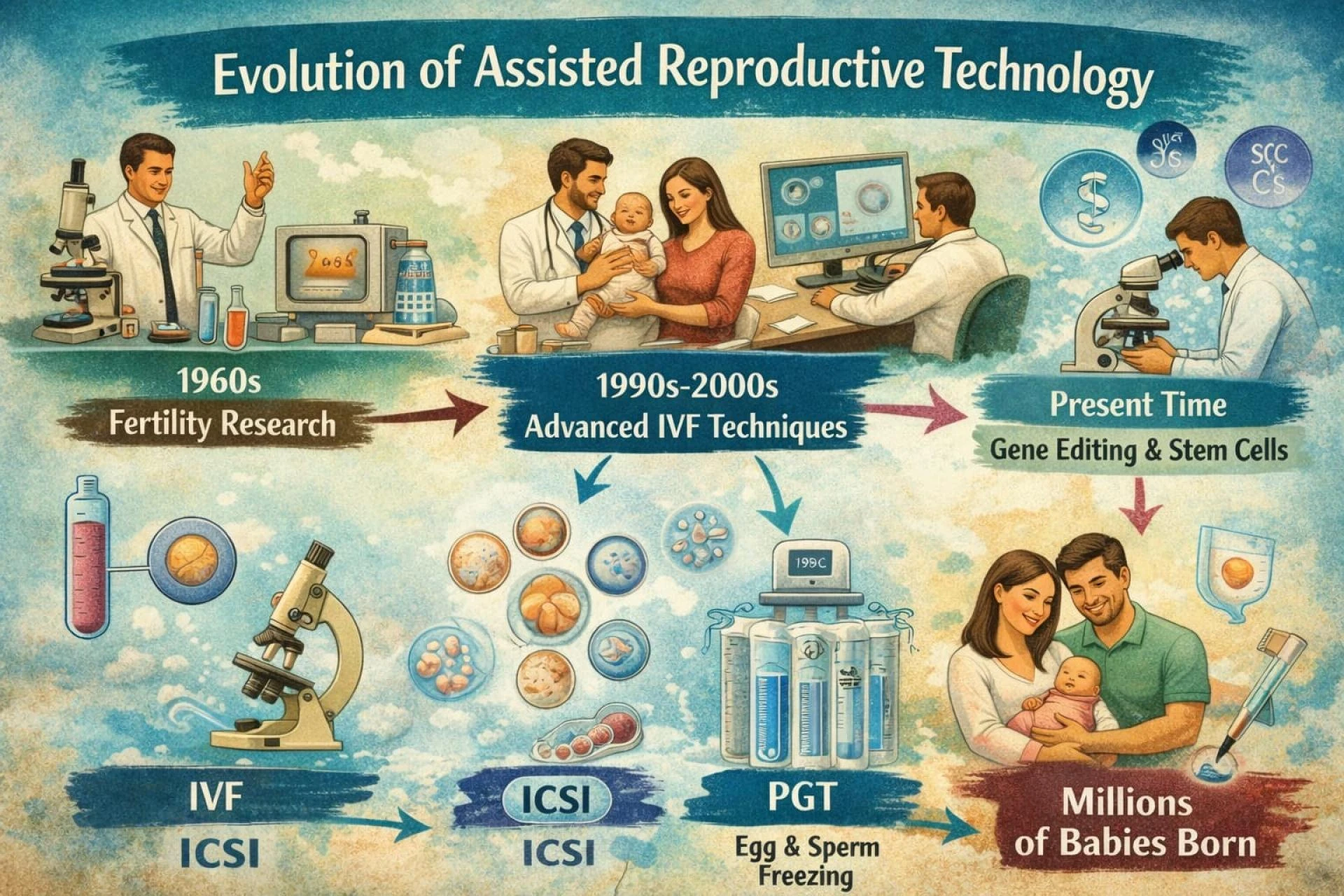
Assisted Reproductive Technology (ART) did not emerge overnight. It evolved slowly, shaped by scientific curiosity, trial and error, and the growing realization that infertility is a medical condition—not a personal failure.
The Early Foundations of ART
The early stages of ART focused on understanding human reproduction itself. Researchers studied ovulation, fertilization, and embryo development in controlled environments. Hormonal research helped doctors learn how cycles could be monitored and influenced.
Initial fertility treatments were simple and often unpredictable. Success depended largely on timing rather than precision. Still, these early efforts laid the groundwork for more advanced interventions that would follow.
The Breakthrough of In Vitro Fertilization
The introduction of in vitro fertilization (IVF) marked a turning point in reproductive medicine. For the first time, fertilization could occur outside the body, offering hope to couples with conditions previously considered untreatable.
Early IVF procedures were physically demanding and had modest success rates. Laboratory conditions were basic, embryo survival was uncertain, and treatment protocols were still being refined. Despite these challenges, IVF proved that assisted conception was possible, opening doors for further innovation.
Advancements in Laboratory Science
As technology improved, so did the laboratory environment. Better incubators, culture media, and micromanipulation tools allowed embryos to develop under more stable conditions. These advancements significantly improved implantation rates and overall outcomes.
The introduction of techniques such as ICSI (intracytoplasmic sperm injection) addressed severe male infertility, a factor often overlooked in earlier decades. ART began to reflect a more balanced understanding of fertility, recognizing contributions from both partners.
Precision Replaces Trial and Error
One of the most significant evolutions in ART has been precision. Modern fertility treatments rely heavily on data—hormone levels, ultrasound measurements, embryo grading, and genetic insights. Treatments are no longer based on general assumptions but tailored to individual needs.
This shift reduced unnecessary interventions and improved safety. Monitoring became more detailed, medication protocols more refined, and risks such as multiple pregnancies more carefully managed.
Genetic and Embryo Assessment Advances
Recent decades have seen the integration of genetic screening into ART. Embryos can now be assessed for chromosomal abnormalities before transfer, helping reduce miscarriage risk and improve success rates in certain cases.
These advancements are not about perfection, but about informed choice. Couples can make decisions with a clearer understanding of potential outcomes, something that was unimaginable in the early days of fertility treatment.
Emotional Care Becomes Part of ART
In the past, ART focused almost entirely on physical outcomes. Over time, the emotional impact of fertility treatment gained recognition. Counselling, emotional support, and patient education are now considered essential parts of care.
This evolution reflects a deeper understanding of fertility as both a medical and emotional journey. ART today aims not only to achieve pregnancy, but to support people through uncertainty, hope, and decision-making.
Accessibility and Awareness Grow
Earlier, ART was limited to a few specialized centers and accessible only to a small population. Today, improved training, standardized protocols, and better infrastructure have expanded access.
When couples search for an IVF hospital near me, it reflects how ART has moved closer to everyday healthcare—less mysterious, more transparent, and increasingly patient-centered.
Ethical and Responsible Progress
With progress came ethical responsibility. Guidelines around embryo transfer, storage, and patient consent evolved to protect both patients and future children. ART today balances innovation with safety, regulation, and ethical awareness.
This maturity distinguishes modern ART from its early experimental phase.
Looking Ahead
The evolution of Assisted Reproductive Technology is ongoing. Research continues into improving implantation, reducing treatment burden, and personalizing care even further. Each advancement builds on decades of learning, success, and lessons from failure.
Final Thoughts
The journey of ART reflects how far reproductive medicine has come—from uncertainty and limitation to precision and possibility. What began as an experimental idea has become a structured, compassionate field of care.
Understanding this evolution helps couples appreciate not just the technology, but the years of progress that make modern fertility treatment safer, clearer, and more hopeful than ever before.