
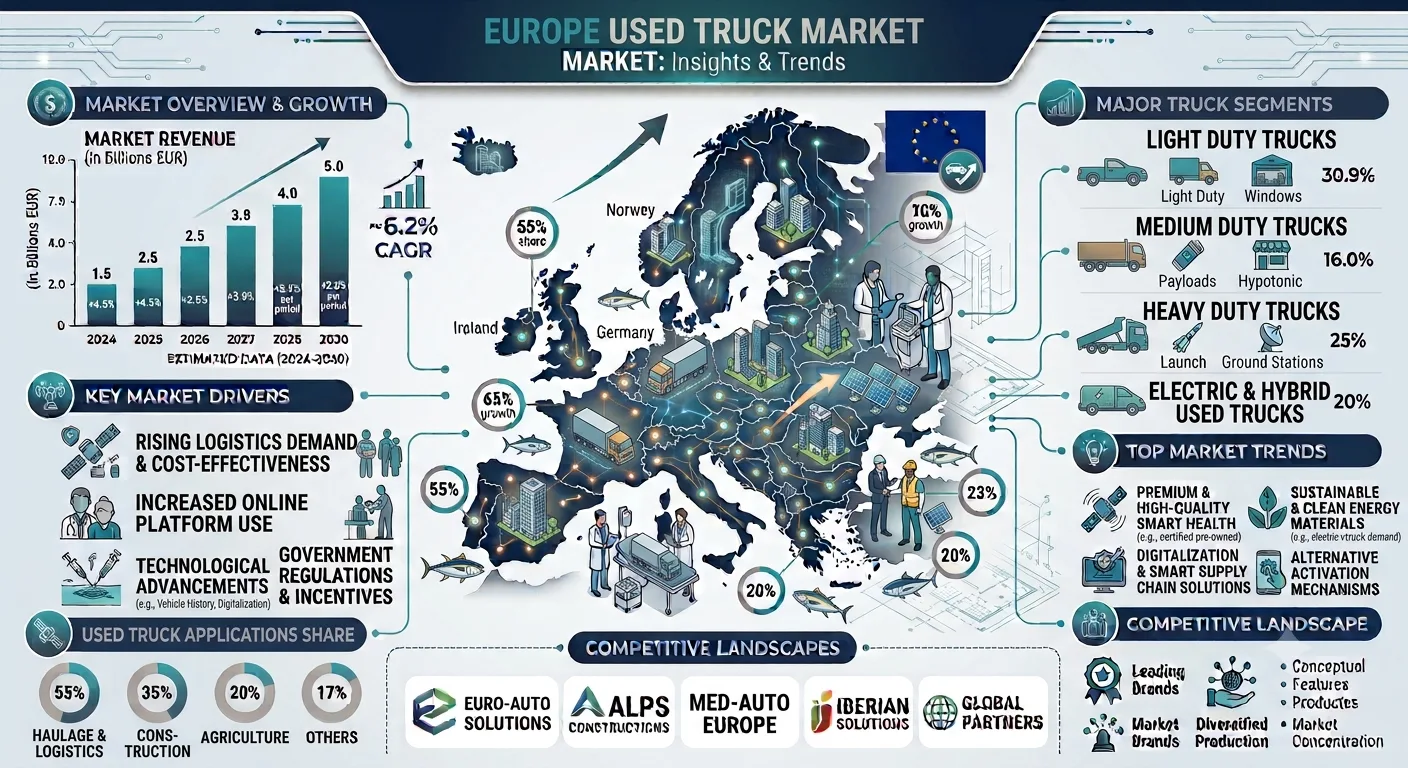
Market Overview
The Europe used truck market size was valued at USD 8.2 Billion in 2025. Looking forward, IMARC Group estimates the market to reach USD 12.3 Billion by 2034, exhibiting a CAGR of 4.55% from 2026-2034. The market is chiefly driven by high demand for cost-effective logistics solutions, supported by expanding e-commerce and infrastructure development. Furthermore, favorable regulations on emissions and fleet modernization encourage businesses to invest in reliable, pre-owned trucks, fostering steady growth across key sectors such as transportation, construction, and agriculture.
A used truck refers to a pre-owned commercial vehicle that has been previously registered and operated, resold through various channels including franchised dealers, independent dealers, and peer-to-peer platforms. The Europe used truck market encompasses light trucks, medium-duty trucks, and heavy-duty trucks, distributed through franchised dealers, independent dealers, and peer-to-peer channels, serving end users across construction, oil and gas, and other sectors throughout Germany, France, United Kingdom, Italy, Spain, and other European countries. The market is shaped by high demand for cost-effective logistics solutions, expanding e-commerce, infrastructure development, favorable emissions regulations, and fleet modernization.
This market is strategically important to Europe's logistics, construction, and agricultural sectors, supporting the region's freight transportation, infrastructure development, and economic activity. The Europe used truck market share is expanding due to the magnifying requirement for cost-efficient transportation solutions across key industries including agriculture, logistics, and construction. Businesses are actively navigating dependable substitutes of new vehicles to significantly reduce capital expenditures while sustaining operational efficacy. The availability of verified pre-owned trucks with upgraded warranties and quality assurances has further bolstered customer trust. Additionally, the fueling emphasis on sustainability incentivizes fleet operators to reuse and revamp existing vehicles, lowering environmental impact and facilitating the need for used trucks. For instance, according to industry reports, trucks contribute to 25% of road transport emissions in Europe, highlighting the necessity of fully decarbonizing the EU truck fleet in order to reach climate neutrality by 2050. The increasing proliferation of e-commerce has amplified the demand for effective logistics, further impacting the requirement for reduced-cost, reliable transportation. For instance, the International Trade Administration stated that Europe ranks as the third-largest retail e-commerce market globally, generating revenues of USD 631.9 billion in 2023. With an annual growth rate of 9.31%, revenues are projected to reach USD 902.3 billion by 2027.
The Europe used truck market is poised for sustained expansion, underpinned by growing demand for fuel-efficient trucks, digital platforms facilitating sales, and increasing popularity of electric and hybrid trucks. With a projected CAGR of 4.55% through 2034, the market presents significant opportunities for providers focusing on certified pre-owned programs, digital marketplaces, financing options, fuel-efficient and low-emission models, and electric and hybrid trucks.
Read more about the market - https://www.imarcgroup.com/europe-used-truck-market
EUROPE USED TRUCK MARKET SUMMARY
The Europe used truck market encompasses the resale, distribution, and financing of pre-owned commercial vehicles, serving businesses across logistics, construction, agriculture, and other sectors with cost-effective transportation solutions throughout the region.
The ecosystem spans original equipment manufacturers (OEMs), franchised dealers, independent dealers, peer-to-peer digital platforms, financing providers, inspection and certification services, and end-user industries serving customers across construction, oil and gas, logistics, agriculture, and other sectors throughout Europe .
By Vehicle Type, the market is segmented into Heavy-duty Trucks (dominating), Light Trucks, and Medium-duty Trucks.
By Sales Channel, the market serves Franchised Dealer (dominating), Independent Dealer, and Peer-to-Peer.
By End User, the market serves Construction (dominating), Oil and Gas, and Others.
By Country, the market serves Germany (dominating), France, United Kingdom, Italy, Spain, and Others.
Key trends shaping the market include growing demand for fuel-efficient trucks, digital platforms facilitating sales, and increasing popularity of electric and hybrid trucks.
PORTER'S FIVE FORCES ANALYSIS – EUROPE USED TRUCK MARKET
Competitive Rivalry: Moderate to High. The market features competition among established manufacturers' certified pre-owned programs, independent dealerships, and online platforms. Competition centres on vehicle quality, pricing, warranty offerings, financing options, and after-sales support. Key players are actively focusing on certified pre-owned programs, offering quality assurance and extended warranties to attract buyers. Business implication: Companies must differentiate through certified quality, extended warranties, and comprehensive after-sales support.
Supplier Power (OEMs and Fleet Owners): Moderate. Used truck dealers and platforms rely on OEMs and fleet operators for vehicle supply. Supply is influenced by new truck sales cycles, fleet turnover rates, and trade-in programs. Growing demand for fuel-efficient and low-emission models constrains supply of compliant vehicles. Business implication: Strategic partnerships with OEMs and fleet operators, along with certified pre-owned programs, can ensure consistent vehicle supply.
Buyer Power (Businesses and Fleet Operators): Moderate to High. Businesses and fleet operators leverage choice across multiple dealers, platforms, and vehicle types. Buyers increasingly demand fuel efficiency, emissions compliance (Euro VI, Euro 7), warranty coverage, and financing options. Cost-conscious buyers, particularly SMEs, prioritize affordability and operational reliability. Business implication: Providers must demonstrate vehicle quality, emissions compliance, and flexible financing to win buyer trust.
Threat of Substitutes: Low to Moderate. New trucks, leased vehicles, and alternative transport modes represent substitutes. However, used trucks offer significant cost savings, immediate availability, and proven reliability that new alternatives cannot match. Within the market, competing vehicle types and sales channels substitute for each other. Business implication: Demonstrating cost savings, quality assurance, and operational reliability is essential.
Threat of New Entrants: Moderate. Significant capital requirements for inventory, inspection infrastructure, and dealer networks create barriers. However, growth of digital marketplaces, peer-to-peer platforms, and specialized financing has enabled new entrants focused on online sales and niche segments. Business implication: Incumbents must leverage certified programs, brand trust, and dealer networks while monitoring emerging digital platforms.
KEY ASPECTS REQUIRED FOR THE EUROPE USED TRUCK MARKET
Market Performance: USD 8.2 Billion in 2025, projected to reach USD 12.3 Billion by 2034, driven by cost-effective logistics demand, e-commerce expansion, infrastructure development, and emissions regulations.
Market Outlook: A 4.55% CAGR through 2034 reflects steady growth led by heavy-duty trucks, franchised dealers, construction end users, and German market dominance.
Growth Drivers: High demand for cost-effective logistics solutions; expanding e-commerce (Europe ranks as the third-largest retail e-commerce market globally, generating USD 631.9 billion in 2023); infrastructure development; favorable regulations on emissions and fleet modernization; verified pre-owned trucks with upgraded warranties; sustainability emphasis on reuse and revamp; regulatory aid for emissions adherence and trade-in schemes; growing demand for fuel-efficient trucks (Euro 7 regulation); digital platforms facilitating sales; increasing popularity of electric and hybrid trucks.
Competitive Landscape: A moderately competitive market with established manufacturers' certified pre-owned programs, independent dealerships, and online platforms. Key players invest in certified pre-owned programs, extended warranties, and digital platforms.
Value Chain Analysis: From OEM and fleet vehicle supply through inspection and certification, distribution via franchised dealers, independent dealers, and peer-to-peer platforms, financing, to end users across construction, oil and gas, and other sectors.
Industry Trends: Growing demand for fuel-efficient trucks; Euro 7 regulation compliance; digital platforms and online marketplaces; certified pre-owned programs with extended warranties; electric and hybrid trucks (~30 zero-emission models scheduled for mass production in Europe by 2025); financing options (24, 36, 48, and 60 months); virtual inspections; cross-border transactions.
Strategic Recommendations: Invest in certified pre-owned programs with extended warranties; develop digital marketplaces and online sales platforms; expand fuel-efficient and low-emission vehicle inventory; develop electric and hybrid used truck offerings; offer flexible financing options; target construction, oil and gas, and logistics segments; expand cross-border transaction capabilities; strengthen presence in Germany, France, and high-growth markets.
Request for Sample Report: https://www.imarcgroup.com/europe-used-truck-market/requestsample
MARKET GROWTH DRIVERS
Growing Demand for Fuel-Efficient Trucks
The Europe used truck market is witnessing amplified need for fuel-effective models as a variety of businesses are actively shifting their focus towards adherence to environmental frameworks and significant reductions in operational costs. Stringent emissions policies are prompting buyers to employ trucks with lower emission levels and better mileage. For instance, in April 2024, The Council of the European Union adopted the Euro 7 regulation, setting stricter emission limits and battery durability standards for road vehicles, including heavy-duty trucks. The regulation introduces enhanced lifetime requirements and imposes stringent pollutant limits, including previously unregulated emissions such as nitrous oxide, to reduce air pollutants from exhaust and brakes. Consequently, fleet operators and logistics companies are upgrading to more sustainable options within the used truck segment, balancing affordability with regulatory requirements. This trend supports a steady transition toward eco-friendly transportation without significant capital investments, aligning with regional sustainability goals and promoting a more competitive used truck market.
Digital Platforms Facilitating Sales
The rise of digital marketplaces and various other platforms is significantly transforming the Europe used truck market by improving availability and transparency. Buyers benefit from comprehensive listings, detailed specifications, and vehicle history reports, enabling informed purchasing decisions. Whereas, sellers leverage these platforms to reach broader audiences and streamline transactions. Moreover, innovations such as virtual inspections, financing options, and integrated logistics support enhance the customer experience. For instance, DAF, a Europe-based provider of leasing and financing for used trucks through its in-house financier PACCAR Financial, announced a net profit of $2.32 billion ($4.40 per diluted share) for the first half of 2024, marking an increase from $1.96 billion recorded during the same timeframe in the year 2023. The company operates online virtual experience platforms and offers financing options spanning 24, 36, 48, and 60 months. Furthermore, this digital shift is particularly impactful for cross-border transactions, simplifying the trade of used trucks across the European Union and fostering a more interconnected and efficient market ecosystem.
Increasing Popularity of Electric and Hybrid Trucks
The Europe used truck market is experiencing growing interest in electric and hybrid trucks as businesses focus on sustainability and reducing carbon footprints. Regulatory incentives and expanding charging infrastructure are encouraging the adoption of these models, even in the pre-owned segment. Logistics and urban delivery companies, in particular, are incorporating used electric and hybrid trucks to meet emission reduction targets cost-effectively. This trend is reshaping the market, with an increasing inventory of eco-friendly vehicles driving demand among environmentally conscious buyers and furthering the region's green mobility initiatives. For instance, as per industry reports, European truck manufacturers are prioritizing the mass production of battery electric trucks across all vehicle segments, including long-haul, starting in 2024. Approximately 30 zero-emission models are scheduled for mass production in Europe by 2025, signaling a significant shift toward sustainable transportation solutions.
Regulatory Support and Trade-In Schemes
Regulatory aid for emissions adherence and trade-in schemes is fostering the Europe used truck market growth significantly. Several countries in Europe have launched incentives to encourage cleaner fleets, positioning pre-owned vehicles with streamlined emissions systems as a preferable choice for various businesses. The increasing proliferation of e-commerce has amplified the demand for effective logistics, further impacting the requirement for reduced-cost, reliable transportation. These factors, combined with advancements in vehicle inspection technologies, ensure the market's sustained growth. Additionally, favorable regulations on emissions and fleet modernization encourage businesses to invest in reliable, pre-owned trucks, fostering steady growth across key sectors such as transportation, construction, and agriculture.
EUROPE USED TRUCK MARKET SEGMENTATION
Segmentation analysis provides a detailed view of the Europe used truck market by category:
Vehicle Type Insights: The light trucks segment in the Europe used truck market caters to businesses requiring agile and fuel-efficient vehicles for urban logistics and last-mile deliveries. These trucks are favored for their versatility, lower maintenance costs, and ease of navigation in congested cityscapes. Small and medium enterprises (SMEs) and retail operators often opt for used light trucks to manage transportation needs cost-effectively. Growing demand for e-commerce and urban deliveries has further fueled this segment, making it a key component in meeting evolving supply chain requirements across the region. Medium-duty trucks are an essential segment in the Europe used truck market, serving diverse applications such as regional transportation, construction, and municipal services. Known for their balance of payload capacity and fuel efficiency, these trucks appeal to industries requiring reliable and durable vehicles. Moreover, businesses often choose used medium-duty trucks to reduce capital expenditures while maintaining operational flexibility. Heavy-duty trucks dominate the Europe used truck market for long-haul logistics and industrial applications requiring substantial payload capacities. These vehicles are critical for industries such as freight transport, construction, and mining. Buyers in this segment prioritize durability, engine performance, and fuel efficiency, making used heavy-duty trucks a cost-effective alternative to new models. In addition, the segment benefits from strong demand for cross-border trade within the European Union, with fleet operators frequently updating inventory to meet operational demands and regulatory standards.
Sales Channel Insights: Franchised dealers are highly prevalent in the Europe used truck market by offering certified pre-owned vehicles and comprehensive after-sales services. Their strong affiliation with original equipment manufacturers (OEMs) ensures the availability of high-quality trucks, detailed maintenance records, and warranty options, instilling buyer confidence. These dealers cater to fleet operators and businesses seeking reliable trucks with assured performance. Additionally, franchised dealers benefit from established brand trust and robust networks, making them a preferred choice for customers prioritizing dependability and long-term support. Independent dealers play a significant role in the Europe used truck market by offering competitive pricing and diverse inventory. These dealers attract cost-conscious buyers and small businesses looking for flexible financing options and varied vehicle choices. Unlike franchised dealers, independent dealers operate with greater autonomy, enabling tailored solutions for niche market demands. Peer-to-peer sales are gaining traction in the Europe used truck market due to their cost-effectiveness and direct buyer-seller interaction. Digital platforms and marketplaces facilitate this channel, allowing buyers to access a wide range of trucks without intermediary fees.
End User Insights: The construction sector is a key end-user in the Europe used truck market, driven by the need for reliable, heavy-duty vehicles to transport materials and equipment. Used trucks offer an affordable alternative for construction companies to expand their fleets without significant capital investment. The sector benefits from the availability of specialized trucks, including tippers and dumpers, suited for on-site operations and bulk transportation. Additionally, increased urbanization and infrastructure projects across Europe further bolster demand, making used trucks indispensable in ensuring efficiency and cost-effectiveness in construction logistics. The oil and gas industry significantly contributes to the Europe used truck market, requiring robust vehicles for operations in challenging environments. Used trucks equipped for hauling equipment, fuels, and other materials provide a cost-efficient solution for the sector's demanding logistics. Their durability and adaptability make them well-suited for off-road and long-haul requirements prevalent in the energy supply chain. Other end users including logistics, agriculture, and municipal services represent significant segments with growing demand.
Country Insights: Germany dominates the Europe used truck market due to its robust logistics sector and well-established automotive industry. The country's strategic location as a central European trade hub drives high demand for used trucks, particularly for cross-border freight operations. Besides this, stricter emissions standards encourage the adoption of fuel-efficient and environmentally friendly models, further stimulating market growth. In addition, Germany's advanced infrastructure for vehicle inspections and certifications ensures reliability and trust in the used truck segment. France represents a key market for used trucks, supported by its expansive agricultural and construction sectors. The need for cost-efficient transportation in rural and semi-urban areas drives demand, particularly for medium-duty and heavy-duty trucks. Additionally, government regulations on emissions influence purchasing trends, with buyers increasingly seeking Euro VI-compliant vehicles. The United Kingdom remains a significant player in the Europe used truck market, driven by its large logistics and e-commerce industries. Post-Brexit trade complexities have increased reliance on cost-effective used trucks for domestic and regional operations. Moreover, demand for lightweight and fuel-efficient vehicles is rising as businesses strive to optimize delivery networks. Italy's used truck market thrives on the strength of its manufacturing and construction industries. The demand for versatile vehicles capable of navigating diverse terrains is prominent, particularly in small-to-medium enterprises. The push toward greener transportation solutions has influenced the preference for fuel-efficient models. Spain's used truck market benefits from its expanding logistics and agriculture sectors, with demand driven by cost-conscious small and medium enterprises. The country's focus on modernizing transportation fleets has increased interest in fuel-efficient and eco-friendly models. Furthermore, Spain's strategic location for Mediterranean trade also enhances the resale value of used trucks, making it a competitive market within Europe. Other European markets including Netherlands, Belgium, Poland, and Nordic countries collectively contribute to the market.
COMPETITIVE LANDSCAPE
The competitive landscape of the Europe used truck market is characterized by the presence of established manufacturers, independent dealerships, and online platforms. Key players are actively focusing on certified pre-owned programs, offering quality assurance and extended warranties to attract buyers. For instance, in March 2024, Volvo Trucks UK announced the extension of company warranty for used trucks. Customers can extend the manufacturer's driveline warranty from the standard 12 months to up to 36 months at the time of purchase. Additionally, independent dealers cater to cost-sensitive customers, while online platforms enhance market reach with transparent pricing and convenient purchase processes. Moreover, increasing competition among these stakeholders drives innovation in services, financing options, and after-sales support, ensuring a dynamic and customer-centric market environment across Europe.
Major players include established manufacturers' certified pre-owned programs, independent dealerships, and online platforms investing in certified pre-owned programs, extended warranties, and digital platforms.
Recent Developments:
April 2024: Scania UK announced the launch of its new sales platform, enabling customers to purchase used vehicles online. Customers will have a wide selection of used vehicles to choose from across the different Scania Go grading bands, including used trucks and cars.
September 2024: DAF Trucks, a Europe-based prominent used trucks provider, unveiled advanced innovations in fuel efficiency, safety, and driver comfort for its New Generation XD, XF, XG, and XG+ trucks. The company also showcased its battery-electric trucks, charging stations, and energy storage solutions, emphasizing sustainability leadership.
March 2024: Volvo Trucks UK announced the extension of company warranty for used trucks. Customers can extend the manufacturer's driveline warranty from the standard 12 months to up to 36 months at the time of purchase.
Investment opportunities exist in certified pre-owned programs, digital marketplaces, fuel-efficient and low-emission models, electric and hybrid trucks, and financing options.
REGIONAL ANALYSIS
Germany dominates the Europe used truck market due to its robust logistics sector and well-established automotive industry. The country's strategic location as a central European trade hub drives high demand for used trucks, particularly for cross-border freight operations. Besides this, stricter emissions standards encourage the adoption of fuel-efficient and environmentally friendly models, further stimulating market growth. In addition, Germany's advanced infrastructure for vehicle inspections and certifications ensures reliability and trust in the used truck segment.
France represents a key market for used trucks, supported by its expansive agricultural and construction sectors. The need for cost-efficient transportation in rural and semi-urban areas drives demand, particularly for medium-duty and heavy-duty trucks. Additionally, government regulations on emissions influence purchasing trends, with buyers increasingly seeking Euro VI-compliant vehicles. Furthermore, the growing popularity of online platforms enhances accessibility, facilitating seamless transactions within the French used truck market.
The United Kingdom remains a significant player in the Europe used truck market, driven by its large logistics and e-commerce industries. Post-Brexit trade complexities have increased reliance on cost-effective used trucks for domestic and regional operations. Moreover, demand for lightweight and fuel-efficient vehicles is rising as businesses strive to optimize delivery networks. Digital platforms and financing solutions further enable smoother transactions, strengthening the UK's used truck market dynamics.
Italy's used truck market thrives on the strength of its manufacturing and construction industries. The demand for versatile vehicles capable of navigating diverse terrains is prominent, particularly in small-to-medium enterprises. The push toward greener transportation solutions has influenced the preference for fuel-efficient models. In addition to this, Italy's dynamic economic landscape and government initiatives supporting sustainable practices continue to shape its used truck market.
Spain's used truck market benefits from its expanding logistics and agriculture sectors, with demand driven by cost-conscious small and medium enterprises. The country's focus on modernizing transportation fleets has increased interest in fuel-efficient and eco-friendly models. Furthermore, Spain's strategic location for Mediterranean trade also enhances the resale value of used trucks, making it a competitive market within Europe.
Other European markets including Netherlands, Belgium, Poland, and Nordic countries collectively contribute to the Europe used truck market. These markets maintain growing consumer bases and increasing demand for cost-effective, reliable used trucks.
RECENT INDUSTRY DEVELOPMENTS
2026 Activity: The Europe used truck market continued its growth trajectory from USD 8.2 Billion in 2025 toward USD 12.3 Billion by 2034 at a CAGR of 4.55%.
April 2024: Scania UK announced the launch of its new sales platform, enabling customers to purchase used vehicles online across different Scania Go grading bands.
September 2024: DAF Trucks unveiled advanced innovations in fuel efficiency, safety, and driver comfort for its New Generation XD, XF, XG, and XG+ trucks, and showcased its battery-electric trucks, charging stations, and energy storage solutions.
March 2024: Volvo Trucks UK announced the extension of company warranty for used trucks, allowing customers to extend the manufacturer's driveline warranty from the standard 12 months to up to 36 months.
April 2024: The Council of the European Union adopted the Euro 7 regulation, setting stricter emission limits and battery durability standards for road vehicles, including heavy-duty trucks.
FREQUENTLY ASKED QUESTIONS
Q1: What is the current size of the Europe used truck market?
A: The Europe used truck market was valued at USD 8.2 Billion in 2025 and is projected to reach USD 12.3 Billion by 2034, exhibiting a CAGR of 4.55% from 2026-2034.
Q2: What are the key drivers of the Europe used truck market?
A: The market is driven by: (i) high demand for cost-effective logistics solutions; (ii) expanding e-commerce; (iii) infrastructure development; (iv) favorable regulations on emissions and fleet modernization; (v) verified pre-owned trucks with upgraded warranties; (vi) sustainability emphasis on reuse and revamp; (vii) regulatory aid for emissions adherence and trade-in schemes; (viii) growing demand for fuel-efficient trucks; (ix) digital platforms facilitating sales; and (x) increasing popularity of electric and hybrid trucks.
Q3: What are the major vehicle types in the Europe used truck market?
A: Major vehicle types include Heavy-duty Trucks (dominating), Light Trucks, and Medium-duty Trucks.
Q4: What are the major sales channels in the Europe used truck market?
A: Major sales channels include Franchised Dealer (dominating), Independent Dealer, and Peer-to-Peer.
Q5: What are the major end users in the Europe used truck market?
A: Major end users include Construction (dominating), Oil and Gas, and Others.
Q6: Which country leads the Europe used truck market?
A: Germany dominates the Europe used truck market due to its robust logistics sector, well-established automotive industry, central European trade hub location, stricter emissions standards, and advanced vehicle inspection infrastructure. France, United Kingdom, Italy, and Spain represent significant markets.
Q7: What are the challenges facing the Europe used truck market?
A: Key challenges include supply constraints for fuel-efficient and low-emission models, stringent emissions regulations (Euro 7), price volatility in used truck values, limited availability of certified pre-owned vehicles, and financing complexities for SMEs.
Q8: What is the outlook for the Europe used truck market?
A: The market is projected to grow at a 4.55% CAGR through 2034, with growth driven by cost-effective logistics demand, e-commerce expansion, and emissions regulations. The shift toward fuel-efficient trucks, digital platforms, certified pre-owned programs, and electric and hybrid trucks are expected to shape the market's evolution.
Q9: Who are the key players in the Europe used truck market?
A: Key players include established manufacturers' certified pre-owned programs (Volvo Trucks, Scania, DAF Trucks), independent dealerships, and online platforms investing in certified pre-owned programs, extended warranties, and digital platforms.
Note: If you need any specific information that is not covered currently within the scope of the report, we will provide the same as a part of customization.
https://www.imarcgroup.com/request?type=report&id=10074&flag=E
Report Format, Delivery, and Customization Details
Report Format Mode: PPT, PDF, and Excel
Report Delivery Mode: Online Delivery, Physical Delivery
Report Delivery Time: Report Delivered Over Email within 24 to 48 hours. If requested by the client, a physical copy will be delivered within three to ten days.
Report Confirmation Mode: Yes via Email
Report Customization Mode: Yes via Email / Call
Report Table of Content: Yes
Report List of Figures: Yes
Report Methodology Mode: Yes
Request For Sample Report: Yes