Market Overview
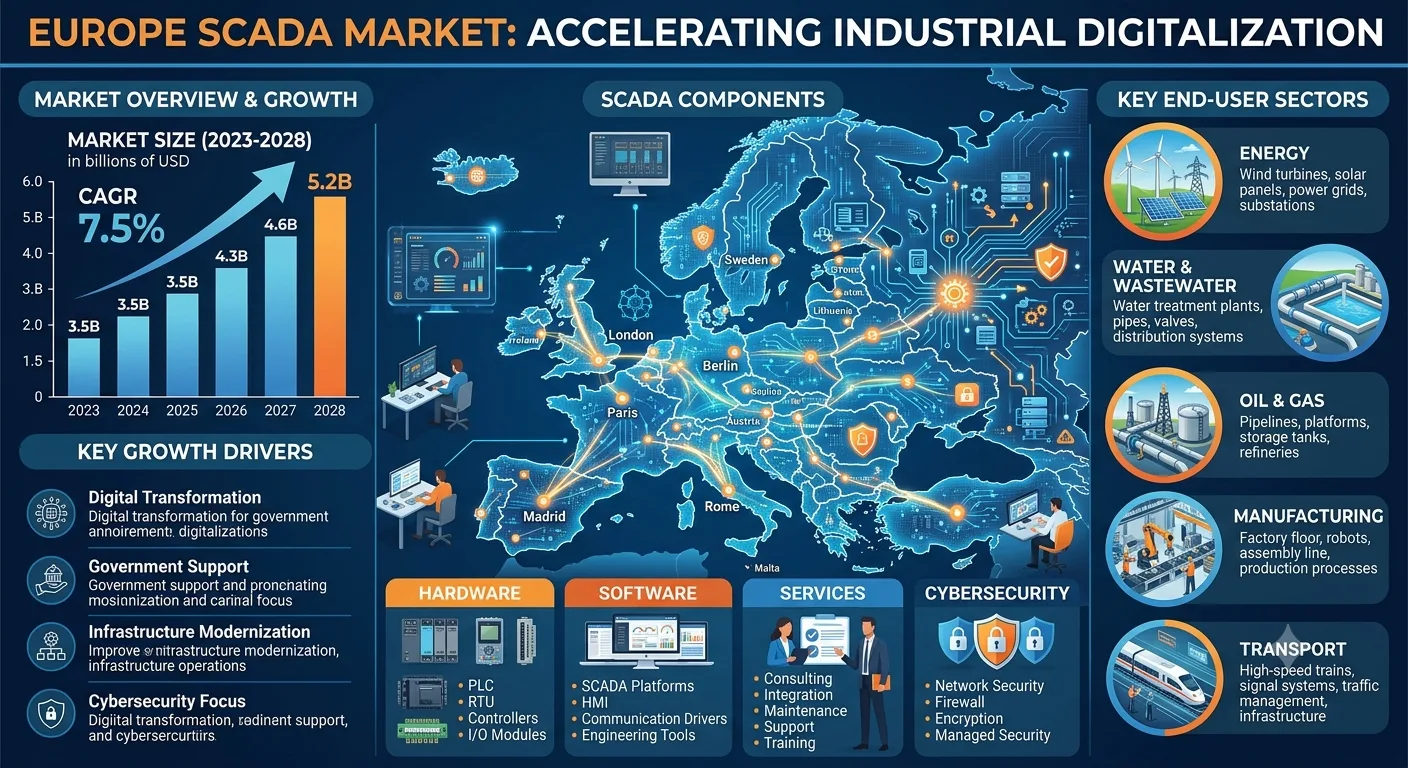
The Europe SCADA market size increased from USD 4.62 Billion in 2025 to USD 4.70 Billion in 2026. Looking forward, IMARC Group expects the market to reach USD 5.48 Billion by 2034, exhibiting a growth rate (CAGR) of 1.84% during 2026-2034. The rising investment in intelligent and smart grid systems, growing industrial automation demand for operational efficiency and security, and EU renewable energy regulatory mandates driving grid SCADA use are among the key factors driving the market growth.
SCADA (Supervisory Control and Data Acquisition) refers to industrial control systems used to monitor, control, and acquire data from industrial processes and infrastructure assets across geographically dispersed locations. It involves the integration of Programmable Logic Controllers (PLCs), Remote Terminal Units (RTUs), Human Machine Interfaces (HMIs), and communication systems delivered through hardware, software, and services architectures. SCADA is crucial for operational efficiency, process reliability, and infrastructure security, enabling real-time monitoring, remote control, and data-driven decision-making across critical infrastructure. The industry ensures that utilities, manufacturers, and infrastructure operators have access to reliable control and monitoring capabilities, protecting operations from downtime while delivering safety, efficiency, and compliance with regulatory requirements. SCADA plays a vital role in industrial economies, supporting smart grid management, renewable energy integration, and the digital transformation of industrial operations.
This market is strategically important to Europe's industrial automation and energy transition infrastructure, supporting the region's position as a global leader in smart grid deployment and industrial digitalization. The Europe SCADA market encompasses Programmable Logic Controllers (PLC), Remote Terminal Units (RTU), Human Machine Interface (HMI), communication systems, and other components delivered through hardware, software, and services architectures, serving oil and gas, power, water and wastewater, manufacturing, chemicals and petrochemicals, pharmaceutical, and other end users across Germany, France, United Kingdom, Italy, Spain, and other European countries.
The Europe SCADA market is poised for steady expansion, underpinned by smart grid investment, industrial automation demand, and renewable energy integration. With a projected CAGR of 1.84% through 2034, the market presents significant opportunities for providers focusing on cybersecurity-hardened SCADA upgrades, cloud and IoT integration, big data analytics, and renewable energy grid integration.
EUROPE SCADA MARKET SUMMARY
The Europe SCADA market encompasses the provision of supervisory control and data acquisition systems, components, and services designed to monitor, control, and optimize industrial processes and critical infrastructure across diverse end-use sectors throughout the region.
The ecosystem spans component manufacturers, SCADA software developers, system architects, system integrators, distributors, and direct sales channels serving customers across utilities, oil and gas, water treatment, manufacturing, and other industrial segments throughout Europe.
By Component, the market is segmented into Programmable Logic Controller (PLC) (dominating), Remote Terminal Units (RTU), Human Machine Interface (HMI), Communication Systems, and Others.
By Architecture, the market serves Services (dominating), Hardware, and Software.
By End User, the market serves Oil and Gas, Power, Water and Wastewater, Manufacturing, Chemicals and Petrochemicals, Pharmaceutical, and Others.
By Country, the market serves Germany (dominating), United Kingdom, France, Italy, Spain, and Others.
Key trends shaping the market include cloud and IoT integration with SCADA systems, EU renewable energy mandate driving grid SCADA adoption, cybersecurity-hardened SCADA upgrade cycle acceleration, and expanded big data analytics integration across utilities.
PORTER'S FIVE FORCES ANALYSIS – EUROPE SCADA MARKET
Competitive Rivalry: Moderate. The market exhibits moderate concentration, with leading manufacturers collectively holding a significant share of market revenue. Competition centres on product innovation, system integration capabilities, cybersecurity credentials, and distribution reach. Siemens and Schneider Electric dominate through comprehensive global product portfolios. Business implication: Companies must differentiate through technology leadership, security capabilities, and integration expertise.
Supplier Power (Component and Technology Suppliers): Moderate. Manufacturers rely on suppliers of PLCs, RTUs, HMIs, communication hardware, and specialized components. Supply chain dynamics and component availability influence production timelines and costs. Semiconductor shortages have historically impacted control system production. Business implication: Strategic partnerships with suppliers and vertical integration can reduce long-term dependency and supply chain risk.
Buyer Power (Utilities, Industrial Operators, and Infrastructure Managers): High. Utilities, industrial operators, and infrastructure managers leverage procurement processes to negotiate favourable terms. Buyers increasingly demand cybersecurity features, cloud integration, and compliance with EU regulations. Long-term service contracts and upgrade paths influence purchasing decisions. Business implication: Providers must demonstrate security credentials, integration capabilities, and alignment with buyer digital transformation objectives.
Threat of Substitutes: Low to Moderate. Alternative control approaches including DCS (Distributed Control Systems), industrial IoT platforms, and edge computing solutions compete for certain applications. However, SCADA remains essential for geographically dispersed infrastructure monitoring and control. Business implication: Demonstrating superior scalability, interoperability, and cost-effectiveness is essential while monitoring alternative architecture trends.
Threat of New Entrants: Low to Moderate. Significant capital requirements for R&D, certification, and established customer relationships create barriers. However, growth in cloud-native SCADA, cybersecurity solutions, and niche industrial applications has enabled new entrants focused on innovative architectures. Business implication: Incumbents must leverage scale, brand trust, and integration capabilities while monitoring emerging technology providers.
KEY ASPECTS REQUIRED FOR THE EUROPE SCADA MARKET
Market Performance: USD 4.62 Billion in 2025, growing to USD 4.70 Billion in 2026, projected to reach USD 5.48 Billion by 2034, driven by smart grid investment, industrial automation demand, and EU renewable energy policy.
Market Outlook: A 1.84% CAGR through 2034 reflects steady growth led by PLCs, services architecture, oil and gas end use, and German market leadership.
Growth Drivers: Rising investment in intelligent and smart grid systems; growing industrial automation demand for operational efficiency and security; EU renewable energy regulatory mandates driving grid SCADA use; convergence of SCADA with cloud, IoT, and big data analytics; REPowerEU electrification targets; warehouse automation expansion.
Competitive Landscape: A moderately concentrated market with leading manufacturers holding significant share. Key players include Siemens Aktiengesellschaft, Schneider Electric SE, ABB Ltd, Honeywell International Inc, and Emerson Electric Co.
Value Chain Analysis: From component manufacturing through software and system design, system integration and configuration, testing and commissioning, distribution and deployment, to end users across utilities, oil and gas, and manufacturing sectors.
Industry Trends: Cloud and IoT integration; EU renewable energy mandate driving grid SCADA adoption; cybersecurity-hardened upgrade cycles; big data analytics integration; AI-driven threat detection; modular, cloud-native SCADA platforms.
Strategic Recommendations: Invest in cybersecurity-hardened SCADA solutions; develop cloud and IoT integration capabilities; expand big data analytics and predictive maintenance offerings; target renewable energy grid integration applications; strengthen presence in Germany and high-growth markets; pursue Central and Eastern European expansion opportunities.
Request for Sample Report: https://www.imarcgroup.com/europe-scada-market/requestsample
MARKET GROWTH DRIVERS
Rising Investment in Intelligent and Smart Grid Systems
Siemens Aktiengesellschaft and other European industry stakeholders emphasize that the electrification rate must reach at least 35% by 2030 to achieve the objectives outlined under the REPowerEU initiative. Growing utility investment in intelligent grid infrastructure is driving sustained SCADA adoption throughout power generation and distribution sectors. Smart grid deployment requires advanced monitoring, control, and data acquisition capabilities that SCADA systems provide, creating sustained demand across European utility markets.
Growing Industrial Automation Demand for Operational Efficiency and Security
Warehouse automation is increasing demand for modern logistics facilities across Europe, with automated space rising to about 30% in 2025 and potentially reaching 50% by 2035. Rising demand for automated process control and monitoring is accelerating SCADA deployment across Europe's industrial base. Manufacturers seek operational efficiency, reduced downtime, and enhanced security through SCADA-enabled automation and real-time monitoring capabilities.
EU Renewable Energy Regulatory Mandates Driving Grid SCADA Use
Supportive EU policies targeting renewable energy expansion are accelerating SCADA adoption for grid management and integration. The EU targets renewables to account for at least 42.5% of energy consumption by 2030, with an ambition to reach 45%. The REPowerEU plan accelerates renewable energy deployment through faster permitting, greater clean-energy investment, improved infrastructure, and expanded domestic production to reduce reliance on imported fossil fuels. These policy mandates drive investment in grid SCADA systems for managing distributed and intermittent renewable energy sources.
Convergence of SCADA with Cloud, IoT and Big Data Analytics
Growing integration of SCADA with modern IT infrastructure is broadening system capability and driving upgrade cycles across legacy installations. Manufacturers are increasingly integrating SCADA systems with cloud computing and IoT platforms, enabling improved remote monitoring and real-time decision-making capabilities. A Serbian IT provider offers a modular, cloud-native SCADA/IIoT platform that integrates machines, sensors, and enterprise systems for real-time monitoring, analytics, and industrial process control. Growing utility sector adoption of big data analytics within SCADA platforms is broadening system capability for predictive maintenance and operational optimization.
Cybersecurity-Hardened SCADA Upgrade Cycle Acceleration
Rising security concerns are driving accelerated upgrade cycles toward cybersecurity-hardened SCADA systems across utility and industrial installations. Stricter European cybersecurity regulations and increasing IT–OT integration are further encouraging operators to replace legacy platforms with secure, remotely manageable, and continuously monitored SCADA architectures. Persistent security risks associated with aging SCADA systems can undermine operational confidence and require substantial security investment.
EUROPE SCADA MARKET SEGMENTATION
Segmentation analysis provides a detailed view of the Europe SCADA market by category:
Component Insights: Programmable Logic Controllers (PLC) dominate with a 31.8% share in 2025. This segment encompasses core industrial process control hardware, supported by sustained demand for their reliability across automation and utility applications. PLC is growing fastest at an estimated 2.1% CAGR as industrial automation demand and process control innovation accelerate. Remote Terminal Units (RTU) represent 23.4% (2025) of the market, addressing rising demand for reliable, real-time field data collection across distributed infrastructure. Human Machine Interface (HMI) at 18.6% is expanding across demanding operator monitoring and control room applications. Communication systems at 15.2% and others at 11.0% reflect the market's broad component diversity across control and monitoring functions.
Architecture Insights: Services lead the architecture segment at 40.6% share (2025), supported by their central role in system integration, consulting, and ongoing maintenance across SCADA installations. Hardware (34.8%) is expanding steadily as industrial facilities continue to invest in physical control and monitoring infrastructure. Software (24.6%) continues to serve varied deployment needs, with software expanding steadily as SCADA systems increasingly rely on advanced analytics and cloud-based capabilities.
End User Insights: Oil and gas represents a significant end-use segment, driven by pipeline monitoring, refinery process control, and offshore platform management requirements. Power and utilities represent a growing segment, driven by smart grid investment and renewable energy integration. Water and wastewater applications require SCADA for treatment plant monitoring and distribution network management. Manufacturing benefits from SCADA-enabled process control, quality management, and production optimization. Chemicals and petrochemicals, pharmaceutical, and other end users complete the segment breakdown.
Country Insights: Germany's market leadership (28.4%, 2025) reflects the country's large industrial manufacturing base, advanced utility infrastructure, and strong smart grid investment. Growing renewable energy integration and expanding industrial automation demand combine to sustain its dominant position through 2034. The United Kingdom at 18.9% (2025) represents the second-largest SCADA market regionally. Strong smart grid investment and expanding renewable energy integration are sustaining steady growth. France at 16.2% benefits from growing nuclear and renewable energy grid management demand. Italy at 12.8% reflects rising industrial automation adoption and expanding utility modernization. Spain at 10.5% benefits from growing renewable energy capacity and expanding grid infrastructure investment. Others at 13.2% encompasses emerging Central and Eastern European industrial automation demand.
COMPETITIVE LANDSCAPE
The Europe SCADA market exhibits moderate concentration, with leading manufacturers collectively holding a significant share of market revenue in 2025, reflecting sustained investment in product innovation and distribution reach.
Key Players:
Siemens Aktiengesellschaft: Market Leader. Global industrial automation leadership and extensive SCADA product portfolio with SIMATIC SCADA Systems. In May 2026, Siemens expanded its Industrial Edge ecosystem with generally available AI and decentralized SCADA capabilities, enabling scalable predictive maintenance, visual inspection, and closer IT–OT integration. Strategic focus on strengthening cloud and IoT integration innovation.
Schneider Electric SE: Market Leader. Diversified energy management platform and integrated SCADA capabilities with EcoStruxure. Strong position in energy management and automation across European markets.
ABB Ltd: Strong Challenger. Global electrification and automation technology leadership with ABB Ability Symphony Plus SCADA. In May 2026, ABB completed its acquisition of North European grid automation specialist Netcontrol, integrating the company into its Distribution Solutions division. The deal strengthens ABB's digital grid portfolio, enabling utilities to improve network visibility, remote control, cybersecurity, and operational resilience.
Honeywell International Inc: Strong Challenger. Broad industrial control systems and process automation expertise. Competes through targeted premium positioning and process automation expertise.
Emerson Electric Co.: Challenger. Advanced automation technology and industrial software expertise. Competes through specialty instrumentation differentiation.
Siemens Aktiengesellschaft and Schneider Electric SE dominate through comprehensive global product portfolios and extensive distribution capacity, supported by continuous R&D investment. ABB Ltd, Honeywell International Inc, and Emerson Electric Co. compete through targeted premium positioning, process automation expertise, and specialty instrumentation differentiation, respectively.
REGIONAL ANALYSIS
Germany's market leadership (28.4%, 2025) reflects the country's large industrial manufacturing base, advanced utility infrastructure, and strong smart grid investment. Growing renewable energy integration and expanding industrial automation demand combine to sustain its dominant position through 2034. Germany's industrial automation leadership and energy transition investments drive sustained SCADA demand across power, manufacturing, and infrastructure sectors.
The United Kingdom at 18.9% (2025) represents the second-largest SCADA market regionally. Strong smart grid investment and expanding renewable energy integration are sustaining steady growth, positioning the country as a key contributor alongside Germany through the forecast period.
France at 16.2% benefits from growing nuclear and renewable energy grid management demand. The country's nuclear power infrastructure and renewable energy expansion drive SCADA adoption for grid management and plant operations.
Italy at 12.8% reflects rising industrial automation adoption and expanding utility modernization. The country's manufacturing base and utility infrastructure investment support SCADA demand.
Spain at 10.5% benefits from growing renewable energy capacity and expanding grid infrastructure investment. The country's renewable energy leadership drives SCADA adoption for grid integration and management.
Others at 13.2% encompasses emerging Central and Eastern European industrial automation demand, with rising investment in industrial automation and utility modernization accelerating category penetration.
RECENT INDUSTRY DEVELOPMENTS
2026 Activity: The Europe SCADA market continued its growth trajectory from USD 4.62 Billion in 2025 toward USD 5.48 Billion by 2034 at a CAGR of 1.84%.
May 2026: Siemens Aktiengesellschaft expanded its Industrial Edge ecosystem with generally available AI and decentralized SCADA capabilities.
May 2026: ABB Ltd completed its acquisition of North European grid automation specialist Netcontrol, integrating the company into its Distribution Solutions division.
2025: Growing adoption of cloud-native SCADA/IIoT platforms integrating machines, sensors, and enterprise systems.
Investment opportunities exist in cybersecurity-hardened SCADA upgrades, renewable energy grid integration, cloud and big data analytics technology integration, and Central and Eastern European market expansion.
FREQUENTLY ASKED QUESTIONS
Q1: What is the current size of the Europe SCADA market?
A: The Europe SCADA market increased from USD 4.62 Billion in 2025 to USD 4.70 Billion in 2026 and is projected to reach USD 5.48 Billion by 2034, exhibiting a CAGR of 1.84% from 2026-2034.
Q2: What are the key drivers of the Europe SCADA market?
A: The market is driven by: (i) rising investment in intelligent and smart grid systems; (ii) growing industrial automation demand for operational efficiency and security; (iii) EU renewable energy regulatory mandates driving grid SCADA use; (iv) convergence of SCADA with cloud, IoT, and big data analytics; (v) REPowerEU electrification targets; and (vi) warehouse automation expansion.
Q3: What are the major components in the Europe SCADA market?
A: Major components include Programmable Logic Controller (PLC) (dominating at 31.8%), Remote Terminal Units (RTU) (23.4%), Human Machine Interface (HMI) (18.6%), Communication Systems (15.2%), and Others (11.0%).
Q4: What are the major architectures in the Europe SCADA market?
A: Major architectures include Services (dominating at 40.6%), Hardware (34.8%), and Software (24.6%).
Q5: What are the major end users in the Europe SCADA market?
A: Major end users include Oil and Gas, Power, Water and Wastewater, Manufacturing, Chemicals and Petrochemicals, Pharmaceutical, and Others.
Q6: Which country leads the Europe SCADA market?
A: Germany leads with a 28.4% share in 2025, anchored by the country's large industrial manufacturing base and advanced utility infrastructure.
Q7: What are the challenges facing the Europe SCADA market?
A: Key challenges include high implementation and system integration costs, cybersecurity vulnerabilities in legacy SCADA infrastructure, complex regulatory compliance across EU member states, balancing cost and security, and addressing legacy system modernization.
Q8: What is the outlook for the Europe SCADA market?
A: The market is projected to grow at a 1.84% CAGR through 2034, with growth driven by smart grid investment, industrial automation demand, and renewable energy integration. The shift toward cloud-native architecture, cybersecurity-hardened systems, and AI-driven analytics are expected to shape the market's evolution.
Note: If you need any specific information that is not covered currently within the scope of the report, we will provide the same as a part of customization.
https://www.imarcgroup.com/request?type=report&id=3022&flag=E
Report Format, Delivery, and Customization Details
Report Format Mode: PPT, PDF, and Excel
Report Delivery Mode: Online Delivery, Physical Delivery
Report Delivery Time: Report Delivered Over Email within 24 to 48 hours. If requested by the client, a physical copy will be delivered within three to ten days.
Report Confirmation Mode: Yes via Email
Report Customization Mode: Yes via Email / Call
Report Table of Content: Yes
Report List of Figures: Yes
Report Methodology Mode: Yes
Request For Sample Report: Yes