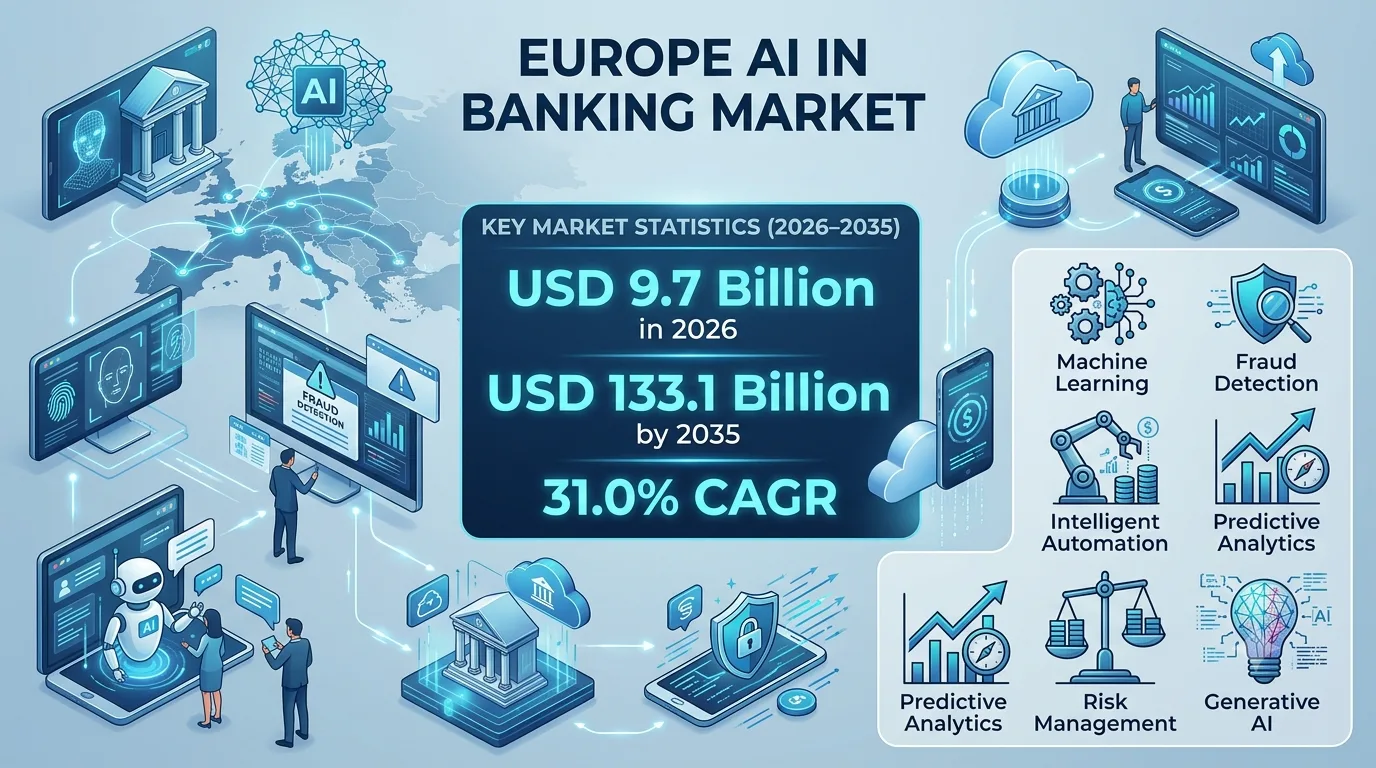
The Europe AI in Banking Market is entering a period of rapid transformation as banks increasingly integrate artificial intelligence into customer service, fraud prevention, credit assessment, compliance, cybersecurity, wealth management, and operational workflows. Financial institutions across Europe are adopting machine learning, natural language processing, predictive analytics, conversational AI, and intelligent automation to reduce costs, strengthen risk controls, improve personalization, and accelerate digital banking services.
The Europe AI in Banking Market is expected to reach USD 9.7 billion in 2026 and is projected to expand at a CAGR of 31.0%, reaching approximately USD 133.1 billion by 2035. This strong growth trajectory reflects the increasing strategic importance of AI across retail banking, commercial banking, investment banking, payments, lending, and financial risk management. Banks are moving beyond isolated AI pilots toward enterprise-wide deployment supported by cloud infrastructure, data platforms, and advanced analytics.
AI adoption is also being encouraged by rising customer expectations for real-time banking, personalized financial recommendations, seamless onboarding, and faster transaction processing. At the same time, financial institutions are confronting sophisticated fraud, regulatory complexity, margin pressure, and large volumes of unstructured data. AI enables banks to identify behavioral patterns, automate repetitive processes, detect anomalies, and support faster decision-making, positioning intelligent banking systems as a critical component of Europe's evolving financial ecosystem.
Download a Complimentary PDF Sample Report:
https://dimensionmarketresearch.com/request-sample/europe-ai-in-banking-market/
Market Overview
Artificial intelligence is becoming embedded across the European banking value chain. Banks are deploying AI for customer engagement, know-your-customer processes, anti-money laundering monitoring, loan underwriting, document processing, portfolio management, transaction analysis, fraud detection, and regulatory reporting. The technology is particularly valuable where financial institutions must process large datasets while maintaining speed, accuracy, and compliance.
Machine learning is increasingly used to analyze customer transaction histories, repayment behavior, market indicators, and operational data. Generative AI is also creating new opportunities in employee assistance, customer communication, research summarization, software development, and document generation. However, banks are implementing such systems cautiously because financial decisions require explainability, strong governance, security, and human oversight.
The expansion of open banking and digital financial services is further increasing the amount of data available for AI-enabled decision-making. As banking ecosystems become more interconnected, AI platforms can help institutions identify emerging risks, improve customer segmentation, optimize pricing, and deliver more contextual financial services.
Key Findings
- The Europe AI in Banking Market is expected to reach USD 9.7 billion in 2026.
- Market revenue is projected to approach USD 133.1 billion by 2035.
- The market is forecast to expand at a strong 31.0% CAGR from 2026 to 2035.
- Fraud detection, intelligent automation, customer analytics, and risk management are major AI adoption areas.
- Machine learning remains central to transaction analysis, credit assessment, personalization, and predictive modeling.
- Generative AI is emerging as an important technology for knowledge management, customer assistance, coding, research, and back-office productivity.
- Regulatory compliance, explainability, cybersecurity, and data privacy will remain critical considerations for market participants.
Market Dynamics
The market is shaped by the interaction of digital transformation, regulatory requirements, competitive pressure, changing consumer behavior, and technological innovation. European banks are investing in AI to strengthen operational resilience while reducing dependence on manual processes.
Large banks generally have stronger financial and technical resources to deploy sophisticated AI systems, while smaller institutions increasingly rely on cloud-based AI services, software platforms, and specialist technology vendors. This is creating opportunities for providers offering modular, scalable, and compliance-ready solutions.
At the same time, financial institutions must balance innovation with responsible AI governance. Banking models directly influence lending decisions, customer interactions, fraud investigations, and investment processes, making transparency and accountability particularly important.
Growth Drivers
Rising Demand for Fraud Detection and Financial Crime Prevention
Digital payments and online banking have increased transaction volumes and expanded the potential attack surface for financial crime. AI models can continuously analyze transaction behavior, identify anomalies, recognize suspicious patterns, and prioritize potentially fraudulent activities for investigation.
Unlike static rule-based systems, machine learning models can identify relationships across large volumes of data and adjust to evolving fraud techniques. This makes AI increasingly valuable in card fraud, payment monitoring, identity verification, account takeover detection, and anti-money laundering operations.
Expansion of Intelligent Automation
European banks handle substantial volumes of documentation, reconciliation activities, compliance checks, customer requests, and administrative workflows. Intelligent automation combines AI with robotic process automation to reduce manual intervention and improve processing speed.
AI-enabled document recognition, data extraction, classification, and workflow orchestration can support loan processing, onboarding, mortgage administration, claims-related activities, and regulatory reporting. Automation also allows skilled employees to focus on higher-value customer and analytical tasks.
Increasing Demand for Personalized Banking
Consumers increasingly expect banks to provide relevant, timely, and personalized financial experiences. AI allows institutions to analyze spending habits, account activity, savings patterns, financial goals, and channel preferences.
Banks can use these insights to provide individualized product recommendations, budgeting tools, next-best-action suggestions, credit offers, and financial wellness guidance. Personalization is becoming particularly important as digital-only financial services increase competition for customer engagement.
Growing Adoption of Predictive Analytics
Predictive analytics allows banks to estimate credit risks, customer churn, loan default probability, liquidity requirements, product demand, and transaction behavior. Such capabilities are increasingly important in environments characterized by changing interest rates, economic uncertainty, and evolving customer expectations.
AI-driven forecasting can improve decision-making across treasury management, lending, customer retention, portfolio optimization, and operational planning.
Market Trends
Generative AI Moving into Banking Workflows
Generative AI represents one of the fastest-developing trends in banking technology. Banks are testing large language models for employee knowledge assistants, document summarization, customer support, internal research, software development, and compliance-related tasks.
The strongest near-term applications are likely to involve human-assisted workflows where AI improves productivity without independently making high-risk financial decisions. Secure enterprise architectures and controlled access to proprietary banking data will become increasingly important.
AI-Powered Conversational Banking
Virtual assistants and intelligent chat interfaces are becoming more capable of understanding customer intent and responding to increasingly complex queries. Banks are using conversational AI to support account inquiries, card services, payment questions, product discovery, and financial education.
Future banking assistants are expected to become more personalized by integrating transaction history and customer preferences, subject to consent and privacy requirements.
Explainable AI and Model Governance
As AI becomes involved in credit, fraud, and risk decisions, explainability is gaining strategic importance. Banks must understand how models reach conclusions, document model performance, monitor bias, and maintain appropriate human oversight.
Consequently, model governance platforms, audit capabilities, explainable AI tools, and monitoring solutions are becoming increasingly relevant across the European banking sector.
Cloud-Based AI Adoption
Cloud infrastructure is making AI capabilities more accessible by providing scalable computing resources, machine learning platforms, data storage, and advanced development environments. Banks are increasingly adopting hybrid and multi-cloud strategies while retaining stricter controls for sensitive workloads.
Cloud-based AI also allows financial institutions to deploy new models faster and integrate analytics across multiple digital channels.
Challenges
Data Privacy and Regulatory Complexity
Banks manage highly sensitive personal and financial information. AI applications therefore require robust controls around data collection, processing, storage, sharing, and model training. Compliance requirements can lengthen implementation cycles and increase governance costs.
Institutions must also ensure that automated decision systems meet expectations for fairness, transparency, accountability, and human intervention where appropriate.
Legacy Banking Infrastructure
Many established European banks continue to operate complex legacy technology systems. Integrating modern AI platforms with fragmented core banking infrastructure can require extensive modernization and data engineering.
Poor data quality, isolated databases, inconsistent standards, and limited interoperability may reduce model accuracy or delay AI deployment.
Shortage of Specialized AI Talent
Banks require professionals with expertise in machine learning, financial modeling, cybersecurity, data engineering, compliance, and model risk management. Competition for skilled professionals remains strong across financial services and technology sectors.
Institutions are responding through internal training, partnerships, managed services, and greater use of low-code AI development environments.
Cybersecurity Risks
AI can strengthen cybersecurity but may also introduce new risks. Models can be targeted through adversarial techniques, manipulated data, prompt-based attacks, or unauthorized access to sensitive information.
Banks therefore need secure model architectures, access controls, testing procedures, continuous monitoring, and comprehensive incident response frameworks.
Market Segmentation Overview
The Europe AI in Banking Market can be evaluated across several important dimensions, including technology, component, deployment model, application, and banking function.
By Technology
Major technologies include machine learning, natural language processing, computer vision, predictive analytics, robotic process automation, and generative AI. Machine learning has broad relevance because it supports fraud detection, credit scoring, forecasting, personalization, and risk modeling.
Natural language processing is important for customer support, document analysis, compliance review, and intelligent search, while generative AI is rapidly emerging across productivity and knowledge-management applications.
By Component
The market includes software, platforms, and services. Software and AI platforms support model development, analytics, automation, data management, and customer engagement. Services include implementation, consulting, integration, training, maintenance, and managed AI operations.
By Deployment
Deployment models include cloud and on-premise solutions. Cloud adoption is increasing because of scalability, flexibility, and faster access to advanced AI capabilities. However, on-premise and hybrid architectures remain relevant where institutions require tighter data controls.
By Application
Major applications include fraud detection, risk management, customer service, credit scoring, compliance, wealth management, cybersecurity, process automation, and predictive analytics.
Fraud detection and risk management remain highly important because banks must identify suspicious activities quickly while managing increasingly complex financial ecosystems.
Purchase the report for comprehensive details:
https://dimensionmarketresearch.com/checkout/europe-ai-in-banking-market/
Regional Analysis
AI adoption varies significantly across Europe depending on the maturity of digital banking ecosystems, availability of technology talent, regulatory readiness, financial-sector investment, and cloud adoption.
The United Kingdom remains an important European center for AI-enabled financial services due to its strong banking, fintech, and digital payments ecosystem. Banks operating in the country are increasingly integrating AI into fraud management, customer engagement, compliance, and operational automation.
Germany represents another significant market, supported by a large banking sector, enterprise technology base, and growing investment in automation and data-driven financial services. Data protection, cybersecurity, and model governance remain especially important considerations.
France is experiencing increasing AI deployment across banking, insurance, payments, and wealth management. Financial institutions are investing in digital customer experiences, fraud prevention, analytics, and automated operations.
Countries including Spain, Italy, the Netherlands, Switzerland, and the Nordic economies also present considerable opportunities as banks modernize digital infrastructure and increase investment in AI-enabled services.
Competitive Landscape
The Europe AI in Banking Market is highly competitive and includes global technology companies, cloud providers, banking software vendors, analytics specialists, cybersecurity companies, consulting organizations, and fintech innovators.
Competition increasingly focuses on model performance, financial-industry expertise, security, regulatory compliance, scalability, integration capabilities, and responsible AI governance. Vendors capable of combining AI with banking-specific workflows are likely to gain greater relevance as institutions seek solutions that can move rapidly from pilot projects to production environments.
Strategic partnerships between banks and technology providers are becoming particularly important because AI transformation typically requires expertise across cloud infrastructure, data modernization, model development, cybersecurity, process redesign, and regulatory governance.
Another competitive factor is the ability to deliver explainable and auditable AI. Banks are unlikely to adopt black-box systems for high-risk financial decisions without strong transparency mechanisms. Vendors offering integrated model monitoring, governance, documentation, and human-review capabilities therefore have significant opportunities.
Future Market Outlook
The future of the Europe AI in Banking Market will be characterized by deeper integration of AI into everyday banking operations. Rather than operating as isolated applications, AI systems are expected to become embedded across customer service, lending, financial crime prevention, treasury, compliance, marketing, wealth management, and internal productivity.
The market's projected expansion from USD 9.7 billion in 2026 to approximately USD 133.1 billion by 2035 indicates that AI is moving from an experimental technology toward foundational banking infrastructure.
Generative AI is expected to become increasingly important, particularly for employee productivity and knowledge-intensive tasks. However, autonomous decision-making in high-risk areas will continue to require rigorous controls and human oversight.
Banks that successfully combine trusted data, scalable infrastructure, responsible AI policies, and workforce transformation are likely to realize the strongest long-term benefits.
Frequently Asked Questions
1. What is the size of the Europe AI in Banking Market in 2026?
The Europe AI in Banking Market is expected to reach approximately USD 9.7 billion in 2026, supported by strong adoption of intelligent automation, machine learning, fraud detection, predictive analytics, and digital banking technologies.
2. What is the expected growth rate of the Europe AI in Banking Market?
The market is projected to expand at a CAGR of 31.0% from 2026 to 2035, reflecting rapidly increasing AI investments across European financial institutions.
3. What will the Europe AI in Banking Market be worth by 2035?
The market is projected to reach approximately USD 133.1 billion by 2035, driven by enterprise-wide AI adoption and the continued modernization of banking infrastructure.
4. What are the major applications of AI in European banking?
Major applications include fraud detection, credit scoring, customer service, risk management, regulatory compliance, cybersecurity, predictive analytics, intelligent automation, and wealth management.
5. What are the major challenges affecting AI adoption in banking?
Important challenges include data privacy requirements, regulatory complexity, legacy infrastructure, cybersecurity risks, model explainability, data quality limitations, and shortages of specialized AI talent.
Summary of Key Insights
The Europe AI in Banking Market is positioned for exceptional expansion as artificial intelligence becomes increasingly integrated into financial decision-making and banking operations. With the market projected to increase from USD 9.7 billion in 2026 to approximately USD 133.1 billion by 2035 at a CAGR of 31.0%, AI is emerging as one of the most influential technologies reshaping European financial services.
Fraud detection, intelligent automation, predictive analytics, personalized banking, compliance, and risk management will remain central growth areas. Generative AI is expected to create additional productivity opportunities across customer service, research, document processing, software development, and employee assistance. However, successful adoption will depend on secure infrastructure, responsible governance, explainable models, high-quality data, and strong regulatory compliance. As banks modernize their technology environments, AI will increasingly become a core foundation for competitive, efficient, and customer-focused banking across Europe.