
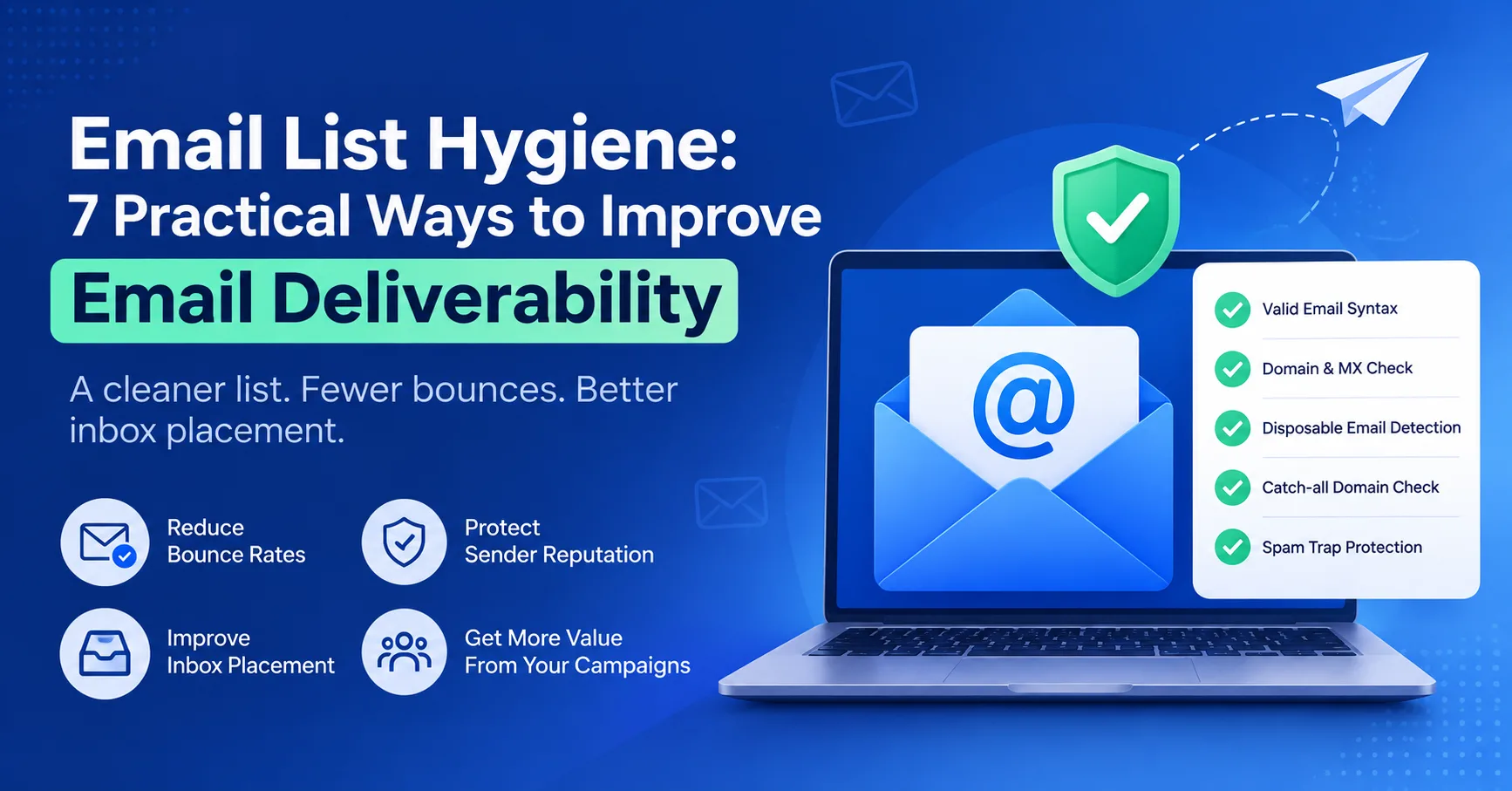
Email List Hygiene: 7 Practical Ways to Improve Email Deliverability
Building an email list is only the beginning of effective email marketing. The quality of the addresses in that list can have a major impact on campaign performance, sender reputation, and ultimately how many messages reach the inbox.
A database can become less reliable over time. People change jobs, abandon old addresses, switch email providers, enter incorrect information into forms, or stop engaging with a brand altogether. If these addresses remain in a marketing database indefinitely, marketers may eventually see more bounces, lower engagement, and less predictable campaign results.
That is why email list hygiene should be treated as an ongoing process rather than a one-time cleanup task.
Here are seven practical ways marketers can maintain a healthier email database.
1. Validate new email addresses at the point of entry
One of the easiest problems to prevent is a bad address entering your database in the first place.
For example, a customer might accidentally type [email protected] instead of [email protected] when completing a signup form. If the error isn't detected, the address may be added to a CRM or email platform and remain there until the next campaign produces a bounce.
Real-time validation can check an address before it becomes part of the active database. Depending on the service being used, these checks may include syntax, domain information, disposable email detection, and other deliverability signals.
Preventing poor-quality data at the source is generally easier than cleaning a large database later.
2. Don't assume that every "valid" address is equally safe
Email validation isn't always as simple as dividing addresses into valid and invalid categories.
Some domains use catch-all configurations that accept messages for addresses even when there isn't a conventional mailbox behind them. Corporate email systems can also behave differently because of security gateways, filtering systems, and privacy controls.
For this reason, marketers should look beyond a single status label when evaluating an address. A risk-based approach can provide more useful information when deciding whether an address should be mailed immediately, reviewed, or treated cautiously.
Marketers looking for ways to verify email addresses and identify potential delivery risks can explore email validation tool that provide additional signals about the quality of contacts.
3. Clean existing lists regularly
Even a well-maintained list will change over time.
Email addresses that were deliverable six months ago may no longer be active today. Employees leave companies, domains change, inboxes are abandoned, and temporary addresses eventually disappear.
For that reason, list cleaning should be part of a recurring marketing workflow. The frequency depends on the size of the database and how often new contacts are added, but marketers managing large or frequently changing lists should avoid treating validation as a once-a-year activity.
Regular checks can help identify addresses that deserve further attention before they negatively affect future campaigns.
4. Pay attention to repeated bounces
A single soft bounce does not necessarily mean that an address is permanently unusable.
A temporary delivery problem could result from a full mailbox, server issue, or temporary restriction. However, repeated delivery failures deserve attention. If the same contact consistently produces bounces across multiple campaigns, continuing to send without investigating can unnecessarily increase delivery risk.
Hard bounces should generally be handled more quickly because they indicate a more permanent delivery problem.
The important point is to look at patterns rather than treating every bounce in exactly the same way.
5. Separate inactive contacts from invalid contacts
An inactive subscriber isn't necessarily an invalid subscriber.
Someone who hasn't opened an email for several months may still have a perfectly deliverable address. Removing every inactive contact immediately could eliminate people who may become interested again.
Instead, marketers can create separate segments for inactive, unengaged, risky, and undeliverable contacts. This makes it easier to design appropriate re-engagement campaigns while keeping clearly problematic addresses away from regular sends.
Segmentation also gives marketers better visibility into the actual health of their database.
6. Be careful with role-based and disposable addresses
Not every technically deliverable address represents an ideal marketing contact.
Addresses such as support@, info@, or sales@ may be shared by multiple people rather than belonging to one individual. Disposable email addresses can also be used temporarily and may have little long-term value for a business relationship.
Whether these addresses should be removed depends on the purpose of the campaign. A B2B newsletter, for example, may have different requirements from a consumer signup campaign.
The key is to understand what different address types mean instead of automatically treating every contact the same way.
7. Make list hygiene part of the marketing workflow
The biggest improvement often comes from changing the process rather than simply choosing another tool.
A practical workflow might look like this:
New signup → validation → CRM → segmentation → campaign → bounce monitoring → periodic revalidation
This approach creates several opportunities to catch problems before they become expensive. New addresses can be checked during signup, existing contacts can be reviewed periodically, and campaign results can provide additional signals about database quality.
It also prevents list hygiene from becoming a large cleanup project every few months.
A healthier list is more useful than a larger list
Email marketing isn't a numbers game where the biggest database always wins. A smaller list containing relevant, deliverable, and engaged contacts can be considerably more valuable than a huge database filled with outdated or questionable addresses.
Good list hygiene combines several practices: validating new contacts, monitoring bounces, reviewing inactive subscribers, understanding different types of email addresses, and periodically checking existing data.
Most importantly, it should be treated as an ongoing part of email marketing rather than a task performed only after deliverability problems appear.
When marketers build these checks into their regular workflows, they gain better control over contact quality and can make campaign performance more predictable over time.