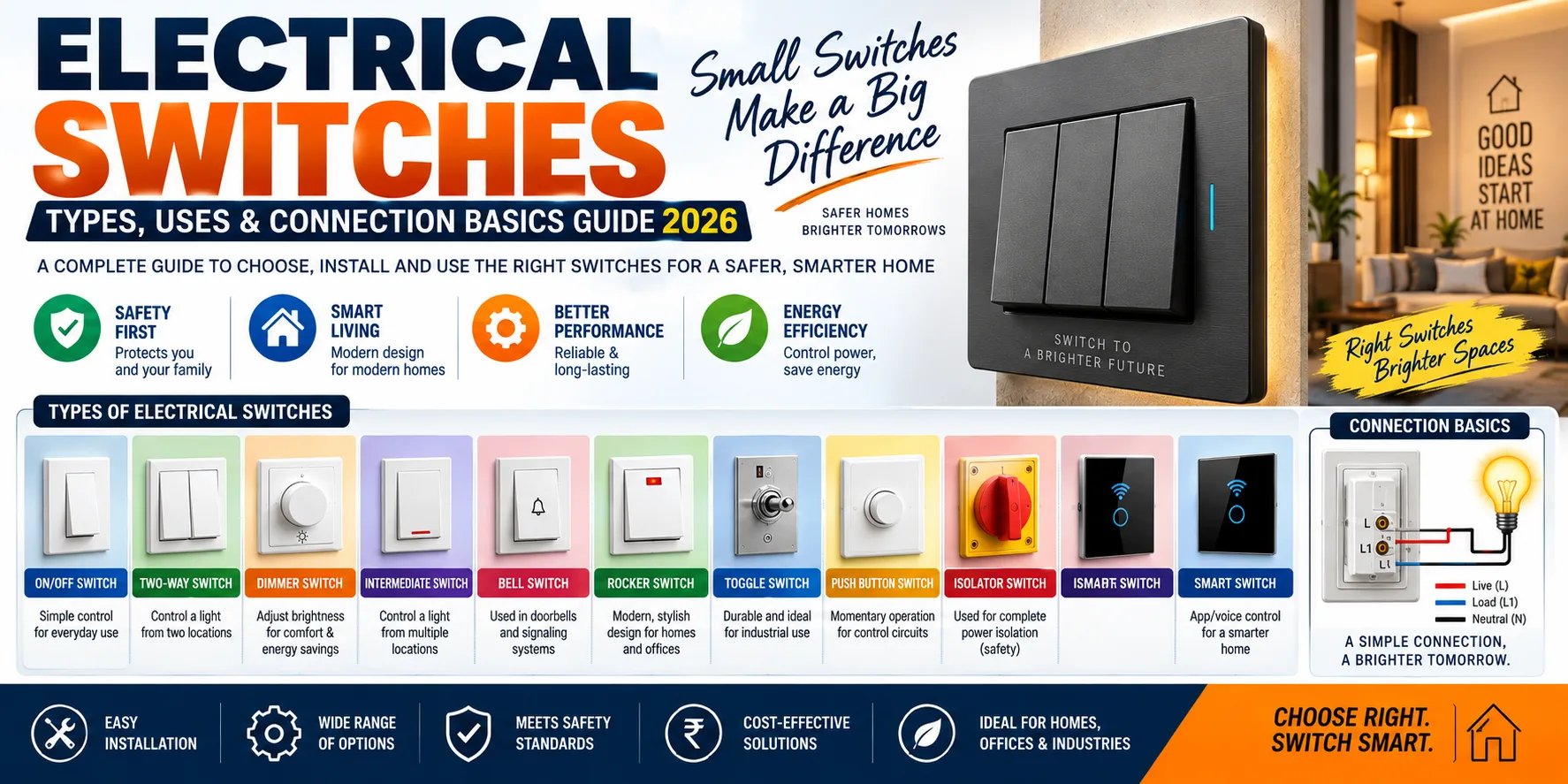
Electrical switches are among the most important components in every residential, commercial, and industrial electrical system. From turning on a bedroom light to controlling appliances, fans, machines, and automated systems, an Electrical Switch provides a simple and reliable way to control the flow of electricity.
With the growing popularity of modular interiors, smart homes, energy-efficient appliances, and modern electrical installations, choosing the right Electrical Switches has become more important than ever. Homeowners, architects, electricians, contractors, and interior designers increasingly look for safe, durable, aesthetically appealing, and application-specific solutions.
This guide explains Electrical Switches in India, their major types, applications, connection basics, safety considerations, and factors to consider when selecting the Best Electrical Switches for residential and commercial use.
What Is an Electrical Switch?
An electrical switch is a device used to open, close, or control an electrical circuit. In its simplest form, a switch either allows current to flow through a circuit or interrupts the flow.
When a switch is turned ON, the electrical circuit is completed, allowing current to reach the connected load. When it is turned OFF, the circuit is interrupted.
Depending on their construction and application, switches can control:
- Lights
- Ceiling fans
- Exhaust fans
- Power outlets
- Appliances
- Pumps
- Motors
- Industrial equipment
- Security systems
- Smart-home devices
- Automated electrical systems
Although the basic purpose remains the same, modern Electrical Switches are available in many designs, configurations, materials, and operating mechanisms.
Why Electrical Switches Are Important
Switches may appear to be simple devices, but they play an essential role in electrical safety and convenience.
A properly selected switch can provide:
1. Safe Circuit Control
Switches allow users to control electrical loads without directly interacting with wires or electrical terminals.
2. Convenience
Strategically installed switches make it easier to control lights, fans, appliances, and other electrical equipment.
3. Improved Interior Design
Modern modular switches can complement contemporary residential and commercial interiors.
4. Circuit Isolation
Certain switches are designed to isolate electrical equipment during maintenance or emergency situations.
5. Automation
Smart switches can integrate lighting and appliances with automation systems, sensors, timers, and mobile applications.
Types of Electrical Switches
There are many Types of electrical switches, and the correct choice depends on the circuit, load, location, operating requirements, and installation method.
Some common types include:
- One-way switches
- Two-way switches
- Intermediate switches
- Single-pole switches
- Double-pole switches
- Push-button switches
- Rocker switches
- Toggle switches
- Rotary switches
- Selector switches
- Slide switches
- Pull-cord switches
- Dimmer switches
- Fan regulators
- Smart switches
- Sensor-based switches
- Emergency switches
- Limit switches
Let's examine some of the most commonly used options.
1. One-Way Switch
A one-way switch is one of the most common switches used in residential electrical installations.
It is generally used when a light or appliance needs to be controlled from a single location.
Typical applications include:
- Bedroom lights
- Bathroom lights
- Kitchen lights
- Ceiling lights
- Small appliances
For example, a bedroom light may have one switch positioned near the entrance. The switch can turn the light ON or OFF from that location.
2. Two-Way Switch
A two-way switch arrangement allows a light or electrical load to be controlled from two different locations.
This configuration is particularly useful in:
- Staircases
- Long corridors
- Large bedrooms
- Hallways
- Large rooms
For example, a staircase light can be operated from the bottom and top of the staircase.
Two-way switching improves convenience because users do not have to return to one specific location to turn the light off.
3. Intermediate Switch
An intermediate switch is used when a single electrical load needs to be controlled from three or more locations.
It is commonly used together with two-way switches.
Applications can include:
- Long corridors
- Large commercial spaces
- Multi-level staircases
- Large bedrooms
- Institutional buildings
This arrangement provides greater flexibility in controlling lighting circuits.
4. Single-Pole Switch
A single-pole switch is designed to control a circuit from one location.
It is widely used in residential applications because many household lighting circuits require simple ON/OFF control.
Single-pole switches are available in different designs, including traditional, modular, rocker, and decorative formats.
5. Double-Pole Switch
A double-pole switch controls two conductors simultaneously.
These switches can be useful for applications where greater circuit isolation is required, subject to the electrical system and applicable installation standards.
They may be used for certain:
- High-power appliances
- Equipment isolation
- Specialized circuits
- Electrical distribution applications
The correct configuration should always be determined by a qualified electrician based on the electrical system and equipment requirements.
Push-Button Switches
Push-button switches operate when a user presses a button.
They can be designed as momentary or maintained-contact switches depending on their intended application.
Common applications include:
- Doorbells
- Control panels
- Industrial equipment
- Alarm systems
- Automation controls
- Certain lighting systems
Push-button switches are available in both residential and industrial designs.
Rocker Switches
Rocker switches use a rocking mechanism to change between ON and OFF positions.
They are popular because they are easy to operate and can have a clean, modern appearance.
Rocker-style mechanisms are commonly found in modular residential switch ranges and equipment controls.
Toggle Switches
Toggle switches use a lever mechanism that moves between positions.
They are commonly associated with traditional electrical equipment, control panels, machinery, and specialized applications.
Although modular rocker switches have become common in modern homes, toggle switches continue to have applications where their mechanical design is suitable.
Rotary Switches
A rotary switch is operated by turning a knob through multiple positions.
Unlike a simple ON/OFF switch, rotary switches can provide selection between several circuits or operating modes.
They are commonly found in:
- Control panels
- Electrical equipment
- Industrial machinery
- Test equipment
- Specialized appliances
Selector Switches
Selector switches allow users to choose between different operating modes.
For example, a machine control system might provide:
- OFF
- Manual
- Automatic
A selector switch can be used to choose the desired mode.
These switches are especially useful in industrial and commercial electrical systems.
Dimmer Switches
Dimmer switches allow compatible lighting systems to operate at different brightness levels rather than simply ON or OFF.
They can be useful for:
- Living rooms
- Bedrooms
- Restaurants
- Hotels
- Theatres
- Hospitality spaces
However, compatibility between the dimmer, lamp, driver, and lighting technology should be confirmed before installation.
Smart Electrical Switches
Smart switches are becoming increasingly popular as smart-home technology develops.
A smart switch can potentially provide features such as:
- Remote control
- Scheduling
- Automation
- Voice control
- Mobile-app operation
- Scene control
- Energy-management integration
Depending on the product and system, smart switches may connect using Wi-Fi, Bluetooth, Zigbee, or other communication technologies.
Smart switches can be particularly useful for homeowners who want to integrate lighting and electrical controls into a broader home automation system.
Electrical Switches for Home
Choosing Electrical Switches for Home requires more than simply selecting an attractive design.
Homeowners should consider:
- Electrical rating
- Voltage compatibility
- Current capacity
- Installation environment
- Mechanical quality
- Material quality
- Safety features
- Design
- Compatibility with existing wiring
- Warranty and after-sales support
Different rooms may also require different solutions.
Living Room
The living room may require multiple switches for:
- Ceiling lights
- Decorative lights
- Fans
- Lamps
- Wall lighting
- Smart devices
Bedroom
Bedroom installations may benefit from convenient switch positioning near the entrance and bedside areas.
Two-way switching can also be useful where users want to operate the same light from different locations.
Kitchen
Kitchen switches should be selected with consideration for the environment, appliance loads, and appropriate installation locations.
Bathroom
Electrical installations in bathrooms require special attention to electrical safety and the location of electrical devices relative to water and moisture.
A qualified electrician should determine suitable equipment and installation practices.
Best Electrical Switches for House: What Should You Look For?
People searching for the Best Electrical Switches for House often focus on appearance, but several technical factors are equally important.
1. Safety
Safety should always be the first consideration.
Look for products designed according to relevant electrical standards and suitable for the intended application.
2. Electrical Rating
The switch should be appropriate for the circuit and load it is controlling.
Using a switch that is not suitable for the electrical load can create safety risks.
3. Construction Quality
Good-quality materials and reliable internal mechanisms can contribute to better durability and consistent operation.
4. Terminal Quality
Secure and appropriately designed terminals are important for reliable electrical connections.
5. Mechanical Operation
A good switch should provide consistent operation without excessive looseness, sticking, or abnormal heating.
6. Design
Modern homes often use modular switch systems that can complement interior design.
7. Availability
Replacement parts and matching switches and sockets should ideally be readily available.
Branded Electrical Switches
Branded Electrical Switches are popular because established manufacturers generally offer standardized product ranges, documented specifications, warranty support, and distribution networks.
However, choosing a product only because it carries a familiar brand name is not enough.
Buyers should compare:
- Product specifications
- Applicable standards
- Warranty
- Product range
- Installation requirements
- Electrical ratings
- Application suitability
- Availability
- Professional recommendations
For residential projects, branded products can also make it easier to maintain a consistent appearance across different rooms.
Electrical Sockets and Switches And Sockets
Switches are commonly installed alongside Electrical Sockets, making Switches And Sockets an important part of any electrical installation.
An electrical socket, also called a receptacle or outlet in some regions, provides a connection point for electrical equipment.
Common socket applications include:
- Mobile chargers
- Televisions
- Computers
- Kitchen appliances
- Refrigerators
- Washing machines
- Office equipment
- Lamps
The socket type and rating should be appropriate for the electrical system and intended load.
Types of Electrical Switches and Sockets
Understanding the Types of Electrical Switches and Sockets helps homeowners and professionals select appropriate products.
Common combinations include:
Switch + Socket
A switch may be installed next to a socket to provide convenient control.
Universal or Multi-Standard Socket
Some socket designs are intended to accept multiple plug configurations. Their suitability should be evaluated carefully based on local standards and intended equipment.
USB Socket
Some modern socket units incorporate USB charging ports.
Data and Communication Modules
Modern modular systems may also include modules for:
- Ethernet
- Telephone
- Audio
- HDMI
- Other low-voltage connections
These modules allow a modular plate system to integrate multiple functions.
Basic Electrical Switch Connection
Understanding the basic principle of a switch connection is useful, but actual electrical installation should be carried out by a qualified electrician.
In a basic lighting circuit, the switch is typically placed in the appropriate live/phase conductor so that turning the switch OFF disconnects the load from the live supply.
A simplified concept is:
Supply → Switch → Light/Load → Return conductor → Supply
The exact wiring arrangement depends on the electrical system, switch type, circuit design, and applicable standards.
Important Safety Rule
Never work on energized electrical wiring.
Before electrical work:
- Turn off the relevant circuit.
- Isolate the supply appropriately.
- Prevent accidental re-energization where practical.
- Verify that the circuit is de-energized using suitable test equipment.
- Use appropriate tools and protective equipment.
- Follow applicable electrical codes and standards.
- Consult a qualified electrician for installation or modification.
Switch Connection: Common Mistakes to Avoid
Incorrect switch installation can create electrical and safety problems.
Common mistakes include:
Using the Wrong Switch Rating
A switch should be suitable for the load it controls.
Loose Terminals
Poorly tightened connections can lead to resistance, heating, arcing, or failure.
Incorrect Conductor Identification
Conductors should be correctly identified and connected according to the electrical system and applicable standards.
Overcrowding
Overfilling electrical boxes can make connections difficult and increase installation risks.
Ignoring Earthing
Appropriate earthing and protective arrangements are essential where required.
Installing Near Moisture Without Proper Consideration
Switches and sockets should be selected and positioned appropriately for wet or damp environments.
Also Read: Types of Switches: Complete Engineering Guide for 2026
How to Choose Electrical Switches in India
The market for Electrical Switches in India includes traditional electrical products, modular systems, smart switches, industrial switches, and specialized control devices.
When choosing products, consider the following factors.
Application
First determine whether the switch is intended for:
- Home
- Office
- Retail shop
- Hotel
- Factory
- School
- Hospital
- Commercial building
Load
Determine what the switch will control.
A lighting circuit and a high-power appliance may require different electrical specifications.
Installation Type
Choose products compatible with the electrical boxes, plates, and wiring arrangement used in the project.
Environment
Consider heat, humidity, dust, moisture, outdoor exposure, and other environmental conditions.
Appearance
For modern interiors, modular designs can provide a coordinated look.
Future Requirements
If the property may later adopt smart-home technology, users can consider whether their selected modular system supports compatible smart modules.
Best Electrical Switches: Quality vs Price
Price is an important consideration, but the cheapest switch is not necessarily the most economical option.
A low-quality switch may experience:
- Mechanical wear
- Loose operation
- Contact problems
- Discoloration
- Premature failure
The Best Electrical Switches should provide an appropriate balance between safety, quality, performance, design, availability, and cost.
For large residential or commercial projects, lifecycle value can be more important than the initial purchase price.
Traditional vs Modular Electrical Switches
Traditional electrical switches have been widely used for decades.
Modular switches provide a more flexible approach because individual modules can often be combined into plates according to the requirements of a room.
Advantages of modular systems can include:
- Contemporary appearance
- Flexible configurations
- Easy replacement of individual modules
- Integration of sockets and switches
- Compatibility with data and smart-home modules
- Consistent interior design
This makes modular systems particularly popular in modern residential and commercial projects.
Smart Homes and the Future of Electrical Switches
The role of the electrical switch is evolving.
Modern homes increasingly combine conventional switching with automation.
Future-oriented electrical installations may include:
- Motion sensors
- Occupancy sensors
- Smart lighting
- Automated curtains
- Energy monitoring
- Voice control
- Remote access
- Scheduled switching
- Scene-based control
However, conventional physical switches remain important because users still need reliable manual control.
The future is therefore likely to involve a combination of traditional switching, electronic control, sensors, and connected systems.
Electrical Switches for Commercial Buildings
Commercial buildings have more complex electrical requirements than typical homes.
Applications can include:
- Offices
- Shopping centres
- Hotels
- Restaurants
- Schools
- Hospitals
- Warehouses
- Factories
Commercial projects may require specialized switchgear and control equipment in addition to standard wall switches.
Designers should consider:
- Load requirements
- Electrical distribution
- Emergency systems
- Maintenance access
- Occupancy patterns
- Automation
- Fire and safety requirements
- Applicable regulations
Electrical design should be handled by appropriately qualified professionals.
Maintenance of Electrical Switches and Sockets
Proper maintenance can help identify potential electrical problems before they become serious.
Watch for signs such as:
- Burning smell
- Sparks
- Excessive heat
- Crackling sounds
- Discoloration
- Loose switches
- Intermittent operation
- Damaged plates
- Broken sockets
A switch or socket showing these symptoms should not be ignored.
The affected circuit should be safely isolated and inspected by a qualified electrician.
Why Quality Matters When Buying Switches And Sockets
Purchasing reliable Switches And Sockets is an investment in electrical safety, convenience, and long-term performance.
Quality products can provide:
- Better mechanical durability
- More consistent operation
- Appropriate electrical ratings
- Better fit and finish
- Easier maintenance
- Product support
- Greater confidence in installation
For new construction and renovation projects, it is also useful to select switches and sockets as part of an overall electrical plan rather than buying individual products randomly.
Frequently Asked Questions
What are the main types of electrical switches?
Common types include one-way, two-way, intermediate, single-pole, double-pole, push-button, rocker, toggle, rotary, selector, dimmer, smart, sensor, and specialized industrial switches.
Which are the Best Electrical Switches for House?
The best option depends on electrical rating, application, safety requirements, construction quality, installation environment, design, and budget. Products from established manufacturers can be considered after checking specifications and applicable standards.
What should I consider when buying Electrical Switches for Home?
Consider electrical rating, safety, construction quality, terminal design, durability, compatibility, appearance, warranty, availability, and the requirements of each room.
Are Branded Electrical Switches better?
Branded Electrical Switches can offer documented specifications, standardized product ranges, warranty support, and distribution networks. However, buyers should still verify that the particular product is suitable for their application.
What is the difference between a one-way and two-way switch?
A one-way switch is generally used to control a circuit from one location, while a two-way switching arrangement allows the same load to be controlled from two locations.
What are Electrical Sockets used for?
Electrical Sockets provide connection points for electrical equipment such as chargers, televisions, computers, appliances, lamps, and other compatible devices.
Can I install electrical switches myself?
Electrical wiring can be hazardous. Installation, modification, or repair should be performed by a qualified electrician who can safely isolate the circuit and comply with applicable electrical requirements.
Are smart switches replacing traditional switches?
Smart switches are expanding rapidly, but traditional switches remain widely used. Many modern systems combine physical controls with smart-home automation.
Conclusion
Electrical switches are fundamental components of modern electrical systems, providing safe and convenient control of lighting, appliances, equipment, and automated systems. From basic one-way switches to two-way, intermediate, dimmer, sensor, and smart switches, there are many Types of electrical switches designed for different applications.
When selecting Electrical Switches in India, homeowners and professionals should look beyond appearance and price. Electrical rating, safety, durability, construction quality, installation environment, compatibility, and long-term availability should all be considered.
For residential projects, selecting the Best Electrical Switches for House involves matching the switch to the room, electrical load, interior design, and future requirements. Similarly, selecting suitable Electrical Sockets and coordinating Switches And Sockets can improve both functionality and appearance.
Whether you are building a new home, renovating an existing property, designing an office, or planning a commercial project, understanding Electrical Switches, their types, uses, and connection principles helps you make better decisions.
The most important principle is simple: choose products appropriate for the electrical application, follow recognized safety requirements, and have electrical connections installed or modified by qualified professionals. With the right planning, modern Branded Electrical Switches, sockets, modular systems, and smart controls can create electrical installations that are safer, more functional, durable, and suitable for today's connected homes and buildings.