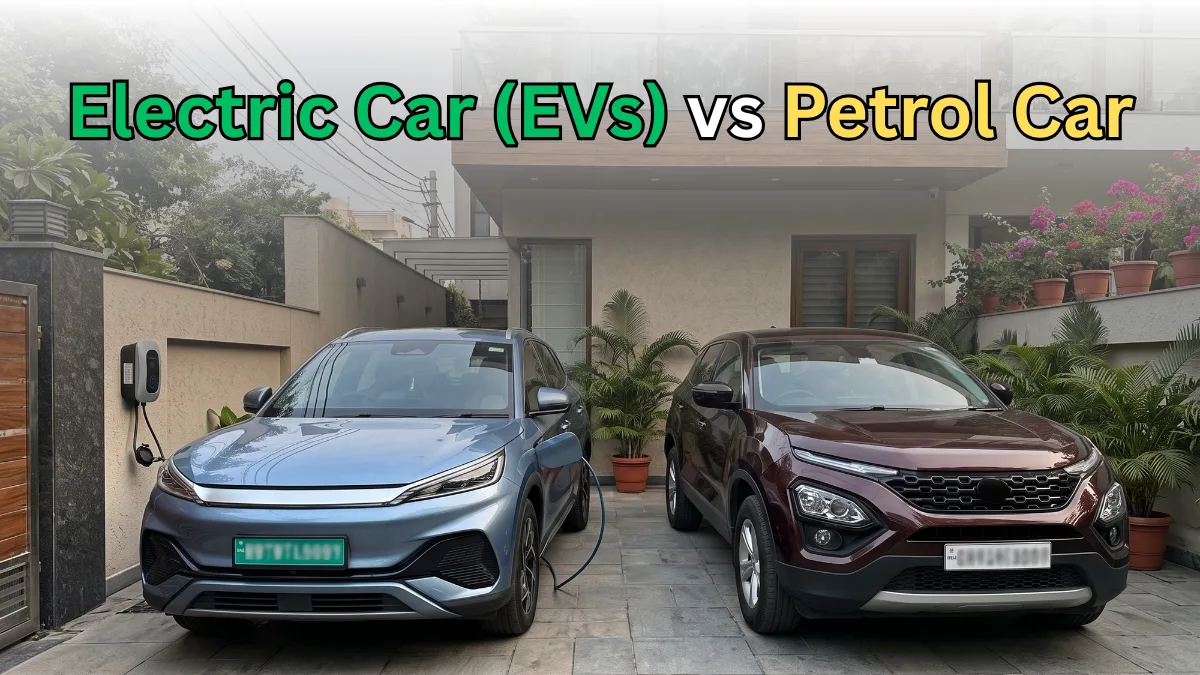
Buying an electric car instead of a petrol car can reduce your daily running expenses, but the cheaper running cost does not automatically make an EV the more affordable choice over five years. The final difference depends on the purchase price, annual driving distance, electricity tariff, petrol price, servicing, insurance and how much the car is worth when you sell it.
For someone who drives 1,000–1,500 km every month and charges mostly at home, an electric car can recover part of its higher purchase price through energy savings. However, a buyer who drives only a few hundred kilometres each month may need much longer to recover the initial price difference.
This comparison uses an illustrative five-year ownership period to show how the numbers work. The prices and running costs are assumptions, not quotations for specific cars. You can replace them with the actual on-road prices and expenses of the models you are considering.
EV vs Petrol Car: Key Cost Differences
An electric car uses electricity stored in its battery, while a petrol car depends on fuel purchased from a petrol pump. This creates the biggest difference in day-to-day running expenses, although both vehicles still involve insurance, tyres, maintenance and depreciation.
Ownership factorElectric carPetrol carAssumed purchase price₹14 lakh₹12 lakhEnergy sourceElectricityPetrolEnergy cost per kmDepends on efficiency and charging tariffDepends on mileage and petrol priceRoutine maintenanceNo engine oil or conventional engine servicingEngine oil, filters and other engine-related servicingHome charging requirementConvenient for regular use, with suitable parking and electrical accessNot requiredPublic infrastructureCharging stationsPetrol pumpsResale valueDepends on battery condition, warranty, demand and model updatesDepends on condition, mileage, demand and model updates
The purchase prices above assume the EV costs ₹2 lakh more than the petrol car. Actual price differences vary considerably by vehicle segment, variant, discounts, state taxes and registration benefits.
1. Five-Year Running Cost: EV vs Petrol
Let's compare two hypothetical cars over the same distance. Both vehicles cover 12,000 km annually, which equals 60,000 km over five years.
The calculation uses a petrol price of ₹100 per litre, petrol mileage of 15 km/litre, EV efficiency of 6 km/kWh and a home electricity tariff of ₹8 per unit. One unit of electricity equals one kilowatt-hour (kWh).
Petrol car fuel cost
A petrol car delivering 15 km/litre needs 800 litres of petrol to cover 12,000 km.
- Annual fuel requirement: 12,000 ÷ 15 = 800 litres
- Annual fuel expense: 800 × ₹100 = ₹80,000
- Five-year fuel expense: ₹80,000 × 5 = ₹4,00,000
The petrol car therefore consumes ₹4 lakh worth of fuel over five years, assuming its mileage and petrol price remain unchanged.
Electric car charging cost
An electric car averaging 6 km per kWh needs approximately 2,000 kWh to cover 12,000 km.
- Annual electricity requirement: 12,000 ÷ 6 = 2,000 kWh
- Annual charging expense: 2,000 × ₹8 = ₹16,000
- Five-year charging expense: ₹16,000 × 5 = ₹80,000
Under these assumptions, the EV spends ₹80,000 on electricity over five years, compared with ₹4 lakh on petrol. This creates a potential energy-cost saving of ₹3.2 lakh.
Actual electricity consumption from the grid may be higher than the energy used for driving because charging involves losses. Public charging tariffs can also be higher than domestic electricity rates. For a more personalised estimate, use the government’s e-AMRIT Journey Cost Calculator, which allows you to enter your annual distance, home electricity tariff, public charging costs and conventional vehicle mileage.
2. Five-Year Cost Comparison
The following table combines the assumed purchase price and energy expenses. It excludes insurance, servicing, financing, home charger installation and resale value, so it is not a complete total cost of ownership.
Expense over five yearsElectric carPetrol carAssumed purchase price₹14,00,000₹12,00,000Electricity or petrol₹80,000₹4,00,000Total before other expenses₹14,80,000₹16,00,000
In this example, the EV costs ₹2 lakh more to buy but saves ₹3.2 lakh on energy. After accounting for the initial price difference, it comes out ₹1.2 lakh ahead before insurance, maintenance, financing, charger installation and resale value.
This is why buyers should compare the entire ownership period rather than relying only on the lower cost per kilometre. A more expensive EV can make financial sense for a high-mileage driver, but the result can change when the purchase price difference is larger or the car is driven less frequently.
3. How Much Can You Save at Different Electricity Tariffs?
Your electricity tariff has a direct effect on the EV's running cost. The following figures use the same assumed efficiency of 6 km/kWh and annual driving distance of 12,000 km.
Electricity tariffAnnual charging costFive-year charging cost₹8/kWh₹16,000₹80,000₹12/kWh₹24,000₹1,20,000₹16/kWh₹32,000₹1,60,000₹20/kWh₹40,000₹2,00,000
These calculations do not include charging losses, which can increase the electricity drawn from the grid. They also assume that every kilometre is covered using electricity at the stated tariff.
Home charging is often the more economical option for regular use, while public DC fast charging can cost more depending on the operator, location and applicable charges. If you cannot install a home charger, estimate your likely public charging expenses before deciding which car to buy.
The e-AMRIT Home Charging Calculator can help estimate charging time and cost using battery capacity, electricity tariff, driving range and other inputs. Its Public Charging Calculator is useful for estimating the cost of charging away from home.
For another practical reference, AllAboutEVs has published an EV running cost guide covering cost per kilometre and monthly expenses. It explains why the actual savings depend on the vehicle's efficiency and how the owner charges it.
4. Maintenance Costs: Which Car Is Cheaper?
Electric cars have fewer conventional powertrain components than petrol cars. They do not require engine oil changes, spark plug replacements or the same engine-related servicing. This can reduce routine maintenance expenses, but it does not mean that an EV is maintenance-free.
Both types of cars require tyre checks and replacements, brake inspections, suspension work, air-conditioning maintenance, cabin filters and attention to other components that wear with use.
An EV's maintenance expenses depend on the model, service schedule, driving conditions and local service costs. Tyre replacement can also become a significant expense, particularly if the car is heavy, driven aggressively or fitted with expensive tyres.
A petrol car has additional engine and fuel-system maintenance requirements. Its service expenses depend on the engine, transmission, mileage and manufacturer schedule. Over five years, these costs can make a difference, but it is better to compare actual service schedules than apply a blanket percentage to either powertrain.
For a model-specific reference, buyers can check the manufacturer's official electric-car service cost calculator. The displayed estimates are indicative and should be checked against the selected model, service interval and authorised workshop quotation.
5. Insurance, Financing and Home Charger Installation
Insurance can narrow the financial gap between an EV and a petrol car. Premiums depend on the vehicle's insured declared value, variant, location, coverage, add-ons, claim history and insurer. A higher-priced car may attract a higher premium, although the final difference varies by policy.
Do not assume that the insurance cost will be identical simply because two cars have similar dimensions or performance. Compare quotations for the exact variants and coverage you plan to purchase.
Financing also matters. If you buy the EV with a loan, the interest paid on its higher purchase price adds to the cost of ownership. A lower monthly EMI does not necessarily mean a cheaper purchase because the loan tenure and down payment may differ.
Home charging installation is another expense to check. Some manufacturers include a charger or basic installation under specific offers, while other installations may require additional wiring, electrical protection, civil work or a sanctioned-load upgrade. Confirm what is included in writing before adding an estimated amount to your budget.
If you rely on public chargers, include realistic charging costs in your calculation rather than assuming every unit will be charged at the domestic electricity tariff.
6. Resale Value and Battery Warranty
Resale value can change the outcome of a five-year comparison more than many buyers expect. An EV's resale price may depend on battery health, remaining warranty, charging history where available, vehicle condition, demand for the model and the arrival of newer cars with better range or features.
Petrol cars also depreciate, and their resale values depend on age, mileage, maintenance records, accident history and market demand. There is no reliable universal rule that every EV loses value faster than every petrol car.
Battery warranty terms deserve particular attention when buying an EV. Check the warranty duration, kilometre limit, battery coverage conditions, degradation thresholds where applicable and whether the coverage transfers to a second owner. A warranty described as lifetime coverage may have eligibility requirements or exclusions, so read the applicable terms rather than relying on the headline.
For more context, see AllAboutEVs' guide to EV battery warranties in India. For the vehicle you plan to purchase, the manufacturer's current warranty document should remain the final reference.
When estimating resale value, compare current used-car listings for similar model years and variants, but treat asking prices as indications rather than confirmed sale prices. A realistic resale estimate is more useful than assuming a fixed percentage of the original price.
7. When Does an EV Recover Its Higher Purchase Price?
In our example, the EV costs ₹2 lakh more upfront but saves ₹3.2 lakh in energy expenses over five years.
The annual energy saving is:
₹80,000 petrol cost − ₹16,000 EV electricity cost = ₹64,000 per year
The approximate time required to recover the ₹2 lakh initial price difference is:
₹2,00,000 ÷ ₹64,000 = 3.1 years
This is an energy-cost break-even estimate, not a guarantee that the EV will become cheaper overall after 3.1 years. Insurance, maintenance, financing, charging losses, installation and resale value can move the break-even point in either direction.
The result also depends on how much you drive. Someone covering 20,000 km a year could potentially recover the price difference sooner, while a driver covering only 5,000–6,000 km annually may take much longer. If the EV's upfront price is substantially higher, the savings may not cover the difference within five years.
Final Verdict: Should You Buy an EV or a Petrol Car?
An electric car can be the more economical choice over five years if you drive regularly, have convenient access to affordable charging and choose a model whose purchase price is reasonably close to that of a comparable petrol car. The benefit becomes more noticeable as annual driving distance increases because the owner can save on every kilometre travelled.
A petrol car may remain the more practical financial choice for people who drive very little, cannot charge at home and would need to rely heavily on expensive public charging. Purchase price, loan interest and resale value can also change which option costs less.
Before making a decision, compare the exact on-road prices and calculate five years of energy, insurance, scheduled servicing, tyres, financing, charger installation and expected resale value. The e-AMRIT portal provides EV-related tools and information that can help with this assessment.
The key is to compare cars based on your actual driving habits and local costs. Lower running expenses are an important advantage of an EV, but the better purchase is the one that fits both your daily needs and your total ownership budget.