
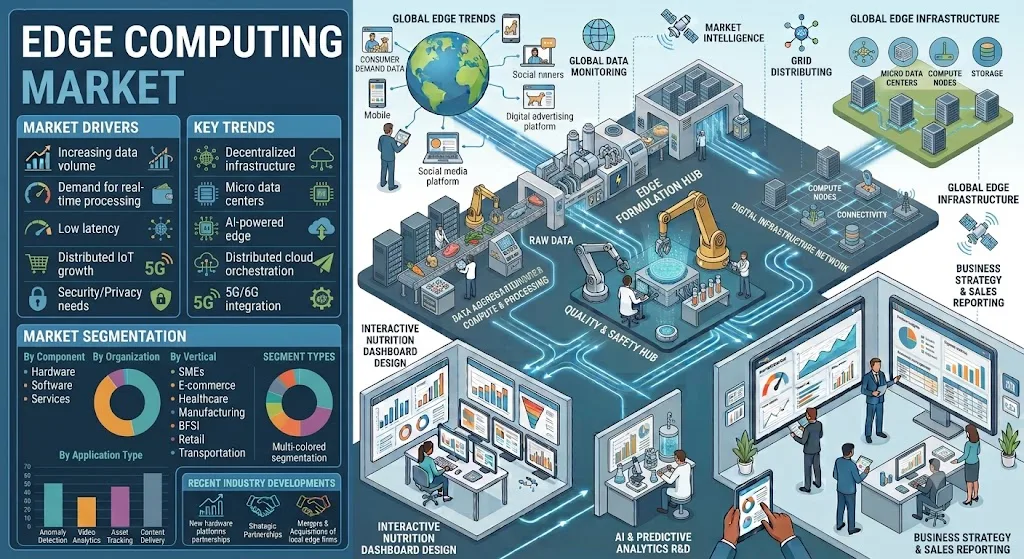
Market Overview:
According to IMARC Group's latest research publication, "Edge Computing Market: Global Industry Trends, Share, Size, Growth, Opportunity and Forecast 2026-2034", The global edge computing market size was valued at USD 22.71 Billion in 2025 and is projected to reach USD 139.01 Billion by 2034, exhibiting a CAGR of 21.51% during the forecast period 2026-2034.
This detailed analysis primarily encompasses industry size, business trends, market share, key growth factors, and regional forecasts. The report offers a comprehensive overview and integrates research findings, market assessments, and data from different sources. It also includes pivotal market dynamics like drivers and challenges, while also highlighting growth opportunities, financial insights, technological improvements, emerging trends, and innovations. Besides this, the report provides regional market evaluation, along with a competitive landscape analysis.
How AI is Reshaping the Future of the Edge Computing Market
- AI inference workloads are rapidly migrating from centralised cloud servers to edge nodes, reducing latency from over 50 milliseconds to under 10 milliseconds for mission-critical industrial and autonomous system applications.
- NVIDIA's Jetson and Cosmos platforms have accelerated AI deployment at the edge, enabling over 100 TOPS inference performance in compact, ruggedised hardware designed for factory floors, vehicles, and remote sites.
- The top 7 edge computing companies, including AWS, HPE, Microsoft, Cisco, Dell, NVIDIA, and Intel, collectively accounted for approximately 37% of global market revenue in 2025, with AI hardware integration being a primary competitive differentiator.
- By 2025, enterprises generated roughly 75% of their data outside traditional data centres, compelling organisations to deploy AI-powered edge nodes that handle initial inference at the device level, cutting backhaul bandwidth costs by 30 to 40% for manufacturers.
- Government initiatives such as the US CHIPS and Science Act, which earmarked over USD 52 Billion for semiconductor and advanced compute infrastructure, are directly funding decentralised edge computing build-outs across federal and defence networks, embedding AI capabilities at the infrastructure level.
Download a sample PDF of this report: https://www.imarcgroup.com/edge-computing-market/requestsample
Key Trends in the Edge Computing Market
- Hardware Dominance Anchored by AI Accelerator Demand: Hardware commands a 42.6% component share in 2025, driven by surging enterprise demand for edge servers, AI accelerator cards, ruggedised gateways, and networking equipment. NVIDIA, Intel, and AMD supply the majority of AI accelerator silicon for edge deployments, while Dell, HPE, and Lenovo anchor general-purpose edge infrastructure across manufacturing, healthcare, and telecommunications verticals.
- 5G Multi-Access Edge Compute Reaching Commercial Maturity: Global 5G connections surpassed 2.25 billion in 2025, with China, the United States, South Korea, and Japan leading deployments. Hyperscalers including AWS Wavelength and Azure Edge Zones are now embedded in carrier networks from AT&T, Verizon, and Vodafone, delivering sub-20 millisecond application latency for enterprise customers at commercial scale.
- Sovereign Edge and Data Localisation Creating a New Market Category: Regulatory frameworks including GDPR, the EU Data Act, India's Digital Personal Data Protection Act, and China's Personal Information Protection Law are mandating in-country data residency. This is driving demand for sovereign edge deployments, particularly in financial services, healthcare, and government verticals, where data cannot legally leave national boundaries.
- SME Adoption Accelerating Through Subscription-Based Edge Services: While large enterprises hold a 61.3% market share in 2025, small and medium-sized enterprises are rapidly entering the edge computing space via subscription-based services such as AWS Local Zones and Azure Edge Zones. The total number of network edge data centres worldwide is estimated to reach nearly 1,200 by 2026, extending infrastructure reach to previously underserved markets.
- Industrial IoT Scaling from Pilots to Factory-Wide Deployments: The Industrial Internet of Things application segment held more than 33% of total edge computing revenue in 2025. Manufacturers are transitioning from limited proof-of-concept deployments to enterprise-wide rollouts of edge-enabled predictive maintenance, quality control, and digital twin systems. Telecommunications companies are expected to invest approximately USD 11.6 Billion per year by 2027 to support this build-out.
We explore the factors propelling the edge computing market growth, including technological advancements, consumer behaviors, and regulatory changes.
Growth Factors in the Edge Computing Market
- IoT Device Proliferation Generating Unmanageable Data Volumes at the Centre: Enterprise IoT connections passed 19 billion in 2025, heading toward approximately 29 billion devices by 2030. The International Data Corporation estimates that globally, there will be nearly 180 ZB of new data generated by 2025, making centralised cloud processing physically and economically impractical for latency-sensitive workloads and fuelling edge infrastructure investment.
- North America Leading Market Investment Backed by Public Policy: North America holds a 34.7% global revenue share in 2025, anchored by the concentration of hyperscale operators and hardware vendors. The CHIPS Act's more than USD 395 Billion in announced semiconductor investment and enterprise AI capital expenditure exceeding USD 300 Billion in 2025 alone are reinforcing the region's position as the dominant market for edge infrastructure buildout.
- Asia Pacific Emerging as the Fastest-Growing Regional Market: Asia Pacific accounts for 29.3% of global edge computing revenue in 2025 and is the fastest-growing region. China operates over 3 million 5G base stations as of 2025, enabling nationwide multi-access edge compute services. India's Digital Public Infrastructure rollout and Japan's Industry 5.0 programmes are generating unprecedented edge data volumes and enterprise adoption across the region.
- Automotive and Autonomous Systems Creating Dedicated Edge Demand: Autonomous vehicles, drones, and robotics require deterministic edge compute with sub-millisecond response envelopes that centralised cloud infrastructure cannot provide. China is projected to account for 26% of global network edge sites by 2026, significantly driven by autonomous vehicle and smart city infrastructure programmes that depend on real-time edge processing.
- Edge AI Market Expanding as a Standalone Growth Engine: The Edge AI market reached USD 25.65 Billion in 2025 and is projected to reach USD 143.06 Billion in the coming years. Computer vision, generative AI inference, and large language model deployment at the edge are creating a new sub-segment of purpose-built hardware and software platforms that extend beyond traditional edge computing use cases.
Leading Companies Operating in the Global Edge Computing Industry:
- Amazon Web Services, Inc.
- Microsoft
- Hewlett Packard Enterprise Development LP
- Cisco Systems, Inc.
- Dell Inc.
- Google Cloud
- NVIDIA Corporation
- IBM Corporation
- Intel Corporation
- Huawei Technologies Co., Ltd.
Edge Computing Market Report Segmentation:
Breakup By Component:
- Hardware
- Software
- Services
Hardware accounts for the majority of shares at 42.6% in 2025 on account of widespread enterprise deployment of edge servers, AI accelerator cards, gateways, and networking equipment across industrial, telecommunications, and healthcare verticals.
Breakup By Organisation Size:
- Large Enterprises
Small and Medium-sized Enterprises (SMEs)
Large enterprises dominate with a 61.3% share in 2025 due to the capital intensity of telco multi-access edge compute rollouts, factory-wide Industry 4.0 deployments, and digital transformation programmes in healthcare and financial services.
Breakup By Vertical:
- Energy and Utilities
- Manufacturing
- Telecommunications
- Healthcare
- Retail
- Others
Breakup By Region:
- North America (United States, Canada)
- Asia Pacific (China, Japan, India, South Korea, Australia, Indonesia, Others)
- Europe (Germany, France, United Kingdom, Italy, Spain, Russia, Others)
- Latin America (Brazil, Mexico, Others)
- Middle East and Africa
North America enjoys the leading position with a 34.7% global revenue share, owing to the concentration of hyperscale cloud providers, aggressive 5G and private 5G rollouts, and public policy investments through the CHIPS and Science Act driving AI infrastructure build-outs across federal and enterprise networks.
Recent News and Developments in the Edge Computing Market
- January 2026: NTT highlighted significant progress on its Mobility AI Platform collaboration with Toyota to support autonomous driving and intelligent transportation systems, leveraging AI-enabled edge infrastructure to deliver real-time vehicle data processing and low-latency decision-making at the network edge.
- February 2026: Intel expanded its edge AI and industrial edge computing portfolio with enhanced edge processing solutions specifically designed for smart manufacturing, robotics, and AI-enabled operational environments, aiming to improve real-time data processing efficiency and support large-scale distributed edge deployments.
- March 2026: Dell Technologies announced advancements in its enterprise edge infrastructure portfolio to support AI workloads, distributed computing environments, and intelligent edge operations, with a focus on scalable edge infrastructure, operational resilience, and real-time enterprise analytics capabilities.
Note: If you require specific details, data, or insights that are not currently included in the scope of this report, we are happy to accommodate your request. As part of our customization service, we will gather and provide the additional information you need, tailored to your specific requirements. Please let us know your exact needs, and we will ensure the report is updated accordingly to meet your expectations.
About Us:
IMARC Group is a global management consulting firm that helps the world's most ambitious changemakers to create a lasting impact. The company provides a comprehensive suite of market entry and expansion services. IMARC offerings include thorough market assessment, feasibility studies, company incorporation assistance, factory setup support, regulatory approvals and licensing navigation, branding, marketing and sales strategies, competitive landscape and benchmarking analyses, pricing and cost research, and procurement research.
Contact Us:
IMARC Group
134 N 4th St. Brooklyn, NY 11249, USA
Email: [email protected]
Tel No: (D) +91 120 433 0800
United States: +1-201-971-6302