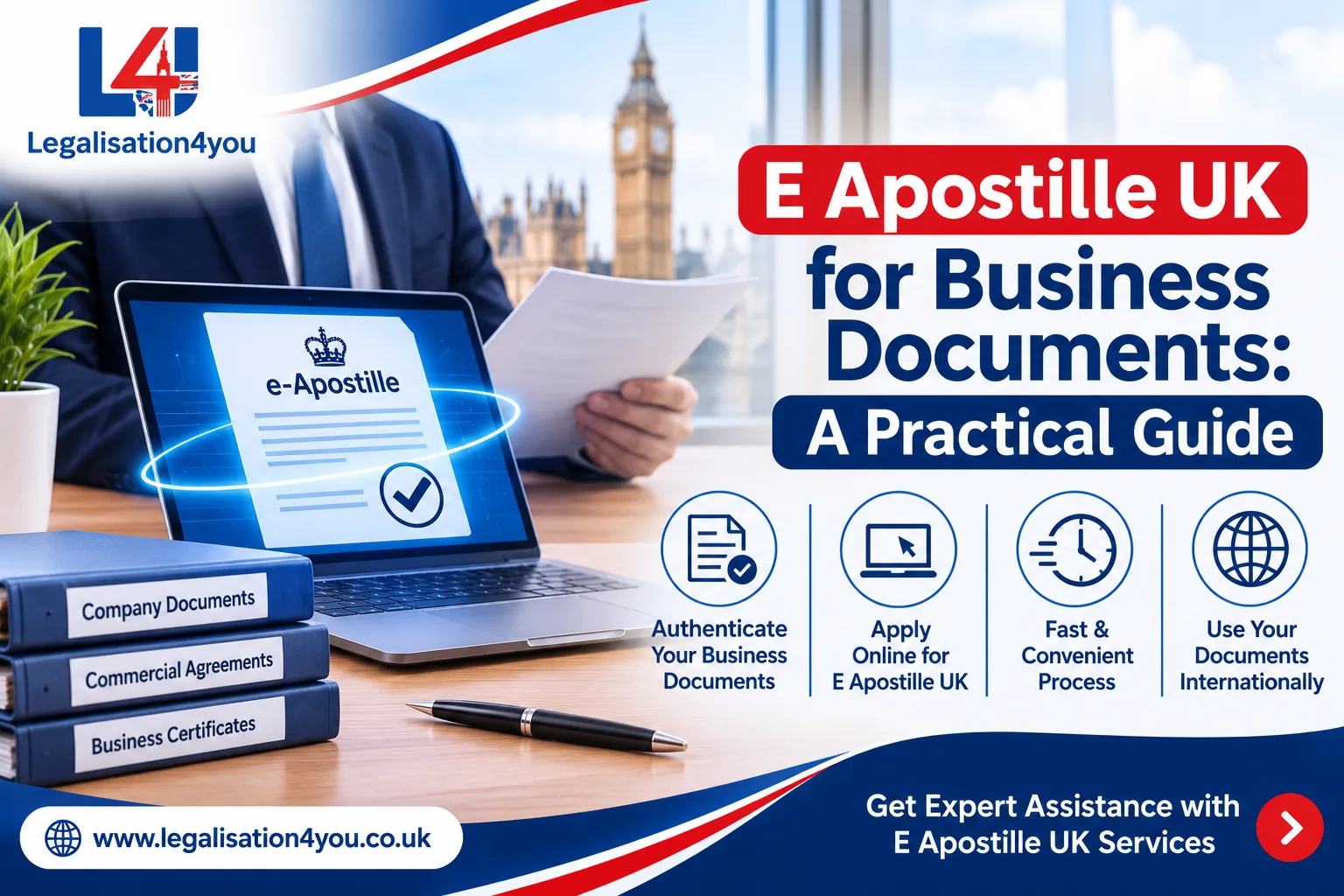
Businesses working with international clients, suppliers, and partners often need to provide official documents to overseas authorities. These documents may include company registration certificates, commercial agreements, powers of attorney, and other legal paperwork. Before these documents can be accepted abroad, they may need official authentication through an apostille.
An e apostille uk service provides a digital way to legalise eligible documents without relying on traditional paper-based processing. It allows businesses to submit electronically signed documents and receive their apostille digitally. This can make international document preparation more convenient, particularly for companies handling overseas transactions.
In this guide, we explain how the process works, which business documents may qualify, and what companies should consider before applying.
What Is an E Apostille UK?
An e-Apostille is an electronic version of the traditional apostille certificate issued by the UK Foreign, Commonwealth and Development Office (FCDO).
An apostille confirms the authenticity of an official signature, stamp, or seal on a document. It helps overseas authorities recognise UK documents without requiring the same document to go through a longer legalisation process in countries covered by the Hague Apostille Convention.
Unlike a traditional apostille, which is attached to a physical document, an electronic apostille is issued digitally as part of a PDF file.
For businesses, an e apostille uk service can simplify document handling by allowing eligible paperwork to be uploaded, processed, downloaded, and shared electronically.
Which Business Documents May Need an Apostille?
Companies expanding into international markets may need to provide different types of official paperwork. The exact documents depend on the purpose of the transaction and the requirements of the receiving authority.
Some common examples include:
1. Certificate of Incorporation
A certificate of incorporation confirms that a company has been legally registered in the UK. Overseas banks, business partners, and government organisations may request an apostilled certificate before completing certain procedures.
2. Memorandum and Articles of Association
These documents explain how a company is established and governed. They may be requested when setting up an overseas branch, registering a business, or completing international corporate transactions.
3. Commercial Agreements
Businesses entering international partnerships may need to provide contracts or commercial agreements. Depending on the receiving authority's requirements, these documents may need certification by a UK notary or solicitor before legalisation.
4. Powers of Attorney
A power of attorney allows an authorised person to act on behalf of a company or individual. It may be needed for overseas property transactions, business representation, or legal procedures.
5. Company Registration Documents
Companies may need to submit official registration records or other corporate documents when opening overseas accounts, establishing subsidiaries, or applying for international licences.
Not every business document automatically qualifies for an electronic apostille. Some may need certification by a UK notary or solicitor before they can be submitted.
How Does the E Apostille UK Process Work?
Understanding the application process helps businesses prepare their paperwork correctly and avoid unnecessary delays.
Here are the main steps involved.
Step 1: Identify the Required Business Documents
Start by confirming which documents the overseas authority or organisation requires. Check whether original documents, certified copies, or electronically signed documents are acceptable.
Different countries and organisations may have different requirements, so checking before applying is important.
Step 2: Arrange Certification if Required
Some business documents need to be certified by an authorised UK professional before they can be legalised.
A UK notary public or solicitor may need to verify the document and apply an appropriate electronic signature. This is particularly relevant for privately prepared documents, such as contracts and powers of attorney.
Step 3: Prepare the Digital Documents
For an electronic apostille application, the relevant documents must be available as PDF files and electronically signed by a UK notary or solicitor.
Make sure the files are complete, readable, and prepared according to the FCDO's requirements.
Step 4: Submit the Online Application
Applicants can use the official UK government legalisation service to apply for an e-Apostille.
You will need to upload the required documents and provide the requested application information. Payment is also required when submitting the application.
Step 5: Receive Your E Apostille
Once the application has been processed successfully, the Legalisation Office will email you when the legalised documents are ready.
You can download the electronic documents and share them with the overseas recipient through email or another accepted digital method.
What Are the Benefits of an E Apostille for Businesses?
An electronic apostille offers several practical advantages for companies managing international paperwork.
1. Convenient Digital Processing
Businesses can submit eligible documents electronically instead of arranging physical delivery to the Legalisation Office.
2. Easier Document Sharing
Once issued, the PDF can be downloaded and shared digitally with overseas clients, business partners, or government organisations.
3. Reduced Paperwork
The electronic process reduces the need to send physical documents through postal or courier services.
4. Useful for International Transactions
Companies dealing with overseas registration, commercial agreements, and corporate administration may benefit from having electronically legalised documents available.
5. Online Verification
Recipients can check the validity of a UK apostille using the official government verification service. This helps overseas organisations confirm that the certificate was issued by the UK Legalisation Office.
E Apostille UK vs Traditional Paper Apostille
Both options provide legalisation, but the application and delivery methods are different.
| Feature | E-Apostille | Paper Apostille |
|---|---|---|
| Format | Electronic PDF | Physical certificate |
| Submission | Digital upload | Online application and physical document submission |
| Delivery | Email/download | Post, courier or eligible in-person submission |
| Sharing | Digital sharing | Physical document delivery |
| Eligibility | Selected document types | Wider range of eligible documents |
The right option depends on the document and the overseas authority's requirements. Some organisations accept electronic apostilles, while others specifically request paper-based certificates.
Common Mistakes Businesses Should Avoid
When arranging an e apostille uk application, businesses should pay attention to the following issues:
- Not checking document eligibility: Some documents cannot receive an electronic apostille.
- Ignoring overseas requirements: The receiving authority may request a traditional paper apostille.
- Submitting incorrect files: Incomplete or incorrectly prepared PDF documents may cause problems.
- Skipping professional certification: Certain documents require an authorised notary or solicitor's electronic signature.
- Leaving applications until the last minute: Allow enough time for document preparation and processing.
Avoiding these mistakes can help companies manage their international paperwork more efficiently.
When Should Businesses Choose an E Apostille?
An electronic apostille may be suitable when a business needs to submit eligible UK documents digitally and the receiving organisation accepts electronic legalisation.
For example, companies completing overseas business registration, providing corporate paperwork to international partners, or submitting certain legal documents may find this option convenient.
However, businesses should always confirm acceptance with the receiving authority before applying. If the recipient requests a physical certificate or the document is excluded from the electronic process, a paper apostille will be necessary.
Get Professional Help With Business Document Legalisation
Preparing business documents for international use requires careful attention to certification and legalisation requirements. Choosing the correct process can help avoid rejected applications and unnecessary delays.
Legalisation4you provides professional assistance with UK apostille services, notary services, and embassy legalisation for documents intended for overseas use.
Whether you need help with company certificates, commercial agreements, or powers of attorney, the team can help you understand the appropriate legalisation route.
Visit to explore the available services and get assistance with preparing your business documents for international use.
Frequently Asked Questions (FAQs)
1. What Is an E Apostille Used for in Business?
It is used to authenticate eligible UK business documents for international purposes. These may include company records, commercial agreements, and powers of attorney, depending on their preparation and eligibility.
2. Can Company Documents Receive an E Apostille?
Some company documents can qualify. However, the document may need to be certified and electronically signed by a UK notary or solicitor before submission.
3. How Long Does an E Apostille UK Application Take?
The FCDO currently states that its e-Apostille service can take up to two working days. Additional time may be needed if a signature requires further verification.
4. How Much Does an E Apostille Cost in the UK?
The current FCDO fee is £35 per document. Fees should be checked on the official government website before applying.
5. Can an E Apostille Be Sent to Overseas Business Partners?
Yes. Once issued, the electronic PDF can be downloaded and shared digitally. However, the receiving organisation must accept electronic apostilles.
6. Is an E Apostille the Same as a Traditional Apostille?
Both authenticate eligible documents for international use. The main difference is that an e-Apostille is issued electronically, while a traditional apostille is attached to a physical document.
7. Are All Business Documents Eligible for an E Apostille?
No. Eligibility depends on the document type and how it has been issued or certified. Certain official records and certificates are excluded from the electronic service.