
Business environment, effective governance of IT is a strategic imperative. Organizations increasingly depend on technology to achieve their business objectives, improve efficiency, and maintain competitive advantage. However, without proper governance, IT can pose risks, drain resources, or misalign with organizational goals. ISO/IEC 38500 provides an international framework for corporate governance of information technology, enabling organizations to ensure that IT supports their business objectives effectively, responsibly, and sustainably.The ISO/IEC 38500 Foundation Training Program equips participants with the essential knowledge, tools, and techniques to understand IT governance principles and practices. Professionals attending this course learn how to guide, evaluate, and monitor the use of IT within their organizations to ensure maximum value, compliance, and risk program.
What is ISO/IEC 38500?
ISO/IEC 38500 is an international standard offering principles and guidelines for governing IT in organizations. It ensures that IT decision-making is accountable, responsible, and aligned with organizational goals. Applicable to organizations of all sizes and sectors, it provides a structured approach to corporate IT governance.
ISO/IEC 38500 emphasizes six key principles:
- Responsibility – Assign clear accountability for IT decision-making and resource management.
- Strategy – Ensure IT strategy supports the organization’s overall business objectives.
- Acquisition – Procure IT resources responsibly and manage investments effectively
- Performance – Evaluate and optimize IT performance to deliver expected outcomes.
- Conformance – Adhere to legal, regulatory, and internal policy requirements.
- Human Behavior – Consider organizational culture, human factors, and stakeholder engagement when governing IT.
By applying these principles, organizations can align IT with business strategy, improve performance, mitigate risks, and ensure compliance with applicable regulations.
Importance of IT Governance
IT governance manager is not just a technical responsibility—it is a strategic function that directly impacts business outcomes. Proper IT governance ensures that organizations:
- Align IT initiatives with corporate strategy to maximize value.
- Assign accountability and decision-making authority appropriately.
- Manage resources efficiently and cost-effectively.
- Identify, assess, and mitigate IT-related risks.
- Comply with legal, regulatory, and policy requirements.
- Promote ethical and responsible use of technology.
Inadequate IT governance can result in project failures, security breaches, regulatory penalties, wasted investments, and reputational damage. By implementing ISO/IEC 38500 principles, organizations can improve their decision-making, optimize IT performance, and achieve sustainable success.
Objectives of the Training Program
The ISO/IEC 38500 IT Foundation course aims to:
- Provide a comprehensive understanding of IT governance principles and practices.
- Clarify the roles and responsibilities of IT stakeholders and decision-makers.
- Teach participants how to apply ISO/IEC 38500 principles in organizational contexts.
- Enable the assessment of IT compliance and risk management.
- Develop skills to guide IT strategy, evaluate performance, and align IT initiatives with business goals.
Through a combination of theoretical knowledge, case studies, and practical exercises, participants learn how to effectively govern IT and contribute to organizational success.
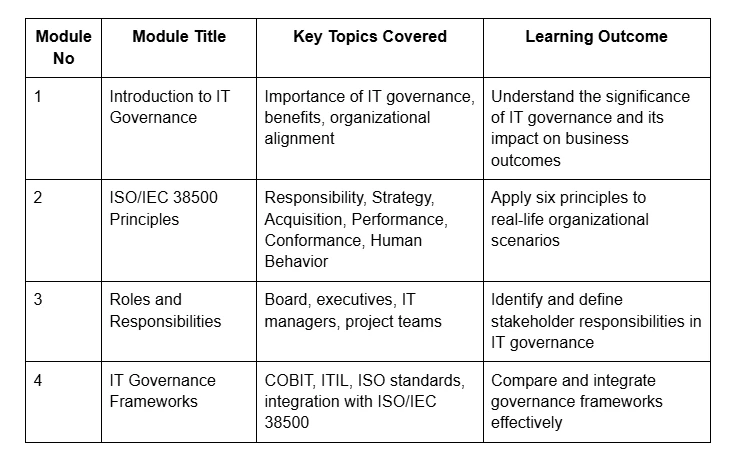
Detailed Training Modules
The course is structured into practical modules to progressively build knowledge,
Benefits of ISO/IEC 38500 Training
Professionals completing this training gain multiple benefits:
- Enhanced Decision-Making – Make informed IT decisions aligned with organizational goals.
- Risk Mitigation – Identify, evaluate, and manage IT risks proactively.
- Regulatory Compliance – Ensure IT operations comply with legal, regulatory, and policy requirements.
- Optimized IT Performance – Track, measure, and improve IT system performance.
- Strategic Alignment – Align IT initiatives with business objectives to maximize value.
- Professional Growth – Strengthen knowledge, credibility, and career opportunities.
The program equips professionals to become effective IT governance leaders, capable of guiding organizations toward responsible and strategic use of technology.
Target Audience
This training is suited for professionals involved in IT governance, strategic decision-making, or IT management. Typical participants include:
- IT Managers and Team Leaders
- Business Executives and Board Members
- Project Managers and Program Managers
- Compliance Officers and Auditors
- IT Consultants and Advisors
- Professionals involved in IT strategy, investment, or governance
No prior in-depth IT technical knowledge is required; the course emphasizes strategic understanding and practical application.
Real-World Applications
ISO/IEC 38500 IT Foundation Certification principles can be applied to:
- Evaluating IT project proposals to ensure alignment with business strategy.
- Conducting audits to assess IT compliance with regulations and policies.
- Monitoring IT performance using key metrics to optimize outcomes.
- Identifying risks associated with IT investments and implementing mitigation plans.
- Improving communication and collaboration between IT teams and business units.
- Designing IT strategies that integrate with overall organizational goals.
By applying these principles, organizations can achieve better resource utilization, improved operational efficiency, and sustainable competitive advantage.
Core Principles of ISO/IEC 38500
The ISO/IEC 38500 principles guide organizations in making effective IT decisions. Each principle can be applied in practical scenarios to enhance IT governance.
1. Responsibility
Assign clear roles and accountability for IT decision-making. For example, a corporate board may delegate IT investment decisions to a specialized IT committee, ensuring clear accountability.
2. Strategy
IT initiatives must align with business goals. For instance, implementing a cloud-based system should support operational efficiency or revenue growth objectives.
3. Acquisition
Evaluate IT projects for value, cost, and risk. Using structured frameworks helps prioritize IT investments that offer measurable benefits.
4. Performance
Regularly monitor IT systems to ensure objectives are met. Metrics like system uptime, project delivery times, and ROI help assess performance.
5. Conformance
Ensure IT practices comply with legal, regulatory, and internal policies. Compliance audits and controls are critical for risk mitigation.
6. Human Behavior
Consider how people interact with IT systems. Training, culture, and ethical practices influence the effectiveness of IT governance.
Case Study Examples
To illustrate the practical application of ISO/IEC 38500:
- Financial Institution IT Governance – A bank used ISO/IEC 38500 principles to align IT investments with regulatory requirements and risk management, resulting in reduced compliance penalties and improved system reliability.
- Healthcare Organization IT Strategy – A hospital adopted ISO/IEC 38500 frameworks to enhance data security, protect patient records, and ensure IT-supported care services were efficient and reliable.
- Global Retail IT Optimization – A retail chain applied IT governance principles to streamline inventory management, optimize IT operations, and improve customer experience through technology integration.
These case studies highlight how structured IT governance leads to measurable organizational benefits.
Learning Outcomes
By the end of the training, participants will be able to:
- Understand the purpose and scope of IT governance.
- Explain the six principles of ISO/IEC 38500.
- Identify and define roles and responsibilities for IT governance.
- Apply governance frameworks in practical organizational scenarios.
- Conduct IT risk assessments and compliance evaluations.
- Monitor IT performance using KPIs and metrics.
- Develop strategies to align IT investments with business objectives.
Participants gain the confidence and skills needed to implement effective IT governance practices in their organizations.
Course Delivery Methods
To ensure accessibility and flexibility, the ISO/IEC 38500 Foundation training is offered in multiple formats:
- Classroom Training – Instructor-led in-person sessions with interactive exercises and discussions.
- Online Instructor-Led Training (ILT) – Live virtual sessions with real-time Q&A, case studies, and exercises.
- Self-Paced eLearning – On-demand modules with interactive content, quizzes, and assessments.
- Hybrid Programs – A combination of online and classroom training for flexibility and convenience.
Practical exercises, case studies, and workshops allow participants to apply knowledge in realistic scenarios.
Career Opportunities After Certification
Completing the ISO/IEC 38500 IT Foundation program opens multiple career pathways, including:
- IT Governance Analyst
- IT Compliance Officer
- IT Risk Manager
- Business Process Manager
- IT Project Manager
- IT Consultant
Organizations increasingly require professionals who can align IT with business strategy, ensure compliance, mitigate risks, and optimize performance. Certification demonstrates capability, knowledge, and credibility in IT governance.
Conclusion
ISO/IEC 38500 IT Governance Foundation Training empowers professionals to effectively guide, evaluate, and monitor IT governance in their organizations. Participants gain practical skills to apply the six core principles, define stakeholder roles, manage risks, ensure compliance, and align IT investments with business objectives. Organizations adopting ISO/IEC 38500 frameworks experience enhanced IT performance, accountability, strategic alignment, and regulatory compliance. This program prepares participants to implement robust governance practices, drive organizational success, and advance their professional growth.