
CBD research has grown dramatically over the last decade as laboratories and analytical researchers explore the potential biological roles of cannabinoids in metabolism, neurobiology, and inflammation studies. Among the most commonly used formulations in laboratory settings is CBD Oil 10% (1000mg per 10ml), a concentration that offers a balance between stability, measurable dosing, and experimental flexibility.
However, one of the biggest problems researchers face today is finding reliable, high-purity CBD sources that meet scientific standards. Many products on the internet are marketed as “CBD oil,” yet lack the essential third-party testing, purity verification, or batch documentation required for legitimate laboratory work.
This is why experienced researchers emphasize sourcing materials from trusted analytical suppliers such as Research Chemical Team, where quality verification and transparent documentation are prioritized.
Understanding CBD Oil 10% for Research Applications
CBD (Cannabidiol) is a non-intoxicating cannabinoid derived from hemp plants. Unlike THC, CBD does not produce psychoactive effects, which is one reason it has become a major focus of pharmacological and biochemical research.
A 10% CBD oil formulation typically contains:
- 1000mg of CBD per 10ml bottle
- A carrier oil such as MCT oil or hemp seed oil
- Stabilized cannabinoid extracts for laboratory use
For researchers, this concentration is particularly useful because it allows accurate dilution, solubility testing, and controlled experimental measurements.
Why Purity and Lab Testing Matter
One of the most critical aspects of cannabinoid research is compound purity. Impurities, solvents, or incorrect cannabinoid ratios can significantly distort experimental results.
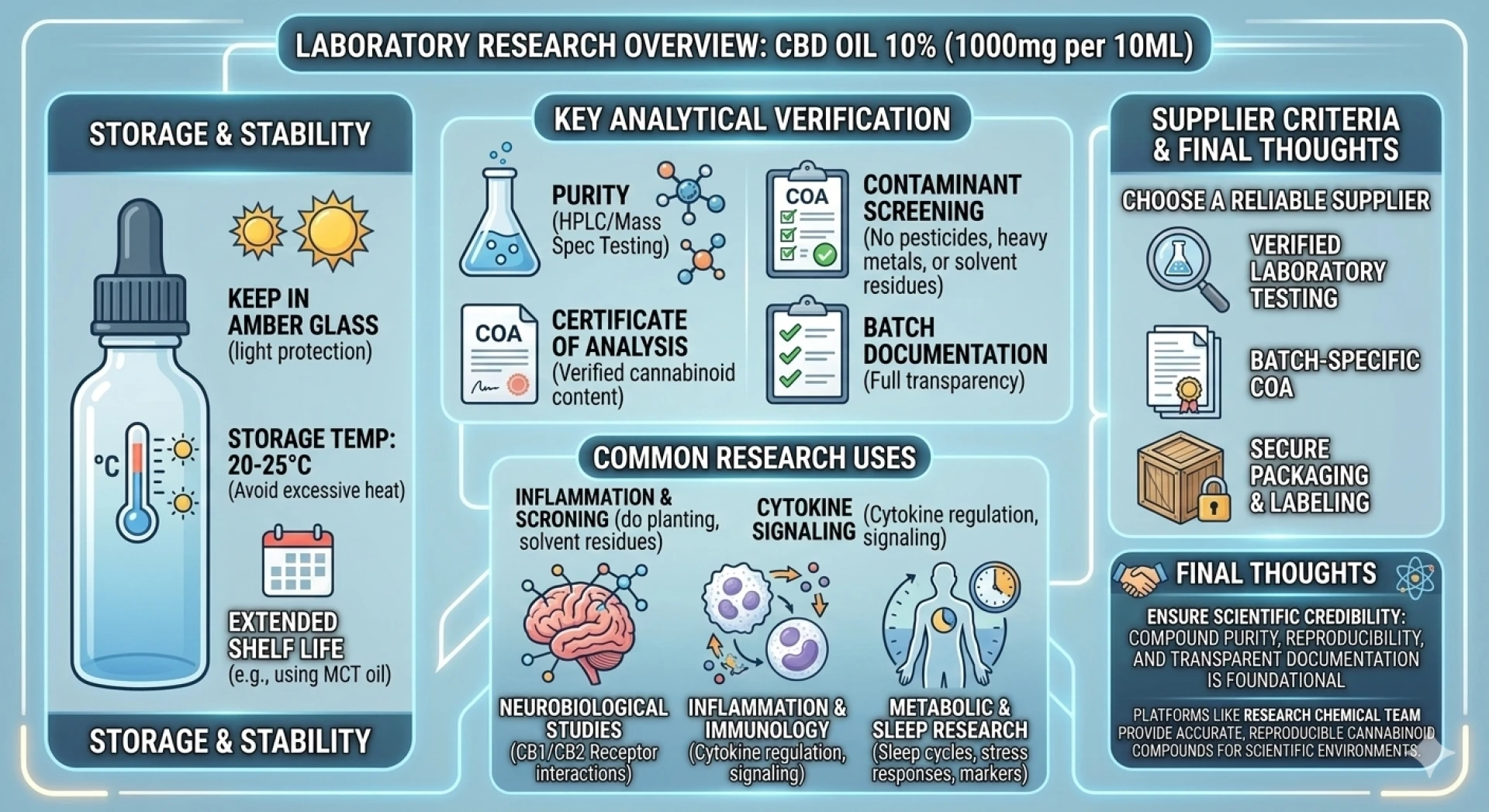
High-quality research CBD products should include:
Certificate of Analysis (COA)
A third-party laboratory report verifying cannabinoid content and purity.
HPLC or Mass Spectrometry Testing
Confirms the identity and concentration of CBD within the formulation.
Contaminant Screening
Ensures the absence of pesticides, heavy metals, and solvent residues.
Reliable suppliers like Research Chemical Team understand that professional laboratories require complete transparency and analytical documentation before incorporating compounds into research protocols.
Common Research Uses of CBD Oil
CBD oil is widely studied across several scientific disciplines.
Neurobiological Studies
Researchers investigate how cannabinoids interact with the endocannabinoid system (ECS), particularly CB1 and CB2 receptor pathways.
Inflammation and Immunology Research
CBD has been studied for its influence on cytokine regulation and inflammatory signaling pathways.
Metabolic and Sleep Research
Some laboratories analyze how cannabinoids may affect sleep cycles, stress responses, and metabolic markers.
A standardized formulation such as CBD Oil 10% – 10ML allows researchers to perform repeatable experiments and controlled dosing studies.
Storage and Stability Considerations
For accurate research results, proper storage is essential.
Recommended storage conditions include:
- Amber glass containers to prevent light degradation
- Room temperature (20–25°C) storage
- Avoiding excessive heat or UV exposure
Carrier oils such as MCT oil are commonly used because they improve cannabinoid stability and extend shelf life.
Choosing a Reliable Supplier
With the global increase in cannabinoid products, distinguishing between consumer-grade CBD and laboratory-grade material has become increasingly important.
Researchers should prioritize suppliers that provide:
- Verified laboratory testing
- Batch-specific Certificates of Analysis
- Secure packaging and proper labeling
Platforms such as Research Chemical Team focus on providing research-focused cannabinoid products intended for analytical and scientific environments, helping laboratories maintain consistency and reliability in their studies.
Final Thoughts
CBD research continues to expand across neuroscience, pharmacology, and biochemical fields. However, the success of any experiment depends heavily on compound purity, stability, and documentation.
By choosing high-purity CBD Oil 10% – 10ML from trusted analytical suppliers, researchers can ensure their studies remain accurate, reproducible, and scientifically credible.
As cannabinoid science evolves, reliable sourcing and strict laboratory standards will remain the foundation of responsible and meaningful research.