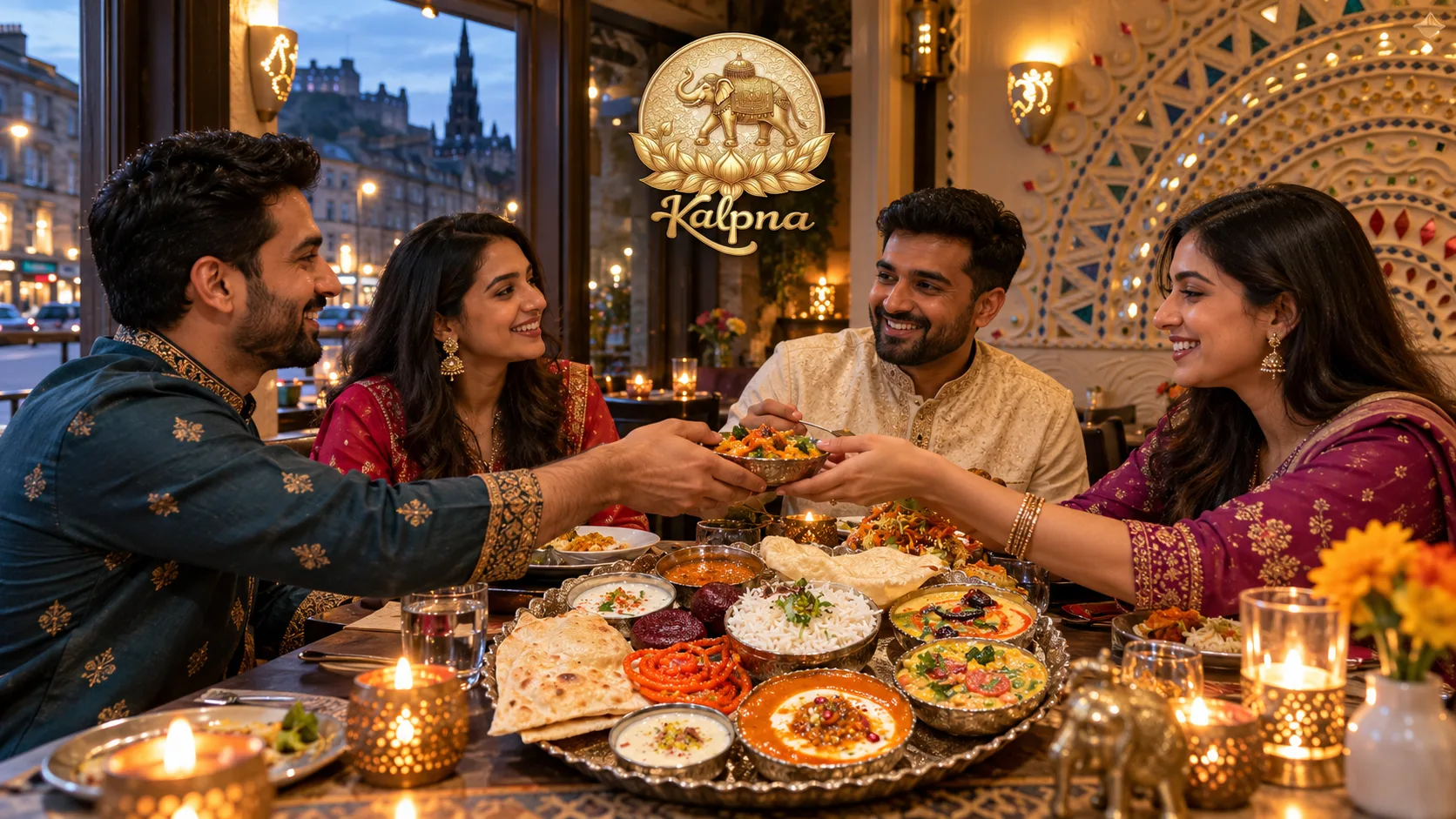
Diwali brings a warmth to autumn that little else in the calendar matches. Homes fill with the smell of ghee and toasted spices, front windows glow with diyas, and families eat together long past sunset. For Hindu, Sikh and Jain communities across the city, it is one of the most important nights of the year. For everyone else, it is a happy reason to plan a good meal, light a candle and slow down for an evening.
If you are deciding how to celebrate Diwali in Edinburgh this year, this guide covers what the festival means, when Diwali 2026 falls, and how to plan a Diwali dinner that suits the occasion, whether you are cooking at home, gathering with friends or booking a table at a vegetarian Indian restaurant in Edinburgh.
What Is Diwali?
Diwali, also known as Deepavali, means “row of lamps” in Sanskrit. It marks the triumph of light over darkness, knowledge over ignorance and good over evil. The stories behind it vary across India, and Hindu, Jain, Sikh and some Buddhist communities celebrate in different ways, but the core symbolism is shared.
For most families the festival runs over five days, with the main night falling on the darkest night of the lunar month. Homes are cleaned and lit, gifts are exchanged, and Diwali food takes centre stage. The lamps in the windows are a small act of welcome, meant to invite blessings, prosperity and warmth into the home for the year ahead.
When Is Diwali 2026?
Diwali follows the lunar calendar, so the date moves each year. In 2026, the main day of Diwali in the UK falls on Sunday 8 November, with the five-day festival starting on Dhanteras (Friday 6 November) and ending with Bhai Dooj. Temples and community groups publish their own Diwali Edinburgh event dates closer to the time, so check with local organisers for gatherings in the city.
If you plan to celebrate with a restaurant meal, look at the days either side of the main day as well as Diwali night itself. Restaurants fill quickly, and Saturday 7 November gives you more choice of times.
Kalpna’s Diwali Menu 2026
This year, Kalpna is serving a special Diwali menu in Edinburgh from 6 to 15 November 2026. The festive menu includes beetroot tikki, patta gobi chaat, mewa mozzarella kofta in makhani gravy, garden avial, lassoni dal, jalebi with rabri and a bite-size paan kulfi.
It comes as a Diwali thali at £20 per person, or as a set course for two at £30. Every guest also receives a small Diwali gift from the team.
Diwali Food Traditions Worth Knowing
Food is where Diwali lives. Recipes vary by region, but a few themes hold across most Hindu households:
- Vegetarian dishes come first, since Diwali is a religious observance rooted in traditions that avoid meat
- Sweets are central: boxes of mithai are given as gifts and served with every meal
- Slow-cooked dals, richer paneer curries and festive breads replace everyday cooking
- Snacks and street-style bites are made in bulk to share with visitors
- Rice, often a festive pulao or biryani, sits at the centre of the table
The details shift by region. A Gujarati Diwali table might carry farsan, kachori and shrikhand. A Punjabi one leans on paneer, chole, halwa and puris. A South Indian celebration might centre on murukku, laddoo and payasam. Our guide to Indian festival foods goes through them in detail. What they all share is generosity: special food for Diwali is meant to feed everyone who walks through the door.
Why a Vegetarian Restaurant Suits Diwali
If you are eating out on or around Diwali, put a purely vegetarian restaurant first. For lifelong vegetarians, and for anyone observing the religious side of the festival, a kitchen that cooks no meat removes the ingredient worries of a mixed-menu restaurant.
Kalpna, on St Patrick Square in Newington, is a vegetarian Indian restaurant in Edinburgh that has run a purely vegetarian kitchen since 1975. Guests can eat freely without asking whether a dish crossed paths with meat or fish during prep.
Building a Diwali Dinner at a Restaurant
A Diwali dinner is a spread, not a one-plate meal. Plan for variety, shared plates and a longer, slower evening than a normal weeknight.
For a group of four to six, a workable Diwali party menu might be:
- Two or three shared starters, such as Samosa Chaat, Dahi Kebab or Harabhara Kebab
- A rich centrepiece curry, such as Saam Savera or Butter Paneer
- A slow-cooked dal, ideally Kalpna Dal Makhani
- A lighter South Indian dish, such as Ananas Moilee or Kumbh Coconut Curry
- Two breads for the table: a garlic naan and a plain tandoori roti
- A rice dish, either basmati or coconut rice
- Two desserts to share, such as Gulab Jamun and Kalpna Mastani
Browse the full vegetarian Indian menu before you book to plan your spread. The team can also guide you on pacing and portions when you order.
The Thali as a Diwali Meal
If your group mixes first-timers and regulars, a thali is one of the simplest ways to celebrate. The Thaali Raj Bhog gives you a starter, four assorted vegetable curries, dal, rice, bread, raita, chutney and dessert on one platter. It takes away the ordering pressure and gives everyone the same variety. New to the format? Our guide to the Indian thali explains how to enjoy one.
For vegan guests, the Vegan Thaali Raj Bhog has the same shape without any dairy, which makes a mixed table much easier to coordinate.
Booking a Diwali Restaurant Table in Edinburgh
Indian restaurants in Edinburgh fill up around Diwali faster than most people expect. If you want to eat out on or near the festival, book early. Two weeks ahead is a good start, and a month is better for the main weekend or a larger group.
Useful notes to include when you book:
- The size of your group and any children
- Dietary requirements across the table
- Whether the meal marks a family occasion
- Your preferred time window
Independent restaurants use these notes to prepare the room. You can book your Diwali table at Kalpna in advance and add the details when you reserve.
Larger Family Gatherings
For extended family visits, especially when relatives travel in for the festival, a set menu often works better than ordering à la carte. It simplifies the bill, speeds up service and lets the kitchen pace a longer evening.
For a larger booking, ring ahead instead of using an online form. Speaking to the team lets you discuss dishes, timings, seating and any family considerations for the night. Our tips on group dining in Edinburgh cover the rest, and you can call 0131 667 9890 to arrange a larger Diwali booking.
Hosting a Diwali Dinner at Home
Not every Diwali dinner happens at a restaurant. Many families in Edinburgh host at home, especially on the main night. A few practical Diwali dinner ideas help.
Keep the menu focused. You do not need ten dishes. Two or three well-cooked curries, a good dal, rice, breads and a couple of sweets feel generous without overwhelming the cook.
Prepare in advance. Curries and dals improve overnight. Make them the day before, reheat gently on the night, and keep Diwali day for lighter tasks like breads, garnishes and sweets.
Add shop-bought support. Not everything has to be homemade. A box of mithai from an Indian sweet shop, samosas from a good takeaway and ready chaat components can fill out the table.
Set the room. Diyas, candles, marigold garlands and a rangoli by the door make a real difference. Even a simple version brings warmth to the meal.
Diwali for Non-Hindu Guests
If you are going to your first Diwali dinner as a non-Hindu guest, there is no complicated etiquette. Bring a small gift, ideally a box of sweets or something for the host’s home. Dress a little more brightly than usual if the occasion calls for it. Take off your shoes when you enter someone’s home. Be ready to eat more than you planned.
If you are unsure about anything, ask. Diwali is one of the most welcoming festivals in the Hindu calendar, and hosts are usually glad to explain what a dish, ritual or gesture means.
Diwali Sweets Worth Trying
Mithai are the heart of a Diwali table. If you have never tried Indian sweets, this is a good excuse. Some to look out for:
- Gulab Jamun: warm milk dumplings soaked in rose and cardamom syrup
- Coconut Halwa: a slow-cooked coconut fudge with cardamom and almonds
- Rice Kheer: a saffron and cardamom rice pudding
- Kesar Malai Pista Kulfi: a firm-set ice cream with pistachio and saffron
- Barfi: a milk-based fudge with many regional variations
- Ladoo: round sweets made from flour, ghee and sugar
At a restaurant, order two desserts to share so everyone tries more than one. At home, a mixed box from an Indian sweet shop makes an easy centrepiece.
Diwali Celebrations in Edinburgh
Beyond restaurant meals and home dinners, Edinburgh’s Hindu community organises cultural events around the festival, from temple gatherings and aarti to community dinners and dance evenings. Societies at the University of Edinburgh often host Diwali events for students who are away from family.
If you are new to the city or want to join a wider Diwali celebration in Edinburgh, check community and cultural listings a few weeks ahead. Events fill quickly, and some need pre-registration.
Diwali Dining Beyond the Main Night
The main night is the obvious focus, but the surrounding week is often just as busy for restaurants and families. Meals just before or after the festival can be quieter, easier to book and no less enjoyable. If the main night is difficult, a weekday evening or the following weekend works well, and Kalpna’s festive menu runs until 15 November.
Planning Ahead
A few habits make festival dining smoother:
- Book at least two weeks ahead for Diwali week
- Order across regional traditions to broaden the table
- Save room for dessert, since sweets are the heart of the meal
- Bring a small gift if you are a guest at someone else’s celebration
- Take photos before the food reaches the table, not while people are eating
A Festival Worth Marking
Whether Diwali is part of your family tradition or you are curious about a festival that has become part of British cultural life, the evening rewards attention. Light a diya. Gather people you care about. Eat well. Share sweets.
Edinburgh does not always feel like the natural home of a festival of lights. The city sits far north, the autumn nights draw in early and the streets can be quiet at this time of year. That is exactly why Diwali suits it. A warm dining room, full of the smell of spices and lit by candles, is one of the small pleasures of a Scottish autumn.
FAQs
Where can I celebrate Diwali in Edinburgh in 2026?
Kalpna on St Patrick Square is one of the longest-running vegetarian Indian restaurants in Edinburgh and runs a special Diwali menu from 6 to 15 November 2026. Temples, community organisations and student groups also run cultural events around the festival, so check local listings for dates.
When is Diwali 2026?
The main day of Diwali in 2026 is Sunday 8 November. The five-day festival runs from Dhanteras on 6 November to Bhai Dooj.
Is there a Diwali thali in Edinburgh?
Yes. Kalpna’s Diwali thali is £20 per person, and a set course for two is £30, available from 6 to 15 November 2026.
Is Kalpna suitable for a Diwali family meal?
Yes. Kalpna has served families in Edinburgh since 1975, and its purely vegetarian menu and family-run atmosphere suit the occasion.
What should I order for a Diwali dinner at a restaurant?
Plan a spread instead of one main course: shared starters, a rich centrepiece curry, a slow-cooked dal, a lighter regional dish, breads, rice and shared desserts. A thali is a good alternative if your group prefers a single order.
Do I need to book a Diwali restaurant in advance?
Yes. Restaurants fill quickly around the festival. Book at least two weeks ahead for Diwali week, and earlier for larger groups.
Are there vegan options for a Diwali meal?
Yes. Many traditional Diwali dishes are naturally vegan, especially in South Indian and Gujarati cooking. At Kalpna, the Vegan Thaali Raj Bhog and several main courses are fully plant-based. The festive Diwali menu contains dairy, so vegan guests are best ordering from the regular menu.
What is Diwali and why is it celebrated?
Diwali, or Deepavali, is a Hindu, Sikh and Jain festival marking the triumph of light over darkness. It usually spans five days, with the main day on the darkest night of the lunar month. Homes are lit with diyas, families gather, and food and sweets take centre stage.