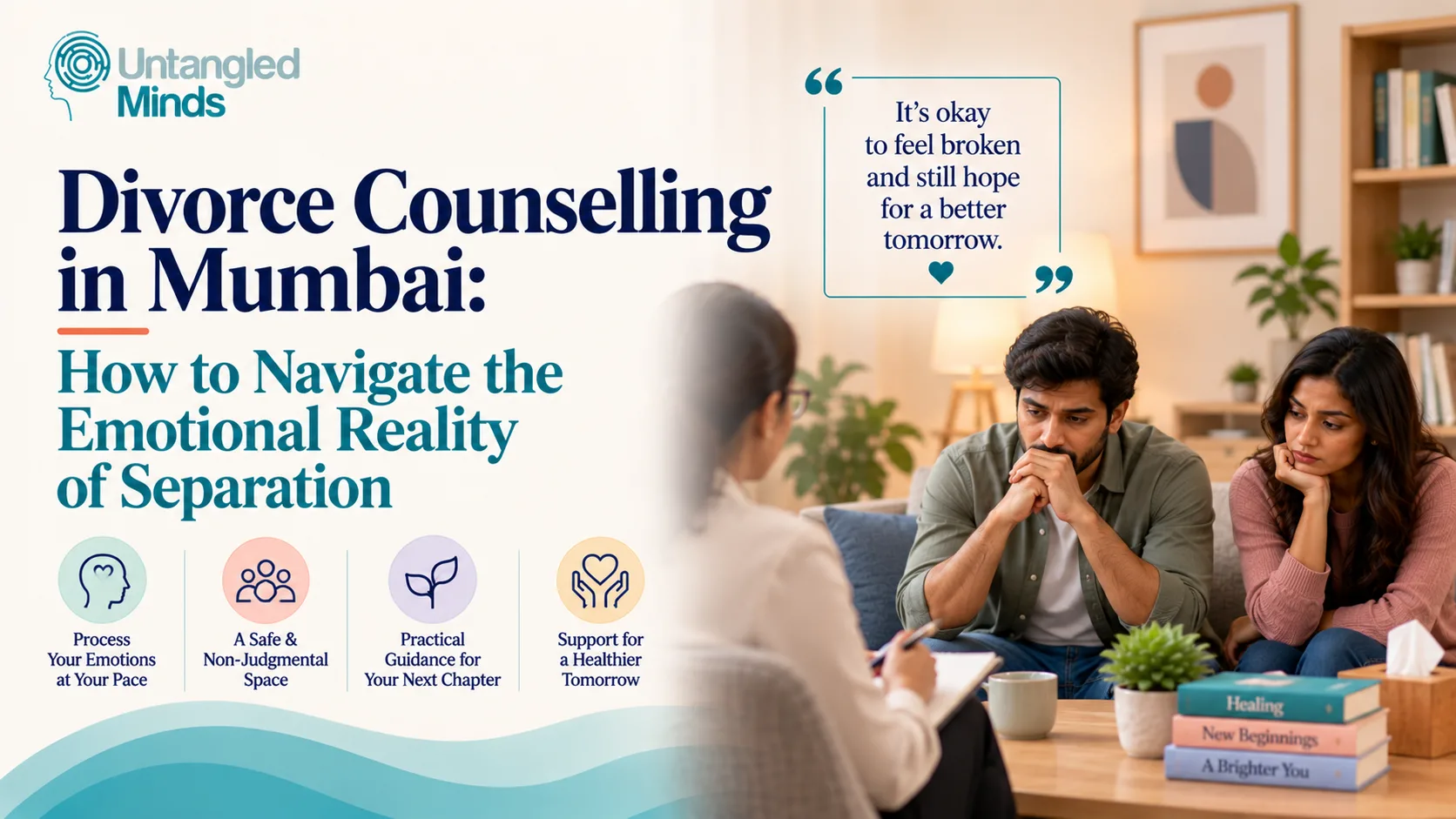
Divorce counselling isn't something most people plan for when they get married. It's something they find themselves searching for at 2am, when the legal process is underway and the practical decisions are being made and somehow, in the middle of all of that, the emotional reality of what is happening hasn't had anywhere to land.
That's usually when I first speak to someone. Not at the beginning of the decision - at the point where the decision has been made and the feelings that come with it have nowhere to go while life continues to demand functioning.
Divorce counselling in Mumbai exists for exactly that gap. Not to change the outcome, not to determine whether it's the right decision - but to give the emotional experience of ending a marriage somewhere to be properly held.
What Nobody Tells You About the Emotional Reality of Divorce
The cultural narrative around divorce has two versions. In one version, leaving a difficult marriage is straightforwardly liberating - you should feel relief, a new beginning, freedom. In the other, divorce is a tragedy with a clear emotional script: grief, regret, obvious visible suffering.
Most people's experience fits neither.
What I actually hear in sessions is more like: grief and relief simultaneously, which feel like they shouldn't be able to coexist and yet do. Confusion about feelings that don't match the narrative - "I wanted this, so why do I feel like I've lost something irreplaceable?" Identity questions that don't get enough airtime - who am I outside of this marriage? What version of my life is available to me now? Fear masquerading as practical concern - "I need to sort the finances" is sometimes a very efficient way to not sit with the fear of being alone.
And anger. Often, a great deal of it, directed at people and places that seem only tangentially related to the actual situation.
The Specific Difficulties of Divorce When There Are Children
This section deserves its own space because the complexity multiplies significantly.
When children are involved, divorce isn't a bilateral ending - it's a structural reorganization that continues indefinitely. Both people remain in each other's lives in a co-parenting capacity, which means the emotional work of grieving the marriage has to happen alongside the ongoing functional relationship. That's a genuinely difficult thing to manage, and most people have no model for how to do it.
Divorce therapy in this context often involves working through the personal grief of the marriage ending and building the emotional and communication tools needed to be effective co-parents without the unprocessed grief from the marriage leaking into every interaction.
I've worked with parents who managed the divorce itself reasonably well but found that being in the same room for their child's school event - two years later - still produced a level of activation that surprised them. The grief and the anger have a long tail. Getting support for that, rather than assuming it should have resolved by now, is entirely appropriate.
What Divorce Counselling Actually Involves
Divorce counselling is not primarily about the legal or practical dimensions of separation - those belong with a lawyer and a financial advisor. What it addresses is the psychological experience: the grief, the identity reorganization, the fear, the anger, the specific exhaustion of navigating a major life change while maintaining the functional demands of daily life.
In sessions, we work on understanding what the marriage represented and what its ending means - which is often more nuanced and surprising than people expect. We work on building the emotional vocabulary for the experience that's happening, because a lot of the difficulty of divorce is that the feelings are too complex and contradictory to be easily named. We work on what comes next - not immediately, not in a forced-positivity way, but in the genuine sense of who this person is and what their life looks like from here.
About Shyamolie Desai
I'm a Clinical Psychologist based in Mumbai with centers in Chembur, Sion, Wadala, and Santacruz. Divorce counselling and separation therapy form a significant part of my practice. I work with individuals navigating the end of marriages, with co-parenting dynamics, and with the specific identity and emotional questions that divorce surfaces. Online sessions are available - which many people in the midst of separation find significantly more manageable than commuting to a clinic.
Frequently Asked Questions
When should I start divorce counselling?
There's no perfect timing. Many people start during the legal process; others come in after things have formally concluded and they find the expected relief hasn't arrived. There is no stage of the process where support isn't useful.
Can divorce counselling help me decide whether to divorce?
Yes. This is a legitimate and common reason to seek divorce therapy - not when the decision has been made, but when you're genuinely uncertain. Working through what the marriage is and isn't, and what's actually driving the consideration, often produces clarity that neither staying nor leaving was providing on its own.
How is divorce counselling different from couples therapy?
Couples therapy works on the relationship with the goal of improving it. Divorce counselling works on the individual's psychological experience of the relationship ending. They serve different purposes at different stages.
Is there support specifically for children going through a parental divorce?
Yes. Child psychology sessions that support children through parental separation are a significant part of my practice - both directly with the child and in consultation with parents about how to support their children through the transition.
The end of a marriage doesn't have to be the end of the story. But it is a significant chapter - one that deserves to be grieved and understood properly rather than just survived and moved past. There's usually more to be learned from it than the practical lessons. And that learning is often what shapes everything that comes after.